Tag: Jonathan Stevenson

Solo Shows

Steve Greene’s crafty agitation

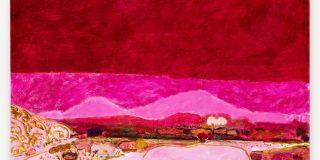
Contributed by Jonathan Stevenson / In an adventurous departure from drawing and collage, Steve Greene now offers intriguingly acerbic abstract paintings in his solo show “News From Nowhere,” on view at Frosch & Co. They are rich with sharply drawn shapes and robustly differentiated visual content, yet they require little deliberation to be appreciated. They penetrate immediately. This quality stems from the thematic cohesiveness produced by trenchant cultural and art-historical tropes distributed among the paintings. Judging by the fluidity of his marks and line, Greene generates these allusions intuitively, with minimal contrivance. 
Screens

Arthouse Art House

Contributed by Jonathan Stevenson / The set-up of Vasilis Katsoupis’ slickly but somewhat facilely resonant feature debut Inside is deceptively simple. A high-end art thief is helicoptered onto the roof of a luxury Manhattan high-rise and, with the aid of a techie accomplice, hacks into the security system of an absurdly opulent penthouse, owned by a high-end art collector who is evidently away for a season or two. The thief is targeting several of Egon Schiele’s signature vampy drawings and a singularly valuable self-portrait.

News Comment Writing

Part 2: On “negative criticism”

Contributed by Jonathan Stevenson / It’s tempting to lament the demise of the takedown review. The form invites both schadenfreude and outrage, which are energizing. In the literary world, it had been fading for some time until B.R. Myers and Dale Peck revived it in the naughts. They enjoyed an extended moment of visceral celebrity, but it seemed to burn out relatively quickly on a pyre of stern earnestness. Literary Hub does publish a list of the year’s “most scathing book reviews,” but the targeted screeds – self-promoting Beltway memoirs, vanity projects by anointed novelists, didactic polemics masquerading as fiction – tend to be overripe, low-hanging fruit that would be exempt from even the most charitable standard of forbearance. The general rule of civility is still that the compulsion to shape opinion is best served by measured reason rather than reactive assault.

Solo Shows

Elisa Soliven’s vessels of impeccable resistance

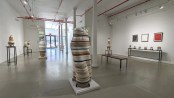
Contributed by Jonathan Stevenson / Elisa Soliven sees her dignified ceramic sculptures, now on display in a faultlessly curated solo show at LABspace in Hillsdale, as vessels containing the rich stuff of life – space, time, cultural tropes, history both grand and personal. Too eclectic and searching to be merely iconic, they are brimming with both old and new referents, and bear their weight with extraordinary grace.

Group Shows

Vivid color and discreet provocation at Mrs.

Contributed by Jonathan Stevenson / The group exhibition “Resounding, Variegated, Leaves” brought together three quite divergent artists – Fabienne Lasserre, Annie Prendergast, and Lily Ramírez – who share a penchant for audacious color choices that serves to unify their work. The show yielded an intellectually satisfying and harmonious experience as well as an aesthetically edifying one. That’s a credit not only to the artists but also to the insightful curators at Mrs. Strategically postured in New York but at a tactical remove in the gritty neighborhood of Maspeth, Queens, the gallery appears to have forged a crisply nuanced niche, gently tilting towards female artists, abstraction, and vivid color.

Solo Shows

Mark Bradford’s urgent abstraction

Contributed by Jonathan Stevenson / “You Don’t Have to Tell Me Twice,” Mark Bradford’s galvanizing tour de force at Hauser & Wirth, was a three-story exhibition of arresting coherence. His muscular paintings grab you by the lapels, pull you in, and visually immerse you to a point of satisfying comprehension.

Screens Solo Shows

Art and Film: Nora Griffin, Wes Anderson, and nostalgia’s virtues and limits

Contributed by Jonathan Stevenson / In 2000, The Onion published a durably wise wise-ass book called Our Dumb Century, chronicling with heavy satirical spin the endless follies of the twentieth one. Maybe a sense of relief lifted the editors. They could be forgiven for surmising, mistakenly, that centuries couldn’t get any stupider. That was the year before 9/11, when the world looked improbably rosy. It remains a moment that many look back on with special fondness. But there is dumb nostalgia and there is smart nostalgia. In “1999 NYC Tees,” a bracing four-day exhibition at Fierman on the Lower East Side, painter Nora Griffin zones in on this period and shows that the smart kind lives on the border “between kitsch and pathos.”

Solo Shows

Bordo to Earth

Contributed by Jonathan Stevenson / Robert Bordo’s gently enveloping solo exhibition “Paint World,” now on view at Bortolami, is comprehensively seductive and sly, staking a claim to the attention of both the dreamer and the realist. Ultimately, he favors the latter. His subject is this rock we all live on. In depicting it impressionistically, from lunar vantage with small, nuanced brushstrokes, he achieves a paradoxically clued-up serenity of pastoral detachment and soft focus – not unlike that of, say, Monet’s waterlilies or, more abstractly, Günther Förg’s patches and crosshatches. But in literally facing the world, as it were, he also directly confronts its profound challenges and emphatically declines to turn his back on them. Thematically, then, this series escalates the existential worry of his earlier “Windshield” and “Crack-up” paintings – presumably planted in part by Guston, with whom Bordo studied – to global scale.

Solo Shows

Chakaia Booker’s lyrical muscle

Contributed by Jonathan Stevenson / Making deeper sense of some abstract art past its initial visual impact can require extended consideration. Not so much Chakaia Booker’s sculpture, now on view in her solo show “Public Opinion” at David Nolan Gallery. Composed predominantly of exactingly configured pieces of black rubber tires along with wood and metal, the work immediately grips you like a confident advocate, calm and insistent. In Minimum Wage, a shovel entwined in flowing ribbons of rubber appears to struggle to do what it is supposed to do.

Group Shows

Bushwick: Cause-and-effect at M. David & Co.

Contributed by Jonathan Stevenson / Fifteen years ago, Jason Andrew was one of relatively few adventurous impresarios and gallerists who together established Bushwick as a New York art community and destination. For nearly five years, his project space Norte Maar was a steady source of the neighborhood’s sublime, funky buzz of possibility for aspiring, often young, artists. Andrew and Norte Maar have moved on, but he has not forgotten Bushwick. After a ten-year absence, he has returned to curate the relentlessly energetic and eclectic group show “Causality” at M. David & Co.

Screens

Triangulating David Hammons: The Melt Goes On Forever

Contributed by Jonathan Stevenson / Getting an authoritative grip on a conceptual artist as elusive and unsusceptible to classification as David Hammons is no mean feat. He has been a willful outsider, defensively attuned to an art world that has, until recently, systematically excluded Blacks and others of color, and remains determined to disrupt and, in some ways, to frustrate the art establishment as he cajoles it into changing. Yet in their deft and moving documentary The Melt Goes on Forever: The Art and Times of David Hammons, which had its American theatrical debut at the Film Forum on May 5, Harold Crooks and Judd Tully essay Hammons’ iconoclastic critique with admirable clarity and due appreciation, plumbing the art, finding the man, and situating him firmly in art history without ever succumbing to hagiography or expository dullness. 

Screens

Art and Film: Kelly Reichardt’s commune of angst

Contributed by Jonathan Stevenson / Kelly Reichardt excels like no other filmmaker at conveying the subtle ravages of time on earth. She brilliantly tackled the epic theme of America’s western expansion in the revisionist westerns Meek’s Cutoff and First Cow and eco-terrorism in Night Moves. But it is the day-to-day yield and subtext of history and politics that most concern her: a young housewife facing down ennui in River of Grass; a friendship deteriorating with age in Old Joy; a young woman seeking a better life unprepared in Wendy and Lucy; women extracting meaning from desolation in the post-feminist Certain Women. For Reichardt, even subdued lives are fully lived and merit sympathetic attention. They include, she insists in Showing Up, the quietly precarious existences of artists. Wise, nuanced, and penetrating, the film is also stealthily hilarious.

Dance

CounterPointe: Dances with artists

Contributed by Jonathan Stevenson / Last weekend in Brooklyn, for the tenth time, Norte Maar presented its unique and superlative CounterPointe dance-and-art performances. Each included seven dances, each of them a collaboration between a female choreographer and a female visual artist. Interpreting the programs is doubly subjective given that two main variables – dance and visual art – come into play.