Search Results for "label/Feature"

Solo Shows

Maureen Dougherty’s collectors: Pride without greed

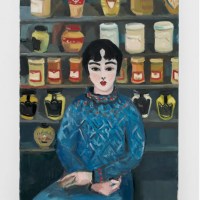
Contributed by Natasha Sweeten / Maureen Dougherty brings her paintings to life with quiet assurance. For “The Completionists,” her current exhibition at Mendes Wood DM in Germantown, she presents portraits of solitary collectors showcasing their collections in muted yet elegant tones not unlike Luc Tuymans’, with dabs of paint nestled into shadows and on tips of asparagus. Objects such as dog figurines, serving dishes, Picasso’s ceramics, skulls, and books are dutifully balanced on horizontal bands of shelving stretching across the picture plane, providing a fixed compositional framework. Perhaps Dougherty’s years of working in abstraction cultivated the acuity and freedom in her brushstroke. Nearly every one of the nine paintings on view fills the expanse of canvas as if to suggest that we’ve zoomed in on a larger presentation, singling out this particular person with this particular array of belongings while also understanding the moment as memory. 
Museum Exhibitions

Rachel Ruysch: Late bloomer

Contributed by David Carrier / Significant twentieth-century artists occasionally depicted flowers. Andy Warhol was one, Ellsworth Kelly another. But it’s hard to think of any major painter today who focuses predominantly on them. Rachel Ruysch (1664–1750) lived in a very different world. Thanks to the bountiful worldwide empire of Golden Age Holland, even this stay-at-home painter could obtain an amazing variety of imported flowers. The Toledo Museum of Art’s “Nature into Art,” drawn from her 150 surviving works, is, improbably, the first major exhibition devoted to her. Botany thrived in Ruysch’s time due in part to Dutch imperialism. Flower painting became a major artistic genre, and she and her rivals enjoyed access to an enormous variety of exotic flowers (and insects). Critics rightfully consider her pre-eminent. “At her best,” the catalogue says, “Ruysch painted like a novelist, creating scenes within a framework at large.“ Indeed, her intricately crafted, remarkably varied paintings convey the story of Dutch capitalism. 

Gallery shows

Elias Wessel: Exposing social media 

Contributed by Chunbum Park / At Picture Theory in Chelsea, Elias Wessel has assembled provocative installations titled “It’s Complicated” and, with composer and musician Natalia Kiёs, “Systems at Play.“ In “It’s Complicated,” busy photographs that document surfing and scrolling behavior stand on pedestals. Holstered at their sides are headphones piping cacophonic sounds and words – styled “Is Possibly Art” – that AI-based text-recognition software has distilled from the long-exposure images.

Museum Exhibitions

Jo Baer: Space, position, and light

Contributed by David Carrier / Five smallish early Jo Baer paintings are on display in one white- walled gallery at DIA Beacon in her exhibition there since 2022. The show is both tantalizing and exasperating. In the 1970s, Baer became famous as a minimalist painter. Then she left New York, published a manifesto in 1983 proclaiming “I am no longer an abstract artist,” and changed her style completely.

Gallery shows

Past, present, and future: The complementary visions of Jodi Hays and Michi Meko

Contributed by Jenny Zoe Casey / In a fascinating and inspired pairing, “The Burden of Wait” at Susan Inglett brings together painters Michi Meko and Jodi Hays and explores the different ways in which inhabitants of a particular region – here the American South – can experience it. Landscape is an important influence for both artists, but their approaches are mostly in opposition.

Museum Exhibitions

Surface, flourish, complexity at the Hessel Museum

Contributed by Anne Swartz / Since its origins in the 1970s, practitioners and advocators of the Pattern and Decoration movement have countered claims that decorative art lacked seriousness. In America at the time, critical arguments focused on the exhaustion of painting, positioning it as an outmoded visual form. Several artists resisted this affront. Instead, they embraced images for their pleasure, opposing the notion of immediacy often considered synonymous with other mediums such as photography.