
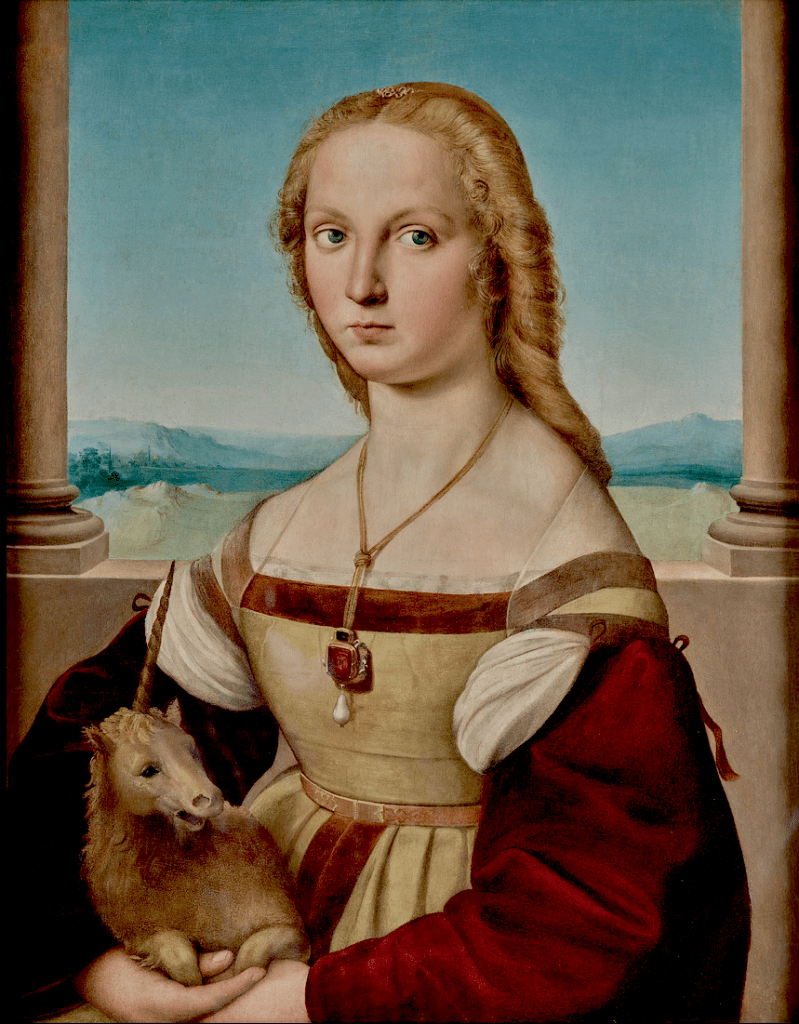
Contributed by Margarett McCann / The sophisticated visual storytelling of Raffaello Sanzio (1483-1520) is emphasized in the Metropolitan Museum of Art’s Raphael: Sublime Poetry. Figure and architectural drawings, collaborations in printmaking, tapestry, and a quarter of his painting oeuvre are accompanied by precedents he imitated and peers whose progress he surpassed. Portrait of a Young Woman with a Unicorn shows Raphael’s seamless meld of real and ideal, solid and delicate, old and new. Gothic simplicity, medieval symbolism, and Flemish detail elegantly cohere with luminous chiaroscuro, perspective, and neoclassical plasticity.
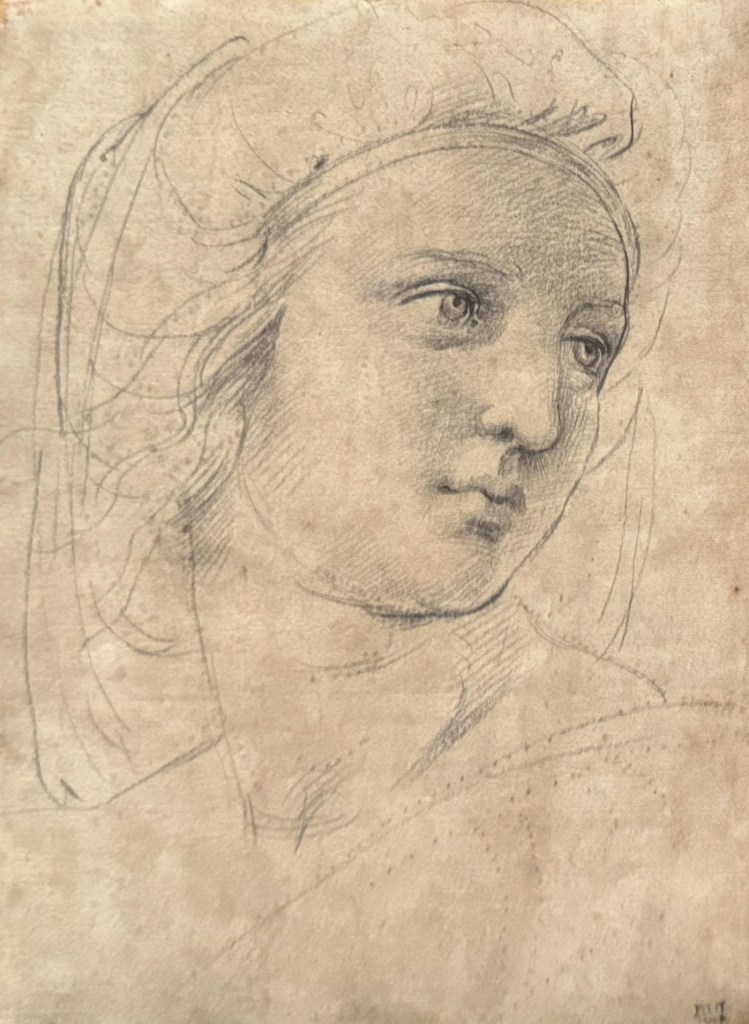
12 x 9 inches
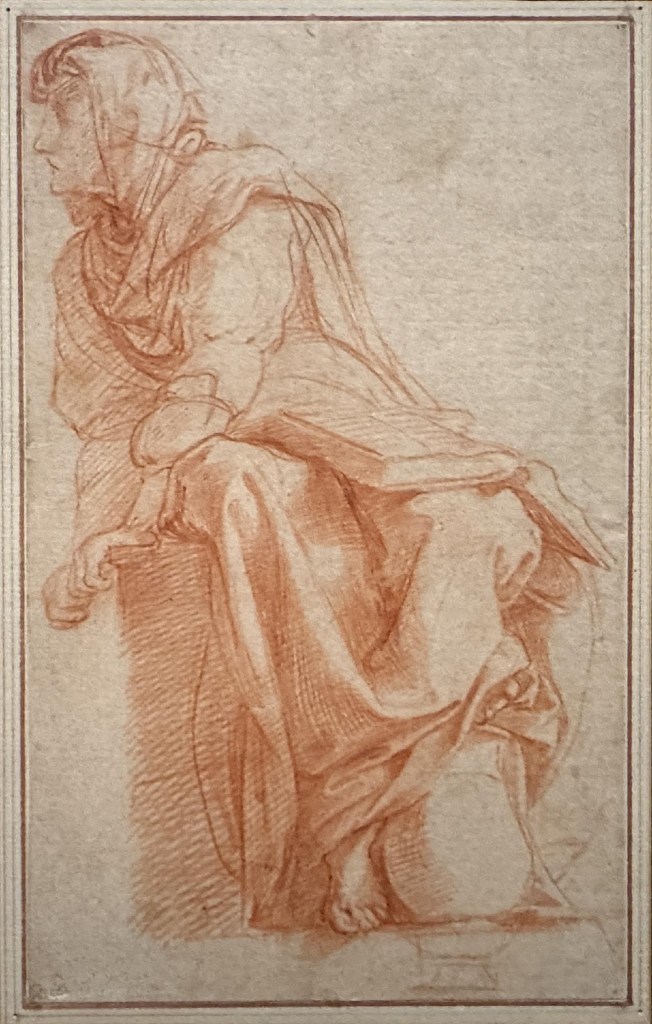
11 × 6 ¾ inches
Raphael’s exemplary disegni (meaning drawings/designs) are also highlighted. He traded many with his pen-pal Durer. Catalog essays explicate Raphael’s process, matching drawings to paintings. He developed iconography researching literary themes, testing different arrangements in various media, followed by anatomical renderings of initially unclothed workshop assistants. Transposed into composites (like School of Athens), individual enlargements, cartoons (cartone means large paper), were laboriously transferred to painting surfaces. Head of the Muse Polyhymnia (for Parnassus) indicates the candor Rapahel brought to the High Renaissance recovery of Greco-Roman verisimilitude. Viewing the Cumean Sybil (for Chigi chapel Sybils) invites re-living its virtuosic execution: the right weight, speed, pressure and value of lines, in the rhythmic location of forms observed, are all easily found
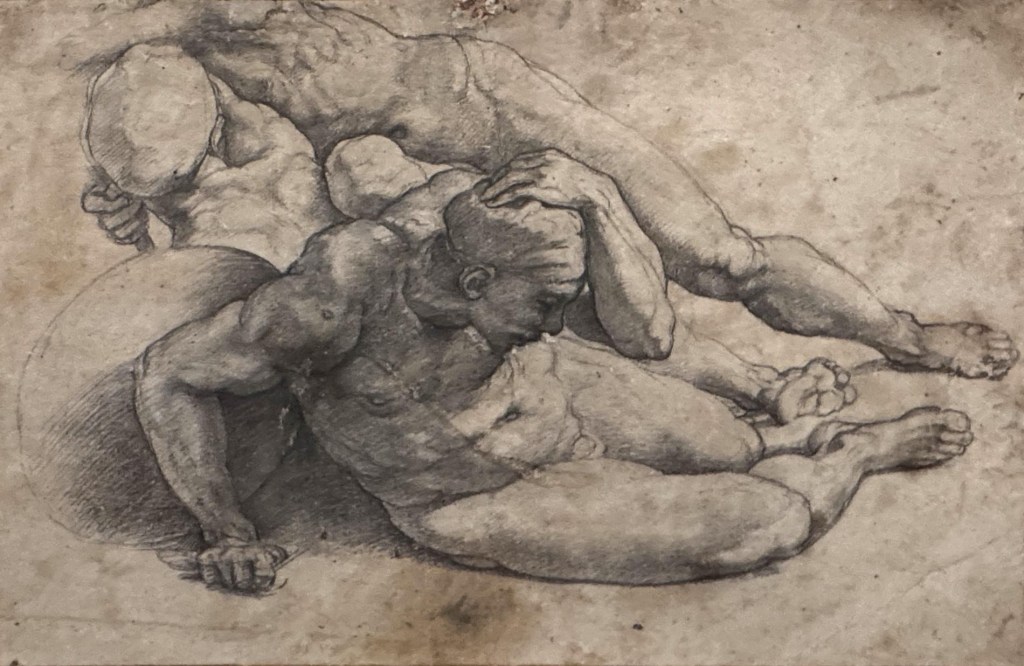
At age 16, Raphael apprenticed to Perugino‘s successful workshop, absorbing his methodical craft and emulating his generalized, detached types. Their blandness let the “pious beholder impose personal detail” onto scripture, following devotional practice (Michael Baxandall). Raphael gleaned more working with Pinturicchio, Signorelli, and Bramante. Driven by curiosity and ambition to Florence age 21, Raphael studied Massaccio, Donatello, Michelangelo’s David, and Michelangelo and Leonardo’s battle cartoons, the “[art] school of the world” (Benvenuto Cellini). Fra Bartolomeo’s blending coaxed Raphael away from inflexible metal-point. Three Reclining Male Nudes combines Michelangelo’s weighty anatomical mechanics with Leonardo’s sensitive light.
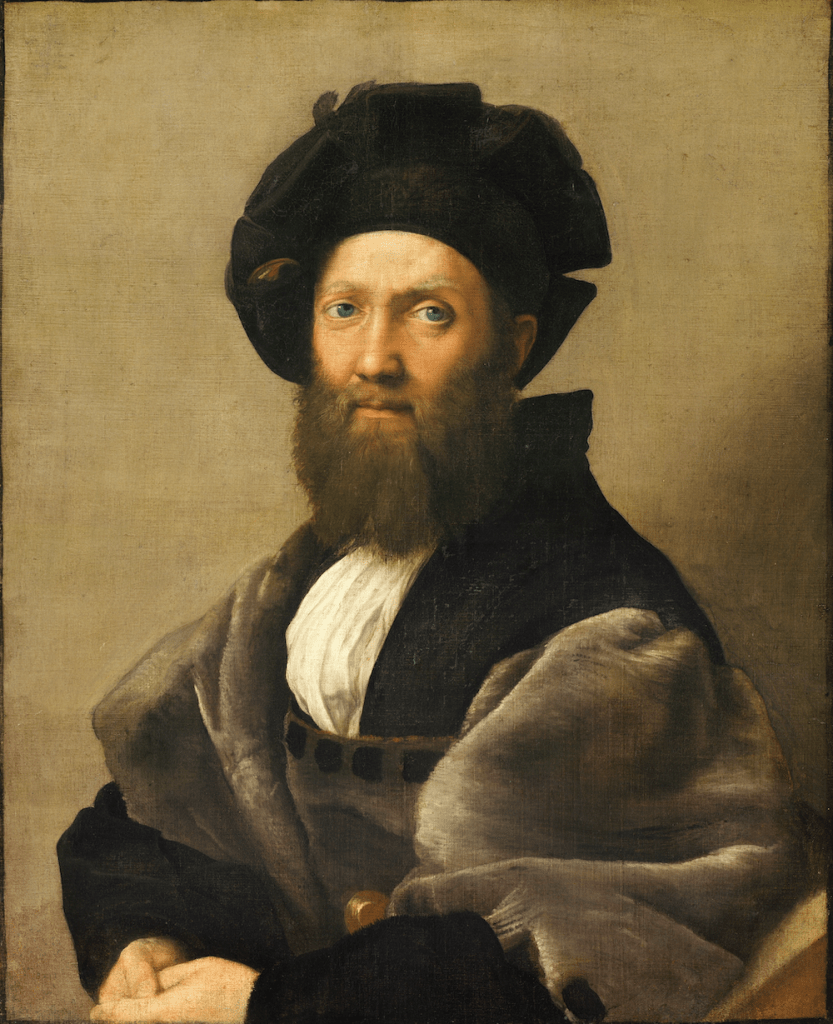
Raphael was exposed to literature by his painter-scholar father Giovanni Santi, whose lengthy poem lauded the transformational Duke of Urbino. Federico da Montefeltro, a model for Machiavelli’s The Prince, amassed Europe’s then-largest library and commissioned paintings in linear perspective by Piero, of ideal cities, and in the new Flemish oil technique. Portrait of Baldessarre Castiglione depicts Raphael’s diplomat friend, whose Book of the Courtier, referencing Urbino’s enlightened court, established a European model of the civilized gentleman. To the figure’s axial stability incorporating Perugino’s geometric construction, and the hands reflecting Flemish portraiture, Raphael brought naturalism, an engaging presence and gaze. The painting embodies Castiglione’s sprezzetura: the artful ability to make difficulty appear effortless.
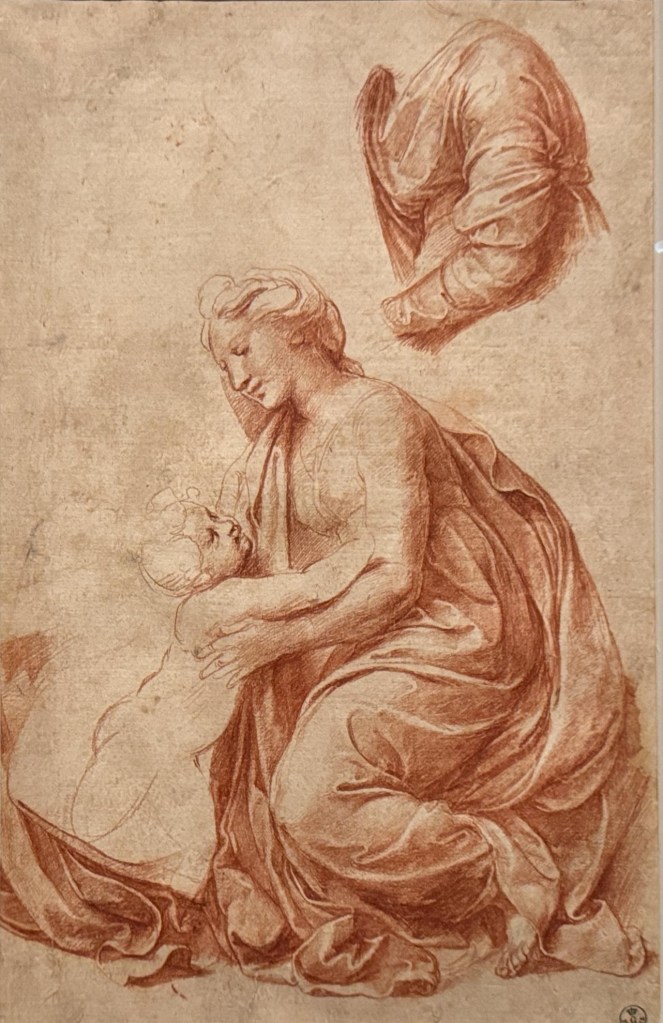
Leonardo’s ideas and drawings, the Mona Lisa and Virgin and Child, profoundly affected Raphael. Leonardo believed gestures, predominant in Italian culture, express “motions of the mind.” Understanding them required study through spontaneous sketchbook reactions. Study for Holy Family of Francis 1 grounds maternal affection in stereometric, sculptural gravity. While Michelangelo’s people heroically contend, and Leonardo’s dwell in mystery, Raphael’s less contemplative types convey social grace.

In the Alba Madonna, Raphael channeled the Michelangelo tondo‘s twisting, foreshortened muscularity into sympathetic body language and tender color harmony, and deftly applied Leonardo’s sfumato, consistent light, pyramidal composition, and pictorial organization through centralizing detail. Reading the visual story, viewers would comprehend “the joy of the Virgin as a privilege preceding her sorrows” (Leo Steinberg). Mary regards the crucifix Jesus morbidly wields, “know[ing] himself born to incipient death.” Madonna and Child, originally a Byzantine motif, can be interpreted tragically, as van der Goes exemplified. Raphael painted gentler versions, this particularly heavenly one suggesting nostalgia. Raphael’s father died when he was eleven, two siblings died in infancy, and his mother died in childbirth when he was eight.
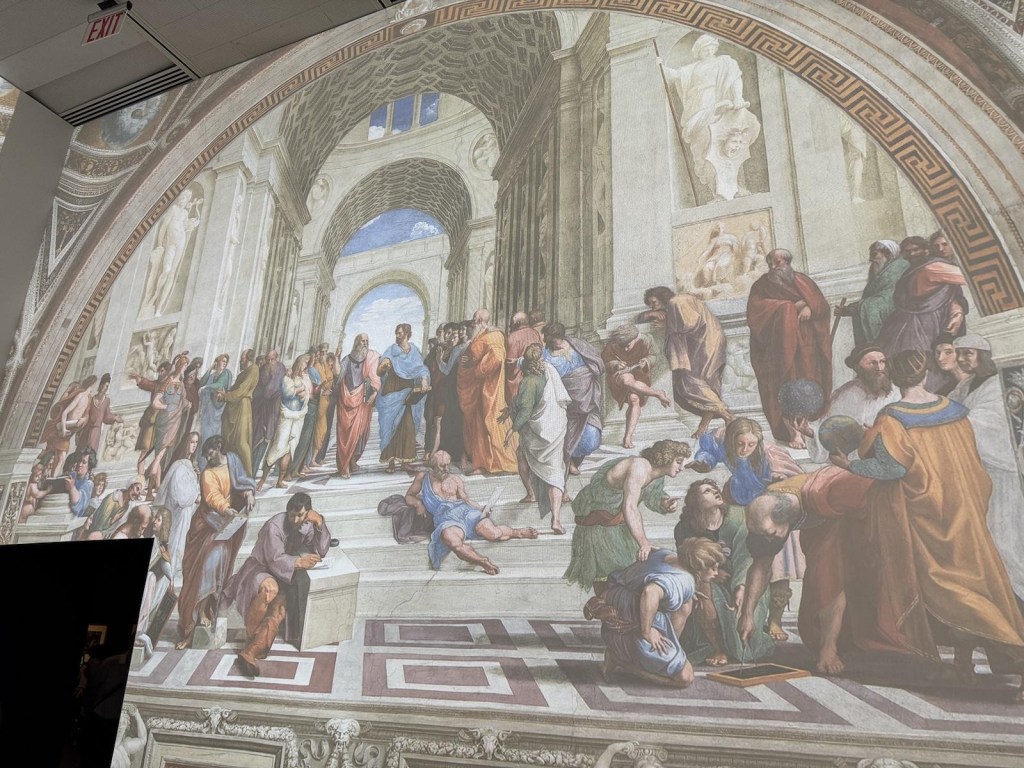
Enterprising Raphael wasted no time. Relocating to Rome at age 25, in demand by powerful patrons and popes, he undertook multifarious projects, including redesigning St. Peter’s and cataloguing ancient monuments (completed by Palladio). The pale projection of School of Athens nonetheless displays Raphael’s passion for antiquity, and technical and conceptual mastery. He’d foregone Perugino’s tensionless, demure, elongated poses – Vasari considered the Umbrian style insipid – for architectonic Vitruvian proportions, and studied gestures evoking Ciceronian rhetoric. At the stage-like scale, humanist confidence, buttressed by massive building (probably painted by Bramante), is quietly projected. After Bramante snuck him a peek of secretive Michelangelo’s ceiling project, however, Raphael’s style changed. Intuitive, Leonardo-esque empathy was subdued by the corporeal heft and astringent color of Michelangelo, yet sans his tenebrous terribilita. Increasing reliance on assistants (purist Michelangelo disapproved) to execute disegni further compromised subtlety. Raphael Inc. theatrics encouraged Mannerist exaggeration and baroque dramatic surplus.
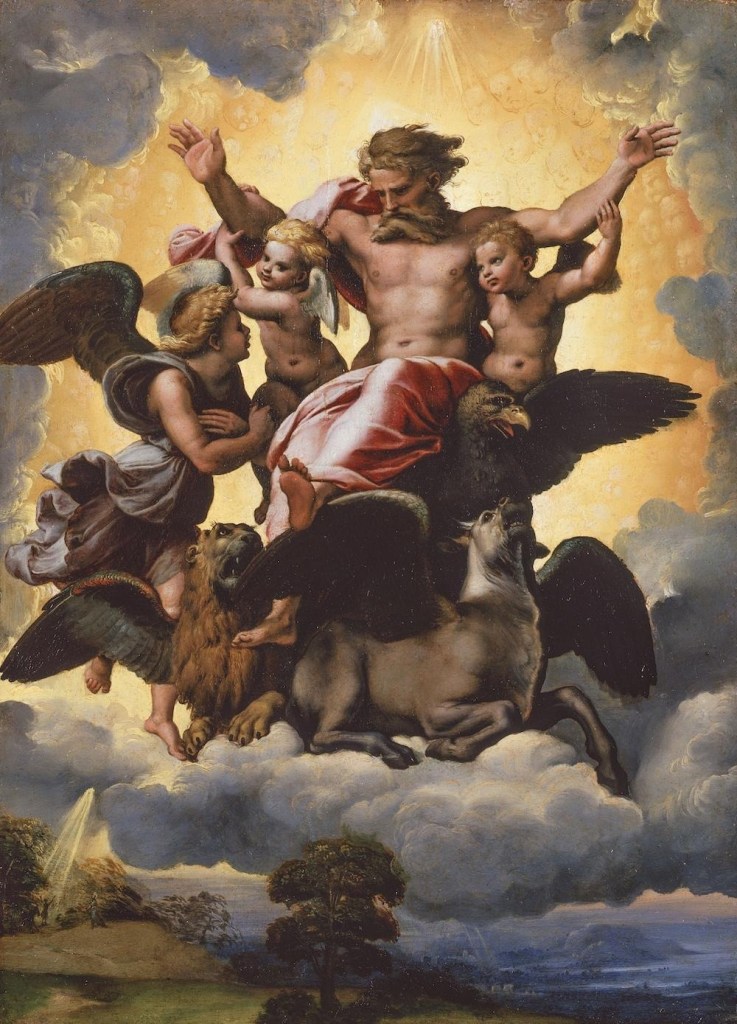
Raphael died age 37, grandly buried in the Pantheon. The art star out-famed Leonardo and Michelangelo during his life and for centuries thereafter; Ingres acquired some of his remains. Producing the first artist’s prints with printmaker Raimondo had disseminated Raphael’s brand across Europe. His persuasive prototypes in exuberant paradigms – like the tiny, triumphalist Vision of Ezekial, possibly painted by assistants – were adapted to Counter-Reformation, aristocratic, and history painting objectives. His disciplined methodology shaped academies, the Raphael Rooms foundational for French Academy in Rome students. The Raphael cartoons – colored blueprints for Belgian tapestries (another huge papal expense precipitating Reformation wars) – landed in England, there widely produced in prints. Raphael’s style shaped the Grand Manner – hence his anglicized name – later rejected by Pre-Raphaelites, who replaced histrionics with excessive detail. This thoughtful exhibition offers musings on talent spread too thin, historical vicissitudes and what-ifs, and Raphael’s driven genius.
“Raphael: Sublime Poetry,” Metropolitan Museum of Art, 1000 Fifth Avenue, New York, NY. Through June 28, 2026.
About the author: Painter and art writer Margaret McCann teaches at the Art Students League. She has shown her work at Antonia Jannone in Milan and been reviewed in La Repubblica, Corriere della Sera, and the Huffington Post. She edited The Figure (Skira/Rizzoli, 2014) for the New York Academy of Art and has written reviews for Painters’ Table, Art New England, and Two Coats of Paint.






.jpg)
%23/media/File:Raphael_The_Sibyls.jpg)
.jpg)


