
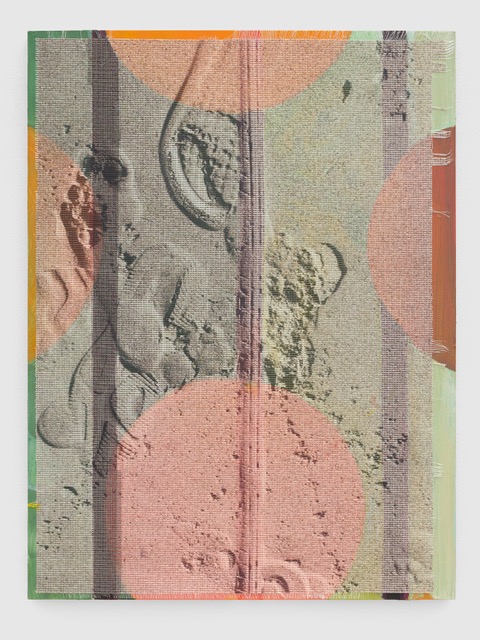
Contributed by Leslie Wayne / For as long as I’ve known Suzanne Joelson – over 40 years now – she has pushed the limits of painting, much as I have tried to do. In what is now an abundantly expanded field, though, I have wondered whether we have much to push against anymore, which makes the endeavor all the more challenging. Contemporary painting includes “mixed media,” has left the proverbial stretcher bar, is no longer tied to the geometry of the rectangle and square, and can be two-sided, cut and slashed, hung and draped, torn and sewn, and collaged. We’ve seen photographs painted on and sculptures so color-bound that they are referred to as three-dimensional paintings. So what value is Joelson adding?
Uniqueness, if it isn’t an outcome of authentic discovery, can feel hollow. Yet the work Joelson has been doing for the last several years is not only unlike anything I’ve seen before but also hard-won and revelatory. Joelson’s UNDER_ground paintings defy ordinary spatial rules. They mix abstraction with representation, formalism with narrative, and photography and printmaking with painting and collage. In a wonderful studio visit I had with her a few years ago, I was immediately taken with how she was overlaying a random geometric abstract layer of painting with a scrim of mesh, onto which she printed a photograph of ground on which she had trodden. The effect was startling and in some ways unreadable until I understood her process. Even when I did, the fascination, visual richness, and complexity of her work were undiminished.
I understand Joelson is moving the work into new territory again, so I’m very happy to have this opportunity to ask her where her paintings are going.
Leslie Wayne: Suzanne. First, congratulations on your numerous recent group exhibitions, including the grand group show at Private Public Gallery in Hudson that recently opened, and the notable suite of new paintings at Bienvenu Steinberg Gallery’s booth at the Armory Fair. Plus the wonderful inclusion in last year’s print edition number ’35 of Dear Dave – all a sign that people are catching on to and intrigued by what you are doing. I know you were upstate for the summer working away. Can you tell me what’s been going on in the studio lately?
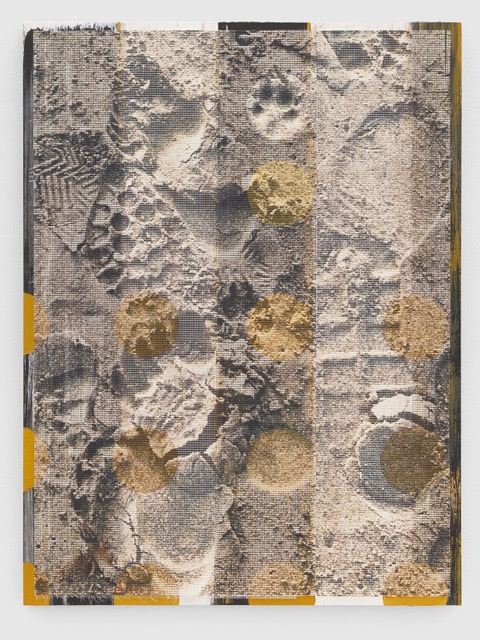
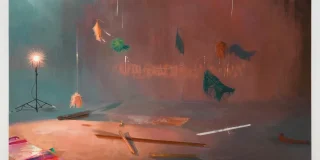
Suzanne Joelson: I am working in two directions and temporarily ignoring a third. In the spring I planned to move forward with the larger tiered pieces, for which I wanted new photographs. Revisiting the site of the original images did not yield an interesting result. So I returned home and set up a similar situation using work lights to mimic the low seaside morning light.
LW: Home upstate or home in the city?
SJ: Home upstate where trees and hills alter the early angled light. I put sand on the steps to the porch and then ran up and down them in different sneakers. As I was reading the Iliad, the footprints seemed like armor in battle scenes. While in the past I had been finding images, this makes the photographs more of a willful fiction.
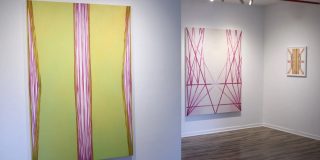
In the meantime, I started a number of smaller pieces in which I have been loosening the fit between the layers. So in the bigger pieces I am moving forward on something I love. In the smaller ones, I am testing the relationship of the overlying photograph to the painting below. The 3/8” margin which reveals the edge of the obscured painting is less consistent.
LW: This is a hallmark of your work. You leave a margin around each painting where the mesh falls short of the edge, revealing the underpainting. This to me is like an actor looking directly into the camera and winking.
SJ: Yes – – – and now the reveal is becoming a more active player. In the new paintings it shifts according to the rhythm of the painting, in relation to the stripes of paint, which are in turn responding to the tire tracks. In some cases, the mesh hangs longer than the panel, in others I shift or cut into the image.
LW: So you are breaking from a formula to privilege process over outcome and allowing the work to tell you where to go next.
SJ: Less a formula than a resting state, but yes. I think a goal for many artists, whatever their routine, is to be conscious and playful. To engage what is, rather than what you thought it might be. We have different ways to get to that moment of being alive with the material, seeing it as new. As much as I dislike being away from the studio, I enjoy returning with freshened eyes.
All this is about intimacy and distance. Your remark about the winking actor harks back to Brecht. We need to hover, whether by way of Kant or Buddha. Leslie, your work is continually engaging change. When I use the word “hover” I think of your trampoline and the views from an airplane. Some of your changes seem internally driven by material. But when your mother died, you processed that with a big change in your approach to picture making. So it is maybe for both of us that change comes from the material under our fingers and from events outside.
LW: Absolutely. And if you are attuned to the world, they become inextricably bound. Ultimately the goal is – yes, to be conscious and playful, which is another way of being fearless and open to failure. It can make for a very bumpy ride, but in the end, you hope to reap the rewards, which are incalculable. You’ve done that continuously with your work, Suzanne – always taking the next step to see where the ideas and the materials will take you.
And now I’m looking at the tiered painting, Stepping Up, and what immediately comes to mind are petroglyphs, like Newspaper Rock in Utah , or some kind of Yucatec Mayan hieroglyphics. Is semiotics something that you are interested in playing with here? The tension between readability, meaning and obscurity? Or do you want the work to remain grounded in the first-person experience of your walking?
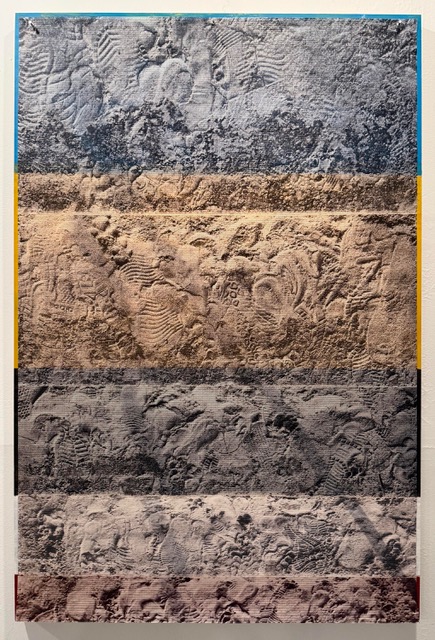
SJ: Complex question. As much as I enjoy the words, “grounded …in walking” I am more involved in the way things read, how we collect information into sensation. When the paintings were more overtly about walking, I was trying to get at the distinction between the experience of the moving feet, the vista and a sense of the map. I may conduct the tour, but it is sufficiently open so that meaning can slip in. Newspaper Rock is amazing! Thank you for showing it to me. I have looked at Mayan hieroglyphics and loved the 2023 Mayan show at the Metropolitan Museum, but It was surprising when the enjambed sneaker prints resembled them. I am less interested in linguistic codes than in the relationship between the symbols, a bodily understanding of scale and gravity. The feet integrate and overlap in what feels to me like a dance. Most of us have feet, and the paintings have a life size footprint, which determines the size of the panel.
What did you mean by obscurity?
LW: Visually the footprints, which read as “symbols,” are so jumbled on top of one another, that you can’t really decipher them. And then they are further obscured by the underlayer of random color.
SJ: Right, I forget that you are thinking of Stepping Up which is a crowd scene while I also have some smaller paintings on my mind. In some there is one foot and crossing a tire tread or two feet in a dance.
One of the allures of the footprints in sand is its suggestion of desert culture and of carved stone. The tracks and footprints are evidence of human passage, and I find my mind wandering from emigration to archaeological sites – Assyrian reliefs, cave paintings and the temples in Khajuraho which are more pictorial than petroglyphs or hieroglyphics.
LW: Yes, and it’s interesting to think about desert sand as a material that can both protect, like the tombs in Egypt’s Valley of the Kings, and destroy in a minute your footprint. In a way, you memorialize your footprints in these paintings as a way of preserving your own passage.
You recall that Don and I were in Egypt a couple of years ago and one of my strongest and most lasting impressions was the phenomenological experience of being among the ruins in situ. I was completely transported into those times, walking among the enormous temple walls, and imagining what it must have been like to live then, in that time and that culture. So when I asked about semiotics vs. imparting the actual experience of walking, I was thinking about the mind body relationship and the disconnect between the two that is such a hallmark of Western culture.

About 8 or 9 years ago you were collaging pieces of what looked like industrial children’s rugs printed with road maps onto your paintings. So I know that the idea of the map and the territory is something you’ve thought a lot about in relationship to the mind body connection and how we experience the world.
SJ: Yes, and now I wish I had gone to Egypt with you. My question for you is whether, even in that rapturous moment, you were aware you were having it. As much as we enjoy contemplating that disconnect, the rift seems increasingly porous. In your reference you go from mind body disconnect to mind body connection. When an idea is new, we need to exaggerate it in order to understand it. Later it becomes more dynamic.
Do you think working in layers or with collaged space inevitably links to dualistic thinking? And then to the mind body question – is it in the nature of our quest that we apprehend art, hoping to be astonished, hoping for a gut punch or a skin tingle, and then feel compelled to rationalize how it happened? Our busy minds attempt to explain our sensations until we get in the studio and the hand thinking begins to take over.
LW: Well, this is why we make art, right? Because language is so often inadequate. Our attempts at explaining the inexplicable or describing the indescribable must fall into the hands of poets and writers. And when that falls short, images may bring us closer to the miraculous experience of being alive in the world.
These days this feels more urgent to me, not only because of the perilous state the world is in existentially, but because we are staring down into the face of the unknown as we age. Do you feel an increased sense of clarity with your work as you get older, or if not clarity, then a sense of purpose?
SJ: Such a thoughtfully constructed question! The destruction of most of what I value, in a country I loved, in a world racing backward, coincides with my increasingly imminent bodily decline.
I want to say, “Yes” to be agreeable, but for me clarity and purpose are at odds with my tendency toward compliance. I have been living in the country where it is, as Oscar Wilde put it, “easy to be good.” The daily disasters in the news distract, making the retreat into my studio more important, as it is where I come to terms with the world outside.

Like Freud’s grandson attempting to affect his mother’s comings and goings, saying “fort” as he threw a tied-up ball of paper at the door and “da” as he pulled it back, I process the things I cannot control in paint. An aesthetic rationale gives me something to do. Then as I work, the subject slips in, unintended. Months into a group of paintings I come to recognize the interior motive. I am not sure that I am clearer now than I have been or if I am more purposeful. With age poking at me, I bounce toward lucid.
As we converse, I wonder what I am telling myself now. What is it with covering an ebullient painting with a veil of shadows in the sand? The answer may be in your question. I may be painting my own disappearance.
“What’s That Sound Everybody Look What’s Going Down”, with Richard Artschwager, Ross Bleckner, Sharon Butler, Deborah Dancy, Michael David, Astrid Dick, James Esber, Heide Fasnacht, Marvin Heiferman, Dana Hoey, Shirley Irons, Suzanne Joelson, Ellen Kozak, Stephen Maine, Donna Moylan, Michael Rodriguez, Hanneline Rogerberg, Michael St John, Viktor Witkowski, and Oliver Wasow. Private Public Gallery, 530 Hudson Street, Hudson, New York.
About the Author: New York artist Leslie Wayne is represented by Jack Shainman Gallery. Wayne is an occasional writer and curator, and has received numerous grants and awards, including a 2017 John Simon Guggenheim Foundation Fellowship. She was awarded a 2025 Art Omi Francis J. Greenburger Award, which honors established artists who have not been fully recognized by the public.








This is one of those interviews that I will have to reread – there’s so many dense and wide-ranging ideas here that it will reward another couple of go-rounds. Thank you!
A really compelling read. Thank you both for this conversation.
A great, great article and interview, full of references to artworks, places, history — and yet intimate.
It seems to offer access to the minds of these two deep-thinking, accomplished artists.
Fabulous
Dear Suzanne, The making of those “paintings” seems like mystery to me. You answered the frame question completely independent. Congratulations. It is hard for me to find out how the topping part is coming over the painted part. Great
From Germany with Love
Klaus
So glad for this dialogue to learn more about your process. The peek at underpainting on the edges work so well as alienation effect ——then the reality of the footprints and marks that seem so ancient and myterious.
Suzanne, I loved seeing your painting at Private Public. In images they are so mysterious – I wasn’t sure what I was looking at. In person the painting is mesmerizing. Thank you both for this thoughtful conversation. After seeing the painting, the dialogue deepens my experience.