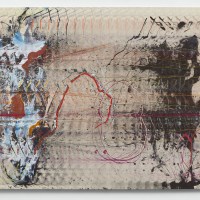
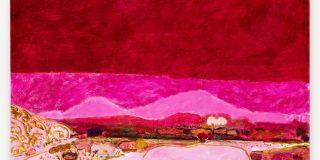
Contributed by Tena Saw / Emily Kraus’s paintings are stuttering fields of glitches and agitation that shake and swagger like a Warhol Elvis. Her debut New York solo exhibition at Luhring Augustine Tribeca arrives with a kind of procedural mythology already attached. The artist works inside a self-designed apparatus, feeding raw canvas through rollers, painting in collaboration with the machine. The paintings come into being from pressure, friction, and chance.
Tag: Tribeca
Alex Kwartler: Open to the world
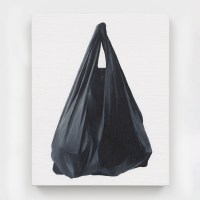
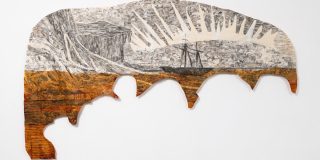
Contributed by Shirley Irons / In a dream, I asked Alex Kwartler if his work was about the unreliability of images. God no, he yelled. “Off-Peak,” his current show at Magenta Plains, presents modestly scaled paintings that read across the room like music, with beats and rests, highs and lows. Their subjects include tender representation, stark pop, painterly abstraction, tin can lids, dots, drains, and shipwrecks. They echo and repeat. Their consistency lies in his assured, skillful paint handling. When you can do anything with paint, why not just do it?
Julie Beaufils: New painting for end times
Contributed by Jason Andrew / It’s easy to associate the new paintings by Julie Beaufils, now on view at Matthew Brown Gallery in Tribeca, with a post-apocalyptic world. The sixteen paintings suggest fractured architectures and abandoned fields, sun baked and rising from a humming radioactive haze. Beaufils lives and works in Paris, and her precise lines and delineated spaces capture its curving promenades, narrowed boulevards, and sinking perspectives. Travels to Los Angeles and the American Southwest have also influenced this new work.
Eileen O’Kane Kornreich: Embracing fluidity
Contributed by Chunbum Park / A man riding a lion. A canine barking at a red painting of men’s legs. Snow White eyeballing the private parts of a man holding onto a chair. A blue queer person’s reach for blankets and pillows arrayed like clouds of a night sky. “Pleasures of Duality,” Eileen O’Kane Kornreich’s solo exhibition at The Opening Gallery in Tribeca, depicts sensuous figures embracing both sides of their identity. It is an agreeably assertive and highly effective migration away from customary gender-based psychological and aesthetic orientations.