Contributed by Sharon Butler / In “Assets,” on view at Green on Red Gallery in Dublin through December 13, Alan Butler – no relation – practices what could be called digital-age synesthesia, the neurological quirk by which the senses get their wires crossed. Synesthetes may taste color or see it as numbers. While Kandinsky had the insight and talent to create arguably the first Western abstract paintings by translating music into painting, Butler has taken on a distinctly twenty-first-century project: transforming open-source digital information – stock quotes, climate data, video game coding, and other assorted online effluvia – into playful physical objects that directly engage the senses. Whereas synesthesia is clinically an involuntary neurological condition, Butler promotes a voluntary one: seeing, hearing, and touching the drab data streams that insidiously encircle our lives as vibrant art.
Please click here to contribute to the Two Coats of Paint year-end fund drive
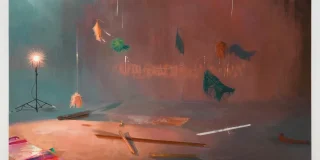
I stopped by the gallery at twilight on a recent visit to Dublin when the lights and digital screens lit up the cement-floored, window-lined space to optimum effect. Collectively, the pieces produced a carnival-like atmosphere of blinking lights, blended sounds, holograms, photography, 3-D printing, and animation. Butler aims to surprise viewers, first visually and then, as they come to understand what makes the pieces move and tick, intellectually. This is not a pedantic tech exhibition; Butler wants us to have fun. Handmade objects, bright paint, lights, and sounds come alive through their targeted interaction with data culled from an array of satellite feeds and websites.
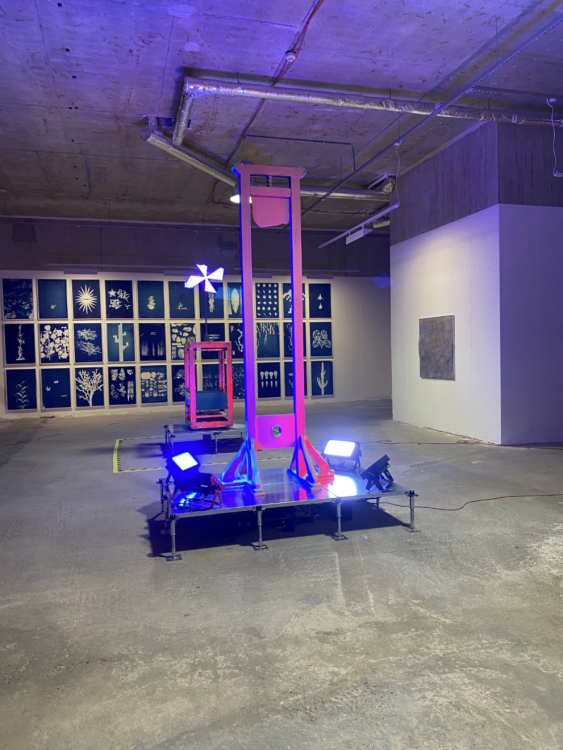
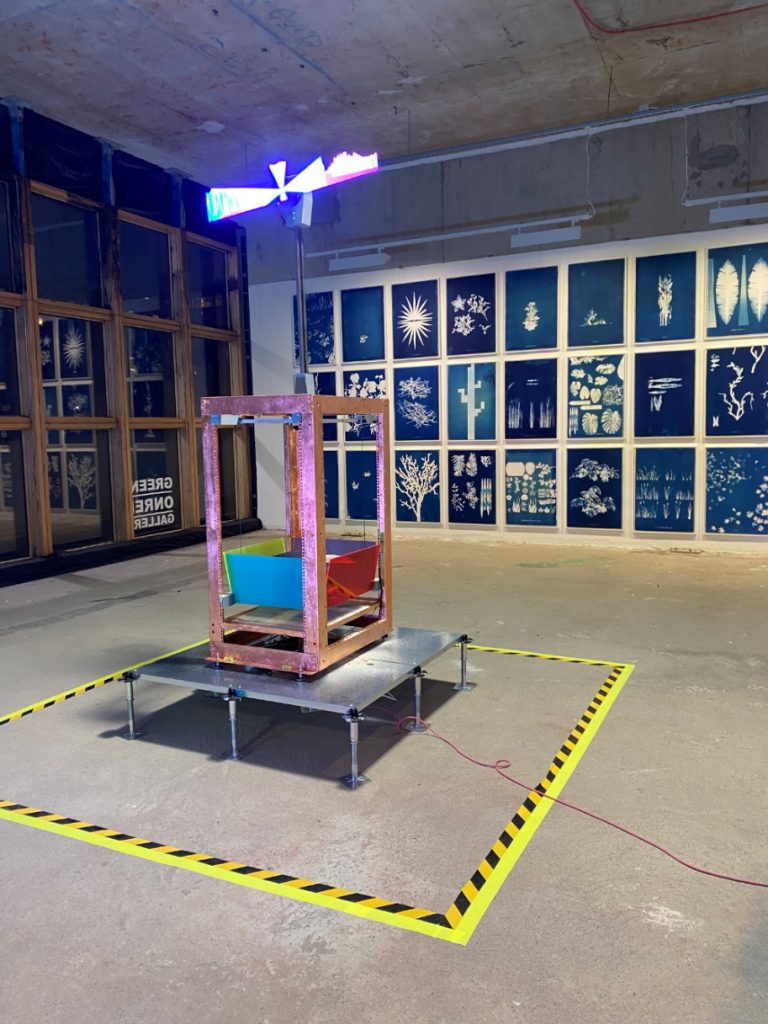
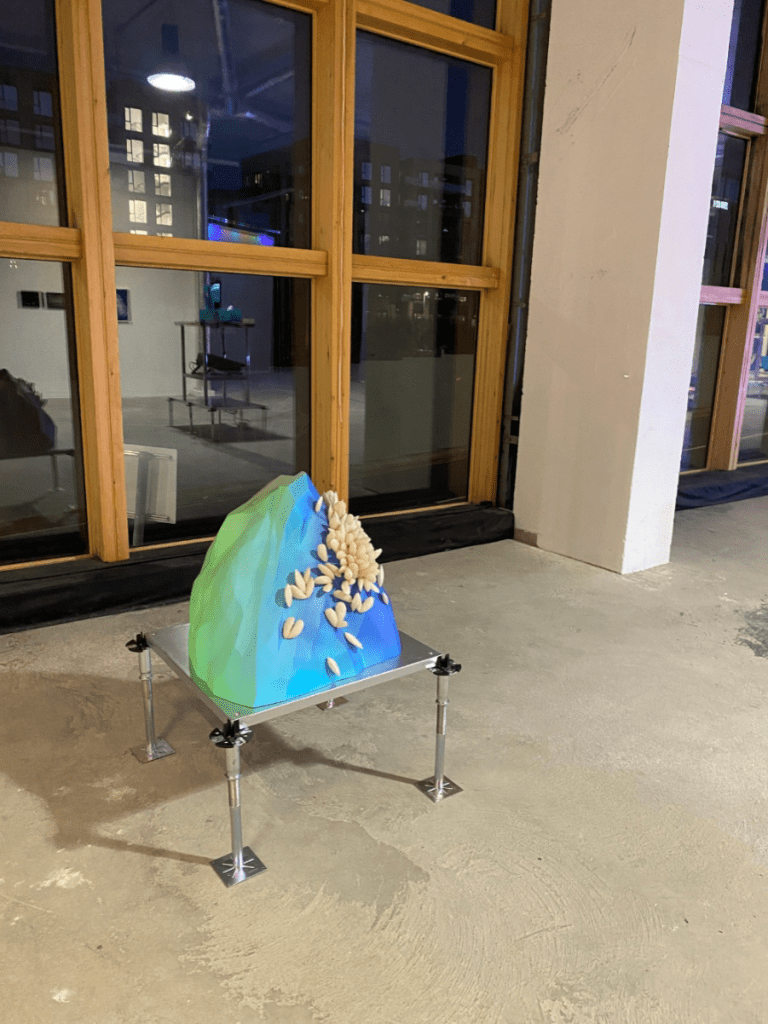
In Vanitas, one of the sculptures in the middle of the gallery, a tall painted vertical structure that looks like a guillotine is bathed in blinking lights. It is attached to a live data feed, and every time a big tech stock loses or gains a million dollars, a drum beats. While I was there, the drumbeat was non-stop, the way a bell buoy responds to the waves on the ocean, clanging for each one. In Cyanotype 33, a more traditionally rendered piece, digital plant images found in video games are subjects of a floor-to-ceiling installation of cyanotype prints that recapitulate pioneer photographer Anna Atkins Photographs of British Algae: Cyanotype Impressions, from 1843. For Ghost Mussels, 3-D printers have rendered perished mollusks into sculptures. They function as contemporary fossils, honoring the lost creatures while at the same time creating permanent synthetic versions of them. Thanatophone, a tabletop piece comprising several electronic gadgets, is decidedly more analytic. Ituses GPS satellites to locate itself on Earth while pulling in real-time weather data to identify the hottest global locations, cross-referencing the coordinates to locate critically endangered plants nearby. Computer-vision algorithms convert plant images to sound, played through a long-range acoustic device’s speaker, and sketch the endangered species on a laboratory oscilloscope within the sculpture.

The centerpiece of the show is Pneuma, a sculpture thatestablishes a direct link between bitcoin transactions and tangible physical phenomena, making the abstract flows of cryptocurrency markets immediately perceptible in the form of a whirling hologram hovering and blinking above the structure. To the Stoic philosophers of ancient Greece, “pneuma” was breath but also one’s spirit or vital force. The work presents blockchain flow as a kind of energetic pulse driving contemporary life – or at least some of it. Butler maps, animates, and critically contextualizes streaming information that directly shapes the world.
Initially, I was smitten with the sheer exuberance of the exhibition, and then, as I was writing this, the onslaught of ideas and processes began to crash my system. I wondered if AI wouldn’t be a better audience for Butler’s work, so I asked AI if it would, in fact, like Butler’s show. “Since AI doesn’t have subjective experiences, preferences, or aesthetic appreciation in the way humans do, I can’t say AI would genuinely ‘like’ anything,” I was told. “The works that respond to live data streams (like Pneuma reacting to Bitcoin transactions, or Thanatophone responding to global heat spikes) essentially perform a function similar to what AI does – it takes inputs from the world and transforms them into another form.” That is, “Assets,” by making the invisible visible, generates a live-streamed synesthesia that quickens anxiety among twenty-first century art-viewing humans.
“Alan Butler: Assets,” Green and Red Gallery, Park Lane, Spencer Dock, Dublin, Ireland. Through December 13, 2025.
About the author: Sharon Butler is a painter and the publisher of Two Coats of Paint.
Please click here to contribute to the Two Coats of Paint year-end fund drive