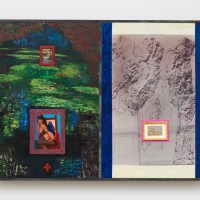
Contributed by Adam Simon / Paul Gardère (1944–2011), whose work is now on view in “Second Nature” at Magenta Plains, is known for a unique version of combine paintings, incorporating assemblage, found objects, photography, dirt and glitter into works that critique the legacy of colonialism in Haiti and its diaspora. The problem with this narrative is that it undersells how formally innovative his work was in its time, the degree to which it stems from his own biography, and how it anticipated our current multi-screen reality.
Tag: Kazimir Malevich
Dannielle Tegeder’s freighted abstraction
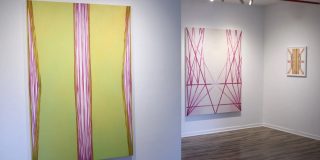
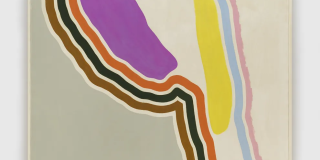
Contributed by Riad Miah / Informed by early modernists such as Piet Mondrian, Kazimir Malevich, Wassily Kandinsky, and Stuart Davis, Dannielle Tegeder’s abstract paintings are in themselves traditional, painted with acrylic on stretched canvas. When displayed, however, their import extends beyond the canvas edges into wall paintings, immersive installations, and even musical collaborations, encouraging a searching and interactive viewing experience. Her solo show “Signals,” currently on view at Standard Space in Sharon, Connecticut, incorporates new elements into her visual vocabulary, including ladder mobiles, stained linen, and walnut panels, freshly drawing on other aspects of art history.
Mark Dagley’s little god
Contributed by Michael Brennan / As a boy, the sculptor Tony Smith – a canonically important and under-appreciated American sculptor who connects AbEx and Minimalism, equally at home with Pollock and Serra – suffered from tuberculosis so severe that his father built him a small shed in the backyard of their South Orange, New Jersey, home, with fiberglass curtains to minimize dust and a small black stove. Smith lived in the spartan outbuilding for several years. Imaging him there might elicit the melancholy that Van Morrison conveys in his aching ballad “T.B. Sheets.” As an adult, however, Smith noted an upside, at least for an artist: “If one spends a long time in a room with only one object, that object becomes a little god.” I grasped the significance of this observation acutely when I encountered Mark Dagley’s sloop-like sculpture Vāyu-Vāta, which, pointed away from a black radiator and darkly mullioned window, dominates the Abaton Project Room in the Financial District.