Tag: Jean Dubuffet

Solo Shows

Bascha Mon: Mountains to climb

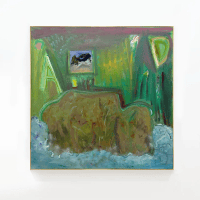
Contributed by Jenny Zoe Casey / In “Kin Terrains,” nonagenarian Bascha Mon’s second exhibition at Tappeto Volante Gallery, Unfinished stands out for its semi-representational approach and for rich, lively colors that reflect Mon’s early-career affinity for Vuillard, among other influences. Made in the 1980s, it is the oldest piece in the show and clearly informs her subsequent work. From the left, the smallest arch reads as a turquoise alcove, a chair resting against it in a space containing other furniture. Behind the alcove are white-barked trees in a purple-green dusk. The color connects the area inside the arch to the trees, but a larger entryway appears blocked, going nowhere. To the right, however, a larger arch is open both to the viewer and a lake in the background. Unfinished’s patented shapes are found in some form in all but two pieces in show, though they become lumpier, irregular, and roughly oval.
Art Fairs

Outsider Art Fair 2025: Between visionary and marketable

Contributed by Jac Lahav / What does “outsider art” mean when the work so labeled is framed in a glossy finish and sold for six figures? When Sanford L. Smith founded the Outsider Art Fair in 1993, he meant it to promote true outsider artists and showcase their work. In 2013, New York art dealer Andrew Edlin bought the fair and it has since become one of New York’s most beloved art events. But it now presents something of a paradox: a space dedicated to self-taught, visionary, and unconventional artists, yet increasingly colonized by prominent galleries and high-end collectors.

Solo Shows

Carol Bruns’s aesthetic moralism

Contributed by Gwenaël Kerlidou / Heart of Darkness, Joseph Conrad’s 1899 novella, is one of the first fictionalized accounts of the ravages of European colonialism in Africa. Marlow, the narrator, while surveying the grounds of an ivory collecting station on the Congo River, catches sight of a row of shriveled heads mounted on stakes. The episode segues to a deeper exploration of the psyche of Kurtz, a terminally ill but very successful ivory harvester working for the king of Belgium. His cryptic last words – “the horror, the horror” – sum up the situation. The title and content of Conrad’s novella reverberates through Carol Bruns’s current exhibition at White Columns of mostly monochromatic frontal sculptures, in which the human figure is omnipresent, either as hieratic totems or as ritual masks. Scattered in the gallery space, an unruly mob of chimeras and other nightmarish characters seems to be stoically harboring the scars, wrinkles, creases, and other traces of immemorable sufferings.