Contributed by David Whelan / “Esthetic Bomb Shelter,” at Ulrik gallery, comes at a time of overwhelming crisis. Conflict and hostility seem to have entered every aspect of life without clear exits. Painters Allen Berke and Lise Soskolne tap into this quandary by visualizing moments of discontent and unease, abstracting form and narrative. Though unsettling, the works are also strangely enjoyable, prompting a kind of cognitive dissonance in the viewer.


Allen Berke, who died unexpectedly in 2003 without having shown the paintings in this exhibition, worked in New York City during the 1980s and ‘90s, finding inspiration from photojournalism. Images of dictators, soldiers, and dissenters pervade his canvases, but they’re cartoonish, rubbery, and grotesque, at other times gestural and poetic. He applied paint in thick layers, giving the eye plenty to feast on.
Lise Soskolne curated the show, including four of her own paintings alongside Berke’s. An artist and activist, her admiration of Berke is clear. With styles ranging from painterly to photographic to atmospheric, Soskolne pairs unexpected forms to create comedic and sometimes unstable scenarios. I could not easily follow Solskone’s journey through paint, so it was hard for me to connect completely with her work. At the same time, its elusiveness felt eerily familiar, perhaps because it resonated with the present moment of dense uncertainty.


Berke’s Untitled, from 1985, a compact painting in red and black tones, depicts two squat political figures with arms raised, facing towards us as though beholding a military parade. The brushwork is active and erosive, suggesting motion and coercion. Between the figures, the pink background comes forward in the form of a tiny crooked curl, squeezing past, pushing and pulling the space. This anguished little shape held my attention as an embodiment of a wretched display of power.
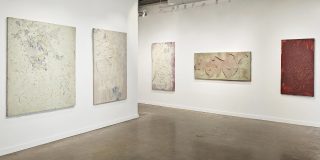
Hung closely together on the main gallery wall is a series of paintings by Berke. The imagery includes soldiers marching, police brutality, tortured bodies, and a comical butcher punching a carcass. In the center is Soskolne’s painting Digitallisman, her most experimental and painterly and my favorite. In it we see four black and white abstractions resembling analog computer graphics striking an Orthodox-looking man in the forehead, causing him to grimace. These incompatible forces bounce off each other, creating a humorous incongruity. The background to the left, painted in a speedy, green grid comes forward, past the blurry figure in the foreground. It is yet another inversion of pictorial space.
Soskolne’s ominously titled If Not Now is more difficult to grasp. In the foreground is a mound of stones and bones, painted in puffy and cartoonish manner. A set of Groucho Marx glasses hover to the left, with no face behind them. The funny disguise appears to be haunting a place of death and desolation. While the paint handling and composition felt somewhat flat, the surreal combination was wry and thought-provoking.


I was most drawn to Berke’s untitled painting presenting an intensely abstracted figure in front of a violet background and yellow base throwing a Molotov cocktail. It’s an explosive combination. Stretched out like taffy, the figure’s motion is at once fast and slow, as through the velocity of his wind-up warped the entire visual field. This effect can be found in all Berke’s paintings. Across the room is his Blue Sky, a painting of two buffoonish male figures, seemingly politicians, leaning backwards to watch three toy-like fighter jets ascend. Both figure and machine are wiggly and heavily outlined, negating their putatively upright composure and sharp contours. The sense of imperception and cluelessness is palpable: powerful men as gaping clowns.
Berke dared to paint violent subject matter with a light and seductive touch. It is a rare accomplishment to coherently locate tragedy and comedy so closely together. Though Soskolne’s paintings are perhaps harder to connect with on a visceral level, her ambiguous narratives are a natural fit with Berke’s, adding another dimension of irrationality to his formal distortions. Together the pair offer a world stretched past recognition and turned inside out, much like our own.

“Allen Berke and Lise Soskolne: Esthetic Bomb Shelter,” Ulrik, 175 Canal Street, 3rd Floor, New York, NY. Through July 12, 2025.
About the author: David Whelan is a painter living in Brooklyn. He has published art reviews in Artforum, The Brooklyn Rail, and Effects Journal, among other publications.