Contributed by Alex Grimley / In the 1972 documentary Painters Painting, Kenneth Noland is asked by director Emile de Antonio, “What does ‘color field painting’ mean?” The plainspoken artist thinks for a second before answering, “What they generally mean, I think, is that the painting is mostly generated by color, rather than, say, drawing or any other means.” Noland’s matter-of-fact response is indicative of his feeling about such terminology. Labels coined in the 1960s like “color field painting” and “post-painterly abstraction” – “a fairly awkward term,” he remarked – circumscribed his art, categorizing it alongside that of painters like Helen Frankenthaler and Jules Olitski, artists whose aims increasingly diverged from Noland’s. “Kenneth Noland: From Center to Edge,” currently on view at Hunter Dunbar Projects, is a concentrated presentation that illustrates the considerable range of the artist’s practice over four decades, from the 1960s to the early 2000s.
Search Results for "label/New Art Center"
Diebenkorn at Gagosian: A remarkable curatorial accomplishment
Contributed by David Carrier / For a long time, I have always thought of Richard Diebenkorn as a great painter. A couple of his paintings were in my local museum, the Carnegie Museum of Art in Pittsburgh, where I treasured seeing them. But he was, so I believed, someone whose development was straightforward, even a little boring. I arrived at Gagosian’s large upstairs gallery on Madison Avenue with low expectations of a thick array of Diebenkorns in that one room. Maybe it had been a mistake, inspired by misguided nostalgia, to take on this assignment. In the event, the exhibition was revelatory, holding me spellbound. This is one reason why I love being an art critic – the surprise.
How the term “zombie formalism” killed the next generation
Contributed by Sharon Butler / In 2014, a single phrase reshaped the trajectory of contemporary abstract painting. When the late Walter Robinson – painter, critic, and veteran of the Pictures Generation – coined the derogatory term “zombie formalism” in an essay for Artspace, he set off a chain reaction that would stigmatize a generation of young abstract artists and cast a long shadow over abstraction in general. More than a decade later, the story of zombie formalism reads as a pungent example of aesthetic cynicism and jadedness – a case study in how criticism, commerce, and cultural anxiety can converge to distort and ultimately damage an entire movement.
LA PST Report: Toward better social behavior
Contributed by Peter Plagens / The first edition of the Getty-sponsored “Pacific Standard Time” slate of exhibitions in 2011 was subtitled simply “Art in L.A., 1945 – 1980,” and it aimed to elucidate Southern California’s contribution to American postwar modern art. In 2017, the second iteration was called “LA/LA,” indicating the city’s Latin American art and artists. This time around PST has declared a more specific theme, “Art and Science Collide,” reminiscent of one of those noble Rose Parade rubrics…
Past, present, and future: The complementary visions of Jodi Hays and Michi Meko
Contributed by Jenny Zoe Casey / In a fascinating and inspired pairing, “The Burden of Wait” at Susan Inglett brings together painters Michi Meko and Jodi Hays and explores the different ways in which inhabitants of a particular region – here the American South – can experience it. Landscape is an important influence for both artists, but their approaches are mostly in opposition.
Surface, flourish, complexity at the Hessel Museum
Contributed by Anne Swartz / Since its origins in the 1970s, practitioners and advocators of the Pattern and Decoration movement have countered claims that decorative art lacked seriousness. In America at the time, critical arguments focused on the exhaustion of painting, positioning it as an outmoded visual form. Several artists resisted this affront. Instead, they embraced images for their pleasure, opposing the notion of immediacy often considered synonymous with other mediums such as photography.
Scene + Sensoria
Scene + Sensoria will be a regularly occurring project of capture, of both the social and aesthetic dimensions of the New York art world, towards […]
The stories we choose to tell: “Fall Reveal” at MoMA
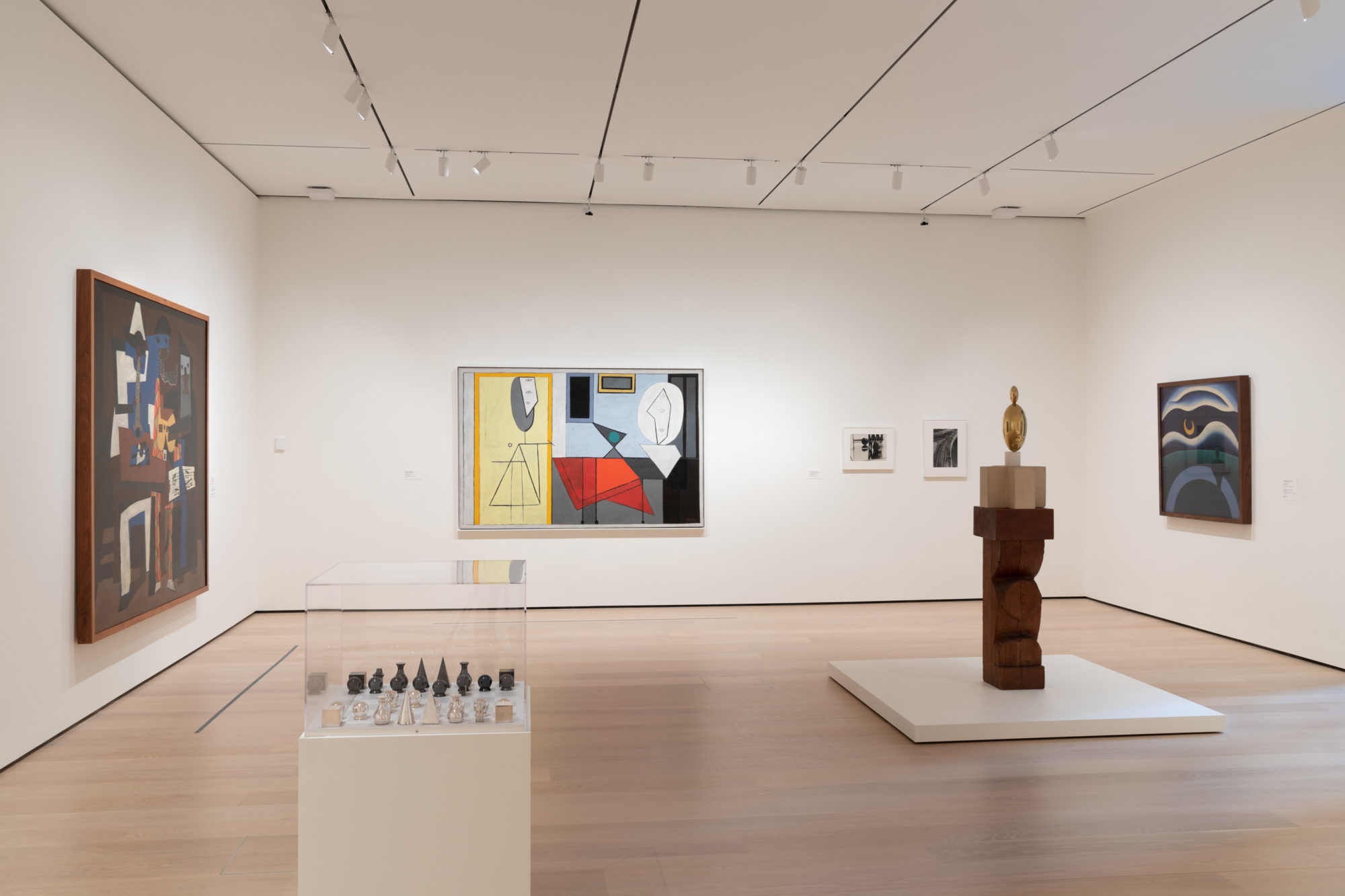
Contributed by Laurie Fendrich / The Museum of Modern Art�s �Fall Reveal� marks the second phase of the museum�s re-telling of the story of Modern […]
Eric N. Mack and Vivian Suter: How to fill a space
By Kristen Clevenson / Eric N. Mack‘s exhibition “Lemme walk across the room“ at the Brooklyn Museum and Vivian Suter�s eponymous show at Gladstone Gallery are ostensibly […]
Catalogue essay: Paul Pieroni on Peter Halley’s 1980s painting
The aim of this text, which was originally published as “Facts are Useless in Emergencies” in Peter Halley: Paintings of the 1980s The Catalogue Raisonne, […]
Carter Ratcliff: Art in the age of Trump
Contributed by Carter Ratcliff / Let�s begin with a painting�not sure it�s a work of art�that could have been painted only now, during Trump�s presidency. This […]
Vija Celmins: To fix the image in memory
Contributed by Laurie Fendrich / Anyone walking out of the Vija Celmins retrospective that opened last week at SFMoMA thinking how good she is at […]
On file: Leslie Brack at Cathouse Proper
Contributed by Sharon Butler / Offices were once equipped with typewriters, copy machines, and paperclips, and, of course, contained the files that organized and stored […]
Rainy day in New York
When I got to the studio this dreary grey morning, my coat and tote bags were sopping wet. Looking up from the building’s entrance on […]
Lunchtime dystopia: CON-Figuration at Postmasters
Contributed by Sharon Butler / Not far from the courthouse, wandering jurors like myself might happen upon Postmasters Gallery on Franklin Street during the mandated […]
Interview: Daniel Kingery in Hunt’s Point
Contributed by Rob Kaiser-Schatzlein / The four paintings I looked at in Daniel Kingery‘s Bronx studio are all medium-sized, human scale. Paint application strategies vary […]
The New Casualists
Contributed by Sharon Butler / The pioneers of abstraction — the Cubists, the Abstract Expressionists, the Minimalists — emerged from firm and identifiable aesthetic roots […]