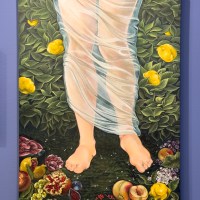
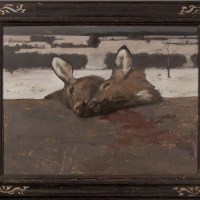
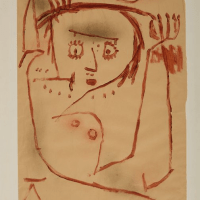
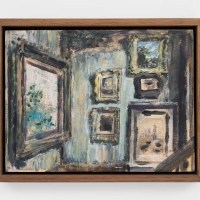
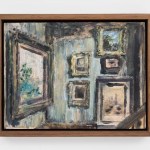
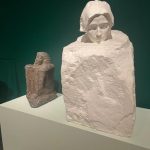
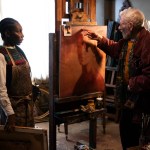
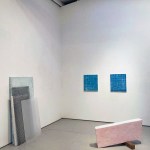
Contributed by Sarah Friedman / Liz Scheer’s “Nocturama,” now up at Galerie Shibumi, is a trippy journey into multimedia works that combine everyday objects, religious texts, and human emotions. The style of the vignettes evokes Mexican votive paintings, conjuring the viewer’s longing for coherent narrative. However, the enigmatic captions do not always seem to explain the scenes they are paired with.
Latest articles
Sylvia Plimack Mangold: Inside to outside
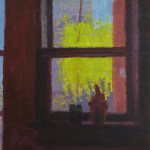
Contributed by David Carrier / As the title “Tapes, Fields, and Trees” indicates, the exhibition of ten works by Sylvia Plimack Mangold at Craig Starr Gallery draws on three bodies of her early work. In the mid-1970s, she made Minimalist paintings of tape measures. Pieces like Taped Over Twenty-Four-Inch Exact Rule on Light Floor, however, reveal a surprising poetry in seemingly prosaic subjects. Then she painted grids, like the one in Painted Graph Paper. Finally, in a remarkable transition, she drew a window looking out on a landscape….
Certain women, 2024
Contributed by Jonathan Stevenson / Eight years ago, Kelly Reichardt’s exquisitely penetrating Certain Women appeared. A singularly nuanced and resolutely independent filmmaker, she patrols the interstices of American history and contemporary society. In this movie, she presented several game female Montanans who couldn’t afford to have feminism on their minds and nonetheless lived reckonable lives – a perspective that she had established sharply in Wendy and Lucy (2008) and reiterated softly in Showing Up (2022). Judging by several recent independent films, Reichardt’s subtle perspective has had lasting influence in framing the quandary of how women establish agency in a society that still – or at least again – often militates against them.
Hudson Valley (+vicinity) Selected Gallery Guide: November 2024
Contributed by Karlyn Benson / October is the most beautiful time to visit the Hudson Valley, Catskills, and Western Connecticut, and there are dozens of new exhibitions to see this month….
NYC Selected Gallery Guide, November 2024
Contributed by Sharon Butler / This month, Marian Goodman has opened her new space in Tribeca—a thoughtfully renovated building at 385 Broadway. Just nearby, at 394 Broadway on the third floor, Pierogi Gallery, a longtime staple in Williamsburg, is marking its 30th anniversary with a pop-up exhibition. The show features works by numerous represented artists, along with selections…
Patricia Fabricant: Fear of empty spaces
Contributed by Christopher Stout / Over the past 15 years, Patricia Fabricant has experimented with distinctive heroic elements within her work, some figurative and some that seem to be extracted from nature. “Horror Vacui,” her solo show at Equity Gallery, presents 26 inventively patterned gouache paintings that follow the conceptual approach the show’s title – meaning “fear of empty spaces” – suggests, filling the entire surface with detail and composition….
Lisa Hoke’s visual rodeo
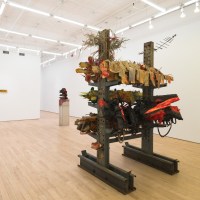
Contributed by Jonathan Stevenson / Information overload has understandably been a popular theme for artists, and many have explored it poignantly….Lisa Hoke is one – a game and capable bull rider in a visual rodeo. In her solo show “Relative Uncertainty” at Kathryn Markel Fine Arts, she meets the challenge with consummate skill, persistent wit, and, not least, a kind of stoical grit that firmly rebuffs any attempt to cast her outwardly joyful approach as sheltered or clueless, utopian or oblivious.
Teak Ramos’s case for beauty
Contributed by Talia Shiroma / It is safe to say that beauty has become an incidental quality in visual art over the last century, taking a back seat to, among other things, art’s expanded range of aesthetic values, its social and political dimensions, and capacity for novelty. So it was surprising to find, at Teak Ramos’s solo show “In Traditional Fashion” at Ulrik Gallery, a self-conscious display of visual delight. The exhibition featured 14 panels clad in white silk and tulle, which ran along the walls like errant pearls. The works are impassive, delicate, and thoughtfully constructed. They are lovely and empty forms.
You Don’t Know Me: Trompe L’Oeil and artistic illusion
Contributed by Mark Wethli / On a small shelf in a quiet corner of Sarah Bouchard Gallery in Woolwich, Maine, sits a dog-eared paperback copy of Lewis Hyde’s Trickster Makes This World: Mischief, Myth, and Art. With a growing sense of delight, we soon realize that the book is itself a trick, a trompe l’oeil sculpture by Justin Richel, convincing in every detail from its vintage 1990s graphics to its well-worn cover….It is a fitting overture to “You Don’t Know Me,” the four-person show currently on view. The artists – Carly Glovinski, Rachel Grobstein, Duncan Hewitt, and Richel – present kindred explorations of parallel realities, producing conundrums and contradictions that give rise to visual enchantment and philosophical contemplation.
Rafael Vega and the creative process
Contributed by Riad Miah / Rafael Vega’s work contemplates the act of making art in its entirety. Each of his two-dimensional relief pieces, now on display in his solo show “To See Is To Conjure” at Helm Contemporary, emerges from a series of deliberate actions – cutting, folding, and stitching – that break down and rebuild the existing composition. Leaving unprimed and untouched canvas as a frame of reference, he lets viewers in on his creative ritual. They see, as it were, how the sausage is made.
Connecting collage and curation at C24
Contributed by William Eckhardt Kohler / “Make It or Break It,” now showing at C24 Gallery in Chelsea, features a group of artist known for their curatorial practices who use collage or found objects to disrupt, critique, and reflect reality. The implication here that collage in particular has become a prominent part of our visual vernacular suggests a pervasively fractured way of seeing the world and a compulsion to reorganize it. Each artist explores how fragments, juxtaposed images, and collected objects more broadly articulate new associations and understandings that encompass personal history, culture, and art history.
Bascha Mon’s personal cosmopolis
Contributed by Michael Brennan / Tappeto Volante Gallery in Gowanus is audaciously hosting a condensed retrospective spanning decades of Bascha Mon’s painting, selected and arranged by the artist herself. Her more recent work dominates the gallery’s anterior space, with paintings from the 1970s – which remain integral to her ongoing inquiry – populating the rear room….
LA PST Report: Toward better social behavior
Contributed by Peter Plagens / The first edition of the Getty-sponsored “Pacific Standard Time” slate of exhibitions in 2011 was subtitled simply “Art in L.A., 1945 – 1980,” and it aimed to elucidate Southern California’s contribution to American postwar modern art. In 2017, the second iteration was called “LA/LA,” indicating the city’s Latin American art and artists. This time around PST has declared a more specific theme, “Art and Science Collide,” reminiscent of one of those noble Rose Parade rubrics…
Unskilled Worker: About a boy and more
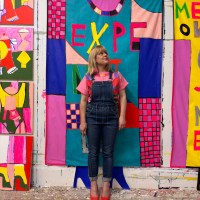
Contributed by Patrick Neal / Upon entering Daniel Cooney Fine Art, one is immediately surrounded by a colorful crowd of idiosyncratic boys. As portrait subjects, they feel oddly familiar and distinctive, and their haunting visages might stop you in your tracks. With deep, rich colors the portraits radiate a warm glow, each subject is suffused with a stained-glass brilliance and idealized in an almost spiritual aura. The paintings are the work of London-based Helen Downie, who goes by the moniker Unskilled Worker – a tongue-in-cheek reference to her self-taught background….
The formidable women who shaped MoMA: Untold stories
Contributed by Laurie Fendrich / I didn’t expect to particularly like MoMA’s Inventing the Modern: Untold Stories of the Women Who Shaped the Museum of Modern Art, but merely to learn from it. Turns out I loved all fourteen essays – each by a contemporary female writer, and each about a woman who worked at or for MoMA during the first decades after its founding in 1929. Many are beautifully written. While all are about formidable, pathbreaking women, none are hagiographic.