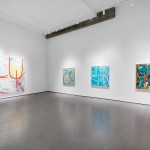
Contributed by Mary Jones / One of many pleasures in “Mashups,” Nancy Evans’s show at Sargent’s Daughters, is the sensation of immersive color. Eight abstract paintings, all 26 x 20 inches, reverberate softly with veils of translucent gradients and undulating organic form. The work is grounded in American Modernism, and a baseline of particular influences come to mind: Arthur Dove, Georgia O’Keefe, Charles Burchfield, and, as a watercolorist, Helen Frankenthaler. But Evans finds her own domain through a mediated technical process that generates luminous depth.
Latest articles
Gerri Rachins’ raptorial abstractions
Contributed by Jonathan Stevenson / While some art pulls you in gently, Gerri Rachins’ paintings, now on display at The Painting Center, grab you like a raptor. Though unequivocally abstract, their affect, as it were, is prehensile. They seem to guard the walls, flexing with taut line and pulsing color, at once opaque and fluid.
Ross Knight: Sculpting in the material world
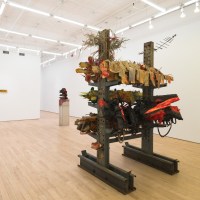
Contributed by Millree Hughes / With precisely targeted color, texture, and feel, Ross Knight’s sculptures in his solo show “Continuous Squeeze” at Off Paradise get at what physical artifacts mean in terms of our fears, fantasies, and daily struggles. Color is critical in Knight’s work. He keeps the palette small and specific, the colors he chooses leaning towards youthful nostalgia: the baby-blue of 1960s cars in Coupled Prop, a buoy yellow with custard drips in another Coupled Prop, the creamy hue of a rawhide dog chew-toy in Device. The band in Adjusted resembles an old, spent balloon, once yellow-orange but turned raw sienna with time. Does anyone ever get over a popped balloon? It’s a toddler’s tragedy. The fleshy knots, like umbilical cord buttons, are rendered useless.
Outsider Art Fair 2025: Between visionary and marketable
Contributed by Jac Lahav / What does “outsider art” mean when the work so labeled is framed in a glossy finish and sold for six figures? When Sanford L. Smith founded the Outsider Art Fair in 1993, he meant it to promote true outsider artists and showcase their work. In 2013, New York art dealer Andrew Edlin bought the fair and it has since become one of New York’s most beloved art events. But it now presents something of a paradox: a space dedicated to self-taught, visionary, and unconventional artists, yet increasingly colonized by prominent galleries and high-end collectors.
Corriero, Segre, Seidl: Open, enveloping, searching
Contributed by Michael Brennan / I have long admired the work of the three artists Michelle Segre and Guy Corriero, whose work is now on display at “Fly like a Flea, Sink like a Stone” at Springs Projects, as well as Claire Seidl, whose show “Days Like These” is up at Helm Contemporary.
Barbara Friedman’s exquisite grotesquery
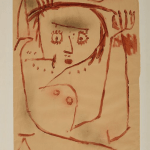
Contributed by Adam Simon / The modus operandi behind much of Barbara Friedman’s work, including her current exhibition “All Rude and Lumpy Matter” at Frosch & Co., has a name, pareidolia, which refers to finding images within abstraction. Think of the age-old pastime of finding faces in clouds.
Daisy Sheff: The anatomy of fairy tales
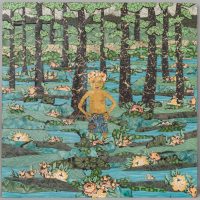
Contributed by Jason Andrew / Daisy Sheff’s exhibition “Begun in the Dazzling Sunshine” at Parker Gallery’s new space on Melrose in Los Angeles, intertwines reality with the fantastical. Her paintings employ leaping animals, fussy architectures, and bright flora to explain narratives that tease the peculiar logic of fairy tales. Their uneven surfaces, cleverly devised characters, and woolly layered scenes are busy and unwieldy. To interpret them is like piecing together the plot of a really great dream.
NYC Selected Gallery Guide, March 2025
After several years during which galleries have focused relentlessly on narrative and figurative work, I feel a vibe shift in the air. Is it wishful thinking or is abstract painting roaring back? I recommend checking out RJ Messineo’s show at CANADA, James Miller at Nichelle Beauchene, Nicolas Bermeo at King’s Leap, and Franklin Evans, who has moved from site-specific wall installations onto canvas in his show at Miles McEnery. I’m looking forward to Moira Dryer’s solo show at Magenta Plains, too. Known for a witty strain of post-minimal abstraction in the 1990s, she was a hero to painters of my generation who were then living in the long shadow of video, photography, and installation work.
Hudson Valley (+vicinity) Selected Gallery Guide: March 2025
Contributed by Karlyn Benson / The Hudson Valley is finally thawing out after a cold, icy February. At the same time, a number of art spaces are opening again after a winter break. There are a lot of openings this month, starting March 1 with Michael Fortenberry at Headstone and a group show of monoprints at The Lockwood Gallery on March 2, both in Kingston. On March 8, Kino Saito in Verplanck…
Cinema 2024: A tight dozen
Contributed by Jonathan Stevenson / For better or worse, directly or inferentially, movies reflect the zeitgeist. This year, they predominantly resonated dread or resignation, and even those focused on personal endeavor had a political tinge. With humanity’s and especially America’s scabrous underbelly fully exposed, both idealism and irony seem to be taking a break, leaving something in between that doesn’t quite amount to earnestness. It’s not the nineties or even the seventies, though the occasional and fleeting nostalgic nod to better days lightened things up. Here’s one (alphabetical) list of the year’s notable movies, with the usual acknowledgement of idiosyncrasy and incompleteness.
“Hyper-meme” at Living Skin: Immaculately funny
Contributed by Will Maddoxx / On Valentine’s Day, I walked into Living Skin, a “project space and persons hub” in Bushwick that had piqued my interest when I read its manifesto and perused promotional images for the group show “Hyper-meme.” I came to the show with some hesitation, as I have been to countless group shows that seemed unfocused and vague. Smatterings of “work about histories of images” or “art of a contemporary landscape” have gotten old and deflating. “Hyper-meme,” however, is sharp, original, and hyper-specific. It blew me away.
“Project A Black Planet” – Enshrining a promised land
Contributed by David Carrier / Few human developments have been more consequential, in terms of both art history and broader cultural expansion, than the movement of Africans within and out of their own continent. The mammoth exhibition “Project A Black Planet: The Art and Culture of Panafrica,” now at the Art Institute of Chicago in twelve high-ceilinged contemporary galleries, includes more than 350 drawings, paintings, photographs, sculptures, installations, watercolors and prints, but also books, magazines, posters, and record albums, made from the 1920s onward. It’s a lot, but never too much.
Berthe Weill: The gallerist who loved art too well
Contributed by John Goodrich / Hindsight, of course, is 20/20. Looking back at the early decades of modernism, we may sense something inevitable about the ascent of Picasso and Matisse. Weren’t both driven, gifted artists poised to take advantage of their cultural moment? And wasn’t the time ripe for Matisse’s upending of expectations of color, and Picasso’s overturning of pictorial structures? Of course, life is not so tidy and linear for the artists operating in the moment. As the luminous exhibition “Make Way for Berthe Weill: Art Dealer of the Parisian Avant-Garde” at NYU’s Grey Art Museum demonstrates, none of the early modernists had a monopoly on talent or a singularly dominant vision of what painting had to be.
Jilaine Jones’s unfolding curiosity
Contributed by David Whelan / If I asked you to make a sculpture about walking through the woods, what would you make? How would you go about expressing an awareness of your body in relation to the dense forest – stepping over downed logs, ducking under branches, feeling your feet against the ground and the sun warm on your skin? In A Walk with D. Ann at 15 Orient, Jilaine Jones suggests that we aren’t just walking through woods but having the experience of being human. There is an emphasis on gravity and things returning to the ground throughout the show. Landscape and motion, forms and space, combine to build emotional weight in the sculptures, asserting a presence while keeping their origins just out of grasp.
Julie Beaufils: New painting for end times
Contributed by Jason Andrew / It’s easy to associate the new paintings by Julie Beaufils, now on view at Matthew Brown Gallery in Tribeca, with a post-apocalyptic world. The sixteen paintings suggest fractured architectures and abandoned fields, sun baked and rising from a humming radioactive haze. Beaufils lives and works in Paris, and her precise lines and delineated spaces capture its curving promenades, narrowed boulevards, and sinking perspectives. Travels to Los Angeles and the American Southwest have also influenced this new work.