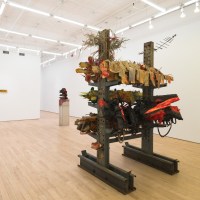
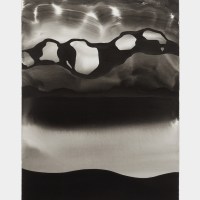
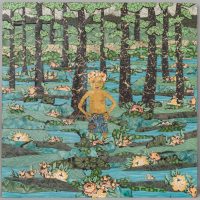
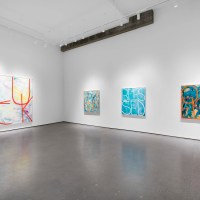
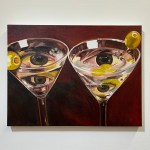
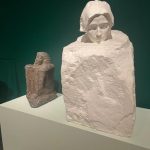
Contributed by Sharon Butler / Walter Robinson played an important role in the New York art scene for over five decades, and on Sunday, February 9, he passed away at his New York home. A piece in Artnet reported that the cause was liver cancer. Walter loved artists and the art world, and he believed that anyone could have a piece of it. You want to be a writer? Go ahead and write. You want to have a gallery? Open one. You want to be a painter? Paint. He was a hub of that world and never seemed to lose interest in the wild schemes…
Latest articles
Everything Turns Away Quite Leisurely
Contributed by Rebecca Chace / It’s 5:40 AM in New York and 12:40 PM in Palestine on August 10, 2024. I run back and forth inside my dark Brooklyn apartment, barefoot in a T-shirt and underpants. The workshop I’m leading for teachers in the West Bank begins in twenty minutes and my internet is down. Unplug the router; count to ten; plug it back in. I’m the one who’s supposed to have good internet. I have hot water, air conditioning, access to health care, and a well-stocked bodega on the corner. I lead workshops for the Institute for Writing and Thinking at Bard College, which has partnered with Al Quds University for sixteen years. When Ibrahim, the soft-spoken director of the program for first-year students, reached out to schedule their annual faculty training sessions, we assumed he meant the workshops would take place on Zoom, not in-person.
Aaron Michael Skolnick: How heartbreakingly silly we are
Contributed by Nancy Friedland / I don’t remember exactly when I first came across the work of Aaron Michael Skolnick, but I do remember the feeling. Confronted by landscapes so filled with love and loss, I wondered how a painting of light in a forest could express so much. When the gorgeous images from his most recent project – face mash-ups of Aaron and famous, sometimes funny, often tragic characters – started to pop up in my feed, I needed to know more. I searched to see what was out there about Aaron’s show “The Entertainer,” currently up at MARCH Gallery in the East Village, and found nothing to satisfy my curiosity. As I began to dig into the work myself, I quickly realized that it had tentacles that wrapped around every aspect of the artist’s life. There were the paintings, yes, beautifully wrought, deftly painted, of course, but there was also an installation, photography, and performance. The work was so layered and complex that I felt the need to reach out directly to Aaron to ask him what it was all about. Last week, I picked up the phone and tried to uncoil some of those tentacles and make sense of a complex, brave, and very funny new body of work.
Call it Orphism
Contributed by Adam Simon / At a Four Walls event in Brooklyn in the early 1990s, Erik Oppenheim, at that time a young artist, stood up and said, “I’m starting an art movement. Anyone who wants to join, meet me in the back after the show.” It was a hilarious and audacious gesture, in part because no one joins an art movement on a whim, like a list-serve or an exercise class, but also because there hadn’t been any artist-initiated movements for a very long time. They proliferated in the late nineteenth and early twentieth century with the advent of Impressionism, Surrealism, Futurism, and Dada, and enjoyed something of a resurgence in the 1960s with Fluxus in the United States, Supports/Surfaces and Zero in Europe, and the Gutai Group in Japan. Most of what we consider movements were proclaimed by an outside observer, usually a critic or curator, looking to group artists who had similar concerns and made work that fit the designation. For the artists themselves to rally around a specific cause, even an aesthetic one, was not required.
Fergus Feehily: The Horse and The Rider
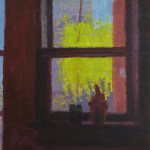
Contributed by Joe Fyfe / Fergus Feehily, who is from Ireland but has lived in Berlin for years, is an unusual contemporary visual artist by virtue of his very careful degree of quiet obliquity. One almost hesitates to approach writing about him and, in this case, writing about his writing. It might be best to get the disclaimers over with: we share gallery representation in Köln, from Galerie Christian Lethert. He recommended me to the gallery, though at the time, long ago, I had never heard of him nor his work. I have since met him a few times. Once we had breakfast at Balthazar in New York and I remember how thoroughly he buttered and spread preserves on two sizable croissants. Feehily is somehow obscure but in plain sight, admired among an informed coterie of artists and collectors and an avid sharer. He does a lot of communicating. He posts on Instagram often, mostly very different kinds of artworks, though he appears to have something of a penchant for religious art. On his website are long year-end lists, an annī of enthusiasms for what he has read and listened to and looked at, whom he has met and spoken with.
Donna Moylan’s egalitarian eclecticism
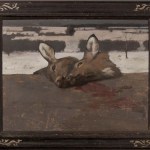
Contributed by Elizabeth Johnson / “Recent Paintings,” Donna Moylan’s first exhibition at Bookstein Projects, collects works finished over the last year in her Kinderhook studio. In our email conversation, Moylan said that “sometimes paintings take years, as if they had to go off and think.” In addition to making paintings that carry time in the process of their production, she forgoes committing to a serial style, allowing her paintings to differ drastically from one to the next. “When I started doing that, in the nineteen-eighties,” she wrote, “I understood that what I wanted was to equalize, or make equivalent, many different styles of painting, and to refer to different cultures or eras with specificity but without differentiation or emphasis, without focusing on ‘styles.’” She has achieved this goal with considerable aplomb.
Studio Visit: Robert Armstrong’s uncanny cohesiveness
Contributed by Jonathan Stevenson / When the distinguished contemporary Irish painter Robert Armstrong first occupied his space on the third floor of Temple Bar Studios in Dublin 40 years ago, as a co-founder of the complex, the area was subdued and undeveloped, like Soho in the 1970s or Tribeca in the 1980s. Now his studio overlooks a bustling courtyard in what has become a magnet for visitors to the city. In turn, Armstrong himself seems to embrace Ireland’s deep and introverted rootedness as well as its exalted and extroverted role in Western culture while also reaching liberally into other worlds – he has traveled all over, with art in mind, and eagerly plumbed art history – in fluid and delicately gestural canvases that at once fasten onto familiar visual tropes and depart for murkier and more speculative realms. How he manages this tension is, by general description, unsurprising: he makes resolutely abstract paintings that remain firmly underpinned by landscape in line and allusion. He strikes this balance, easier said than done, and even more remarkably sustains it, reflecting a thorough but unobtrusive understanding that, as Colm Toibin puts it in an eloquent essay for a book of Armstrong’s work, “nothing … is free of association.”
Andrew Mer: All things obscure and oblique
Contributed by Amanda Church / What do we not see every day even when we are looking? Andrew Mer, aka @bigfusss on Instagram (where these photographs were first discovered), considers the question in his current show “Agog” – the filmmaker’s first exhibition of photography since moving to New York 30 years ago – at Mitchell Algus Gallery. The show consists of thirty 14 x 11-inch digital prints, shot on an iPhone starting in 2020, in editions of five with two artist’s proofs. The spontaneous photos of street scenes are in one sense classic Instagram moments, evanescent and transient. At the same time, they capture the so-easy-to-overlook minutiae of urban existence in precise compositions.
NYC Selected Gallery Guide, February 2025
Contributed by Sharon Butler / It’s February, we’re two weeks into the first hundred days, and your head, like mine, may be spinning. Take your mind off the world for a minute. Be grateful for the good things in your life, maybe figure out how to help where help is needed. A little light could emerge from the February shows. “La Banda” gets back together at Tappeto Volante Projects. Platform Project Space reopens from their winter break with a big group show called “New Life,” curated by Alexi Worth and Danica Lundy. Rumor is that it involves paintings of babies. Maybe it’s time to see a show at Halsey McKay Gallery HMGP in Greenpoint, where Timothy Bergstrom’s work is on view. Then let’s all go buy a canister of pepper spray and sign up for a self-defense class.
Hudson Valley (+vicinity) Selected Gallery Guide: February 2025
Contributed by Karlyn Benson / It’s been a rough few weeks on many levels, from the fires in Los Angeles to the drastic policy changes taking place in Washington. It can be hard to stay focused and motivated. If you need to feel uplifted and inspired, I urge you to visit a gallery or museum this weekend. There are dozens of exciting shows to see and new spaces to visit, including The International Museum of Dinnerware Design and the HoloCenter located around the corner from the newly reopened Center for Photography (CPW) in Kingston. One of my favorite things about the Hudson Valley…
Drew Shiflett and Carter Hodgkin on the creative process
Contributed by Riad Miah / In conjunction with their two-person exhibition, The Shape of Things, at the John Molloy Gallery, I had the opportunity to engage in a conversation with artists Drew Shiflett and Carter Hodgkin about their materials and unusual creative processes. At first, their pairing seemed unexpected, as their visual languages appeared quite distinct. However, after seeing the exhibition firsthand, I came to appreciate the deep connections and underlying commonalities in their work.
Theresa Daddezio: A pinball wizard’s aesthetic order
Contributed by Jason Andrew / In her new paintings in “Bloom” at DC Moore Gallery, Theresa Daddezio suggests an ornate elegance structured by a quirky sense of pinball-wizardry. Playful and lighthearted, each of the sixteen paintings in this packed show offers a vibrant world of color and fluid forms, simulating the visual experience of a flashy arcade. The paintings are spatially dense and lyrically conceived. Their all-over purity might tie her work to aesthetic movements like Neo-Plasticism. Indeed, her work, in Mondrian’s terms, expresses the “aesthetically purified” and ignores “the particulars of appearance.” Yet it also embodies a fantasized complexity that affords the paintings a dynamic arc. Daddezio has certainly found her cipher – an algorithm defined by petal-like structures, collaged color gradations, and zig-zagging linear forms.
Jen Mazza’s narrative interplay
Contributed by Michael Brennan / “Vicissitudes of Nature” is the magisterial title of Jen Mazza’s first solo exhibition with Ulterior Gallery, and, given the calamitous start of 2025, her Cassandra-like premonitions could hardly be any timelier. Nearly two dozen paintings and works on paper occupy the top floor of the tin-tiled, pitched-ceilinged space. Deftly and seamlessly, Mazza uses a variety of techniques and strategies, appropriating images from multiple sources. The idea is to conflate them with important cultural signifiers while recontextualizing them into new narratives of interiority, as, say, Virginia Woolf did in her contemplation of “the waves” in her eponymous novel, quoted in the show.
Deirdre Frost: Windows on the world
Contributed by Sharon Butler / Deirdre Frost’s multifaceted paintings, on display in her solo show “Tumbling Earth” at Kevin Kavanagh Gallery in Dublin, exude an edgy, futuristic energy you’d glean from a David Lynch movie, in which teal curtains and magenta skies feel oddly familiar yet distinctly foreign. Frost, who is based in Cork, challenges us to reconsider what home might look like when the distinction between indoor and outdoor no longer held. Her world could be the one that emerged after some kind of apocalypse, in the wake of civilization, viewed furtively, perhaps from caves.
Cyrilla Mozenter: The quieting of industrial material
Contributed by Michael Brennan / To my mind, the cultivation of art is mainly about making distinctions, and Cyrilla Mozenter’s solo show “Problems of Art” at 57W57 Arts hits that mark. She is essentially a sculptor – and a great one – in that she makes beautiful objects. Much as I admire her approach to volume, though, it’s her novel transformation of drawing into predominantly felt sculpture – decisive cuts made with sewing shears, silk whipstitching like super-sutures – that generates the greatest sense of adventure.