

Contributed by Katarina Wong / In the heat of summer, “Curvilinear Abstraction” at McKenzie Fine Art is a bracing group show that takes the viewer on a journey by turns lyrical, cosmic, regenerative, and intimate, calling on the imagination as much as formal appreciation.
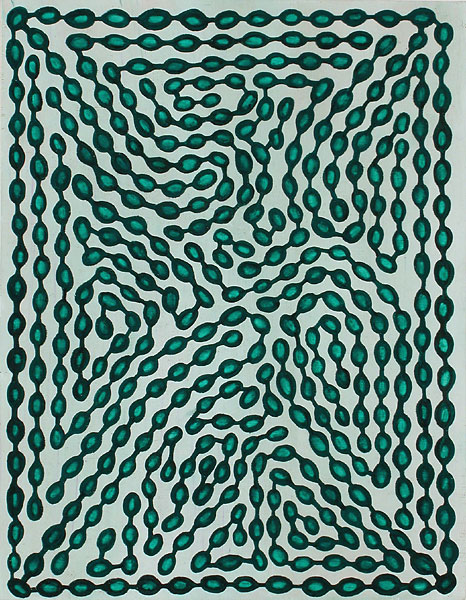
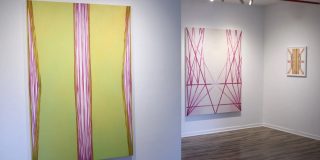
Lori Ellison once wrote about her work, “Proportion based on the lyric, not the epic – that is where the juice lives.” Now, ten years after her passing, those words echo in the two paintings of hers included in the show, one featuring undulating lines of leaf-like shapes, the other a repetition of purple arches against a lilac background. Reprieves from any narrative, they create an opportunity to ease into a wordless, lilting visual logic.
Ellison’s remark could apply to many of the artists in the show. Nancy Blum’s two Large Cloud drawings are inspired by Tibetan thangka paintings and her own spiritual practice. Clouds are often used in Buddhism as a metaphor for the impermanence of thoughts and emotions, and here arise as swirling colors set against the blackness of the paper itself, inviting notice of what is fleeting.

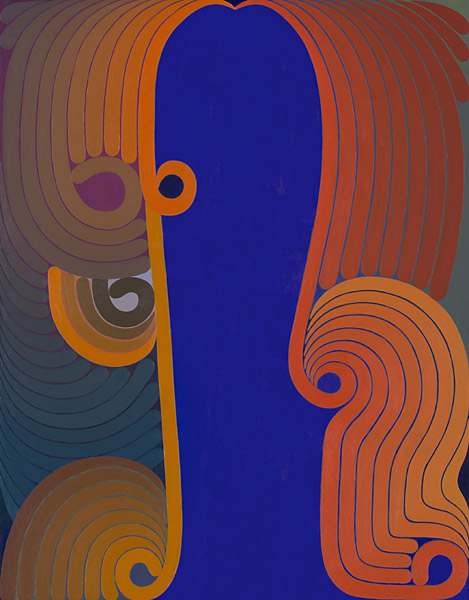
Maureen McQuillan, long on the McKenzie roster, creates pulsing ribbons of color suspended in polymer, each wavy line more like light than matter. Jenny Kemp uses patterns of gradation to generate visual rhythms. In Middle Part, for example, she arranges shades of blues, ochres, and oranges in mysterious, primal forms. The vibrant colors seem to hum as they curve around one another.

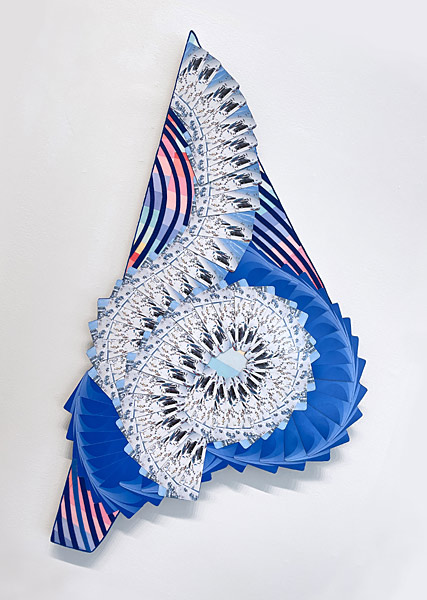
In a different vein, Sky Pape’s shimmering mandalas, Katia Santibañez’s fractal-like expansions, and Lisa Hoke’s spiraling constructions of felt and playing cards feel like gestures vaulting out to the cosmos.

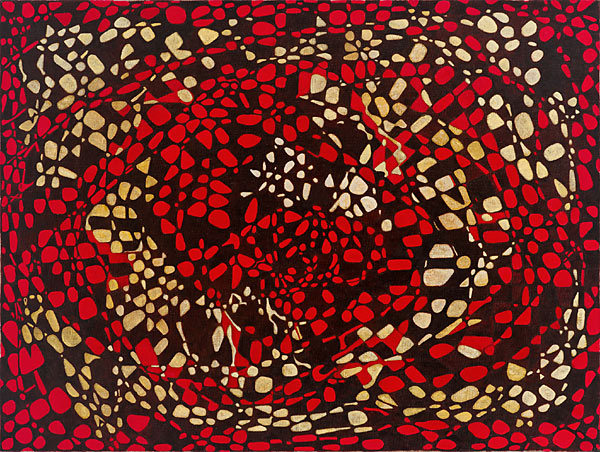
Tripping the light fantastic, Sarah Walker’s paintings blossom so insistently that you can feel the tension as their organic shapes fill and push against their 12-by-12-inch boundaries. The surfaces appear painted, scraped down, then repainted, in a kind of dance between the ordinary and the psychedelic in the original sense of “mind manifesting.” As Walker asks: “How does the mind consolidate an image or object that combines the physical, personal, spatial and virtual?”
Pauline Galiana and Mery Lynn McCorkle make very different work, but share a deep sense of environmental responsibility, one that recalls the Buddhist teacher Joanna Macy’s “Great Turning” towards a more sustainable means of living. Galiana meticulously loops small fragments of shredded paper – from envelopes, notes, old artwork, and the like – into delicate and deliberate circular shapes, building a novel relationship with the quotidian.

McCorkle, reluctant to add to an already object-laden world, recycles old work and uses only art supplies she already has. Her triptych Strange Fruit is painted over earlier work, with bits and pieces of the originals peeking through. Inspired by Billie Holiday’s song about lynching, it suggests both dark undercurrents and a resilient, regenerative world.

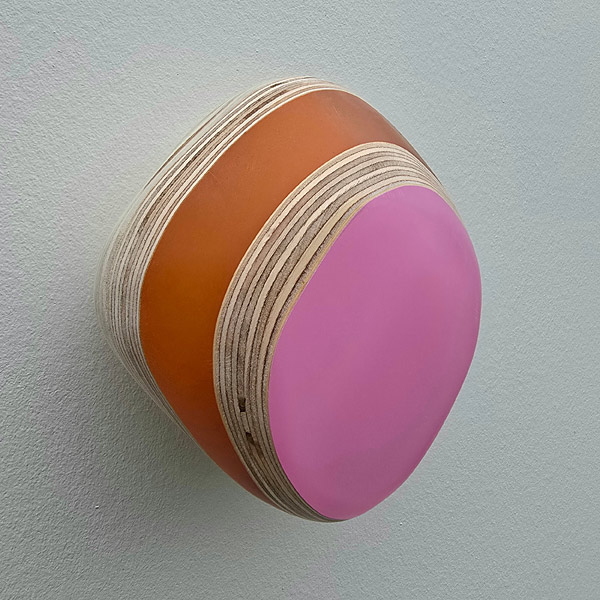
A curve, of course, can be sexy and even intimate. Michelle Benoit’s quiet sculptures beg to be held. Each could fit in one’s hand yet feel like an entire expanding world unto itself. The soft curves of the shape, the gentle striations of the light wood, and the sanded Lucite produce colors that seem lit from within and relax the viewer. When you look into these small, glowing sculptures, everything else seems to drop away.
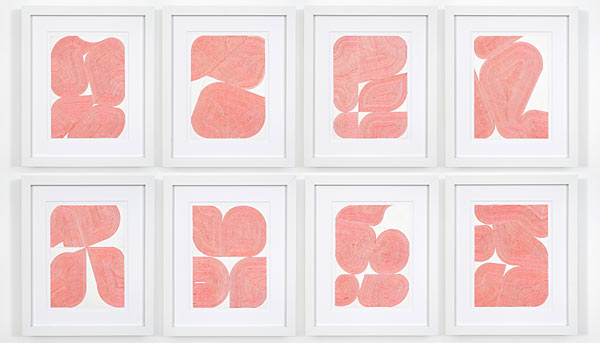
Likewise, Jessica Deane Rosner’s piece, composed of eight red ink drawings, has an intimacy that draws you close. Plump forms challenge the smallness of the paper, revealing the ambition and limitations of the artist’s own flesh: her obsessive mark-making, the delicate wavering of her hand. Each panel may be an experiment, but together they are a declaration of existence – the artist’s, the artwork’s, and the viewer’s.
“Curvilinear Abstraction” is a deeply satisfying show, embracing a superficially straightforward theme expansively, through a generous range of literal and metaphorical twists and turns. It calls to mind Rainer Maria Rilke’s Book of Hours, in which he wrote: “I live my life in widening circles that reach out across the world.” This show invites viewers to consider the richness of a curving gesture, line, or shape, widening their own circles of perception.

“Curvilinear Abstraction,” McKenzie Fine Art, 55 Orchard Street, New York, NY. Through August 15, 2025. Artists: Michelle Benoit, Nancy Blum, Lori Ellison (1958–2015), Pauline Galiana, Lisa Hoke, Jenny Kemp, Mery Lynn McCorkle, Maureen McQuillan, Sky Pape, Jessica Deane Rosner, Katia Santibañez, and Sarah Walker.
About the author: Katarina Wong is an artist and the author of Three Threads, a weekly newsletter that uses art to explore personal creativity.








Of course it is more than coincidence that these artists are women!
This is part of a very large movement happening now toward more lyric painting.
The curve rather than the slash, the curve rather than obsessive right angles…
Hundertwasser claimed that the preponderance of right angles rather than curves
in architecture is indicative of mental and spiritual imbalance.
The Ellison quote is definitely going in the archives.
Lovely selection!