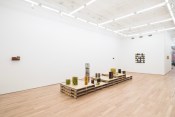
Contributed by Matthew Logsdon / Upon entering “Leech,” Kari Cholnoky’s third solo exhibition at Nicelle Beauchene Gallery, one of the first sculptures encountered is Conservation of Mass, a cranial-like form of smooth, peach-colored alabaster atop a steel pedestal. It is vertically symmetrical, with the most protruding elements centered like noses, creating a ribbed topography of ridges and recesses that suggest a face. The casual viewer is afforded just enough space between the sculpture and the wall to peek around the back of the piece but not enough to see it from eye level. An especially bold and engaged visitor, though, would find a wisdom tooth resting within a fleshy cavity. Is this the physical record of bodily alteration? Part of a strategy of removing superfluous body parts? Conservation of Mass embodies mortal life: confrontation, cat and mouse, meat and bone. There’s acknowledgment that sometimes something needs to be cut out to salvage the whole.
Tag: Nicelle Beauchene Gallery
Eleanor Ray: The power of the small
Contributed by Michael Brennan / Many conceptualists, favoring the unconstrained and expansive, balk at the representation or framing of any experience as image. Long after he abandoned painting, the late installation artist Robert Irwin likened it to a mere “keyhole” of perception. In Zen and the Art of Motorcycle Maintenance, Robert Pirsig declared that compartmentalizing experience for viewing made you “a passive observer” for whom “it’s all moving by you boringly in a frame.” Yet surely not every living experience has to be as open-ended as a motorcycle racing across salt flats. While a painting can never capture the full immensity of life, with adequate perception and economy of means – say, Luke Howard’s vision of the sky realized in paper and watercolor – even a diminutive one can provide a meaningful distillation of experience. The paintings of Eleanor Ray, now on display in her third solo show at Nicelle Beauchene Gallery, constitute abundant evidence.
Lucy Puls: Meaning in obsolescence
Contributed by Talia Shiroma / Pink teddy bears, plastic ponies, and the blank face of a Mac 512 computer peer out from blocks of amber murk. They are among the discarded goods on display at Nicelle Beauchene Gallery as part of Berkeley-based artist Lucy Puls’s solo show, spanning works created between 1989 and 2003. For the series In Resin, which she began in the early nineties, Puls amassed secondhand items from thrift shops and encased them in translucent resin prisms. Ranging from a BB gun to records, these once-coveted objects now register as curiously impotent, floating in their chambers like specimens in jars. Although they are up for sale once more, the encased objects feel unobtainable, as if quarantined from both time and human desire.