Contributed by Jonathan Stevenson / In the Marshall Tucker Band’s road classic “24 Hours at a Time,” the driver’s been down around Houston, but feels compelled to keep his wheels rolling. If you like art, though, Houston, Texas, is no place to blow through heedlessly or in too much of a hurry. Its art community is remarkably rich and somewhat dispersed, and rewards purposeful meandering rather than surgical strikes. Still, I only had a couple of days. A sensible strategy was to start at the Menil complex, located in a serene, unobtrusive neighborhood in the heart of the city, and fan out. The main collection, keynoted by Houston painter Dorothy Hood’s formidably portentous 1970 painting Clouds, currently features an incisive and intensive Terry Winters show, “Vitalized Geometry,” and a bracing array of surrealist work, opening with a tight Max Ernst room that coyly opens up to much more.
Tag: Martha Tuttle
Marina Adams: Patches of sun in a shadowy world
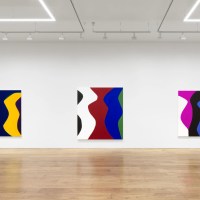
Contributed by Amanda Church / Marina Adams has long been exploring the range of allusions that can be conjured by various color combinations and the scale and placement of simple shapes, which press up and vibrate against each other in subtle, sexy ways. Curvy configurations, interspersed with diamonds and triangles, hint at myriad aspects of nature and the female form. In Adams’ current show “Cosmic Repair” at Timothy Taylor, variations on this trajectory continue in nine paintings, all new and acrylic on linen except Singing to the Highest Deity from 2020 hanging by itself in the back room. Influences range from Matisse to, according to the press release, “Uzbek textiles, Indigenous American Southwest pottery, and the Great Pyramids.”
Theresa Daddezio: A pinball wizard’s aesthetic order
Contributed by Jason Andrew / In her new paintings in “Bloom” at DC Moore Gallery, Theresa Daddezio suggests an ornate elegance structured by a quirky sense of pinball-wizardry. Playful and lighthearted, each of the sixteen paintings in this packed show offers a vibrant world of color and fluid forms, simulating the visual experience of a flashy arcade. The paintings are spatially dense and lyrically conceived. Their all-over purity might tie her work to aesthetic movements like Neo-Plasticism. Indeed, her work, in Mondrian’s terms, expresses the “aesthetically purified” and ignores “the particulars of appearance.” Yet it also embodies a fantasized complexity that affords the paintings a dynamic arc. Daddezio has certainly found her cipher – an algorithm defined by petal-like structures, collaged color gradations, and zig-zagging linear forms.