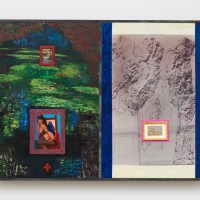
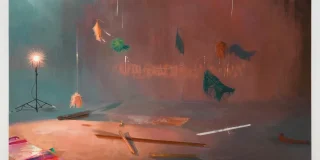
Contributed by Adam Simon / Paul Gardère (1944–2011), whose work is now on view in “Second Nature” at Magenta Plains, is known for a unique version of combine paintings, incorporating assemblage, found objects, photography, dirt and glitter into works that critique the legacy of colonialism in Haiti and its diaspora. The problem with this narrative is that it undersells how formally innovative his work was in its time, the degree to which it stems from his own biography, and how it anticipated our current multi-screen reality.
Tag: Magenta Plains
Tina Girouard: In the realm of the possible
Contributed by Adam Simon / At some point, my IG algorithm sent me a clip of Brian Eno talking about how the term ‘genius’ should be replaced with ‘scenius’ because no artist works in a vacuum. Artists all come from some version of a scene, however small. Perhaps no one illustrates this better than Tina Girouard, who died in 2020 and whose work can currently be seen in NYC at two galleries, Magenta Plains and Anat Egbi, and at the Center for Art, Research and Alliances (CARA). During the 1970s, Girouard was instrumental in founding 112 Greene Street…
Dan Dowd and the folds of memory
Contributed by Mark Wethli / As I viewed Dan Dowd’s intimate and poetic work, now at Magenta Plains, I considered our inclination to cathect feelings and memories onto objects. Clothing in particular echoes the shapes of our bodies; touches them; connotes gender, time, and economic status; and absorbs everything from our scent to our DNA. Dowd creates small, iconic assemblages out of found materials, including fragments of inner tubes, clothing, rags, and home décor.
Jane Swavely and the Bowery tradition
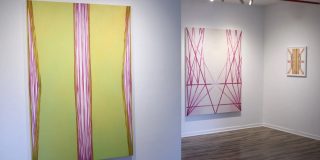
Contributed by Michael Brennan / Magenta Plains is located on the Bowery, just as it breaks left onto Canal Street, in Chinatown. Upon entering, viewers are immediately greeted by a washy terre verte Jane Swavely painting, OID #3 Green, hanging above the desk. It sets an organic tone and is indicative of the half-dozen paintings to follow, hanging in the first-floor main gallery. Swavely’s seven canvases are all vertical, and are mostly diptychs, internalized or externalized. They are loosely painted with a 2- to 2 ½-inch flat brush, heavy on the solvent, with some wiping away by hand. Much color mixing happens directly on the surface. Swavely favors flared, phosphorescent hues. She cleverly manipulates paint with rags to create the illusion of light emitting from the ground. Her work glows, appearing backlit.
Don Dudley’s pure authenticity
Contributed by Adam Simon / Don Dudley’s minimalism has always had a West Coast flavor, more concerned with perception than objecthood. Like many artists of his generation, he has steered clear of expressionism, or anything that shifted attention from the object to the artist. His focus has been on the purely visual.
Memento Vivere: Danica Lundy at Magenta Plains
Contributed by Margaret McCann / Like a strobe light gifted with consciousness, Danica Lundy lets whatever she sees point a way through a painting. The six works in �Three Hole Punch� at Magenta Plains are informed by memories of soccer practice, parties, school, and more � themes that function mainly as armatures for corporeal drama and mesmerizing painting detail.