

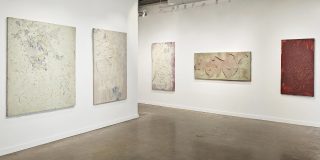
Contributed by Doug Milford / Good art can have multiple sources of meaning – material, color, scale, intention, chance, change, process, metaphor, ontology, epistemology, philosophy, biography, zeitgeist, history, and more. These may or may not be apparent or even deliberate, but they make up the work’s internal structure and shape its style. Ideally, though certainly not always, these influences operate in concert while remaining distinct. The nine works in Claudia Parducci’s exhibition “Blue”, at Ochi Gallery in Los Angeles in February and March, achieve this balance, both as individual pieces and as an ensemble. The six years that had passed since her previous show included a three-year hiatus from painting after the death of her husband, the artist Peter Alexander, in 2020. This body of work was a response to his passing.
Among the studio materials Alexander left behind were sawhorses, mid-size canvases, and boxes of blue pastels, all of which became the material of the exhibition. “I didn’t want to give them away,” she recalled in an interview for the show. “I felt like I had to use them up to move forward in my practice and get back to my own work. In the process of using up his pastels initially I was just scribbling to use them all up and I started noticing how much of the pastel dust doesn’t stick to the paper and I began trying to catch the falling dust.” The process, she continued, “was poignant to me — the transition of this pastel from a stick to a bunch of powder and the idea of trying to recycle that … began to seem to me like a really wonderful way to document impermanence and change and chance.”


Specially for this series, Parducci developed a process involving multiple paper or canvas panels. She scribbled with a pastel urgently and completely over the surface of the top panel, generating a rain of pastel dust that fell onto the bottom panel or panels, which she had brushed beforehand with an adhesive medium that caught the dust — a creation by accretion. She repeated these actions and conditions for each work, establishing a dynamic but orderly style that simulated naturally occurring phenomena such as water condensing on a window or waves lapping a sandy shore, enlisting both the physical phenomenon of gravity and the spiritual one of acceptance. Installed in the rectangular gallery, the works were “sanctuaried” from art history and current trends alike to tell an entirely personal story. Instead of beckoning critical attention or reaching for allusions, they simply embodied a reverence for life and death and encapsulated the artist’s own death-and-separation narrative.
Parducci’s bifurcated hands-on/hands-off process entailed embracing chance in the service of conjuring uniqueness and a personal touch. While this approach can undermine any provisional “plan” for the artwork that the artist may have, precisely such “failure” can also yield aesthetic success. Black & Blue 4 (Combine), the piece with the largest expanse of blue, incorporates a random mustard-colored drip from a leak in Parducci’s studio roof that lends it just-so panache. In Black & Blue 7 (Combine), the lower catchment panel is enlivened by flat, centimeter-wide clumps of pastel that somehow coagulated in the sticky medium. Black & Blue 6 (Combine) got a bit splashed, as her studio hosts two lively dogs. The contingent zing reflects the acceptance of accidents that marks the series as an acutely personal elegy, without resort to external standards.


67 x 28 x 10 inches

The ultramarine blue pastel color that dominated the show was Alexander’s favorite, which is why Parducci was left with so many of those pastels. It’s an important color for many artists, including Van Gogh, Matisse, Picasso, Yves Klein, Miles Davis, Elvis, Bob Dylan, Joni Mitchell, and Joan Didion, among others. While orange cautions, green is nature, yellow yields, and red halts, blue beckons and consoles. It’s the color of the sky and the sea, that of Earth seen from space, and, according to surveys, the world’s favorite color. Maybe this is why blue has a calming effect in therapy and healing. Blue is the color of the fourth chakra, which, according to yoga philosophy and traditional East-Indian medicine, is the one of the seven energy centers in the human body, residing in the throat and considered a source of change and forgiveness. But blue is also the color of melancholy, even depression. All these associations cater to the quiet conversation with Alexander that Parducci had in mind in creating the work for the show.
Decidedly unironic and reference-free, the work invites the viewer’s respect and sincerity. In its Minimalist elegance and intimate provenance, it’s sublime in the Burkean romantic sense, whereby the specter of death enhances beauty, which is born of the heart rather than the brain, outside the narrative trajectory of other work, and now resting in peace.
“Claudia Parducci: Blue,” Ochi, 605 N. Western Avenue, Los Angeles, CA. February 18–March 29, 2025.
About the author: Doug Milford was an owner and director of Piezo Electric and Milford Galleries, founder of Artnet magazine, and managing partner of Artsystems. He is currently a writer and photographer who lives in Woodstock, New York.





Beautiful Doug. Good job.
Chris