Tag: Agnes Pelton

Solo Shows

Polly Shindler’s natural reverie

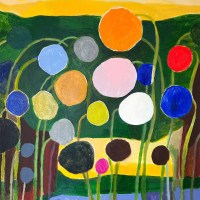
Contributed by Lawre Stone / Known for painting interior spaces and domestic objects, Polly Shindler shifts her subject to the rural Hudson Valley landscape for her exhibition “Valley Music” at Deanna Evans Projects. Images of mountains, flowers, and fields hang in sequence on the walls, like a roll of snapshots taken from the car window. Shindler’s paintings do speak to the compulsion to pull over to the side of the road, take out the phone, and hope to capture the elusive, astonishing beauty of nature. Complementing the landscapes are larger, close-up paintings combining flower heads, stems, and leaves with abstract elements. Schindler’s flowers grow from the ground, with wispy stems and simplified blooms reaching for otherworldly skies. Painting in a full Crayola color array, she plumbs the sublimeness available every day.
Solo Shows

Nancy Evans: Cosmic absorption

Contributed by Mary Jones / One of many pleasures in “Mashups,” Nancy Evans’s show at Sargent’s Daughters, is the sensation of immersive color. Eight abstract paintings, all 26 x 20 inches, reverberate softly with veils of translucent gradients and undulating organic form. The work is grounded in American Modernism, and a baseline of particular influences come to mind: Arthur Dove, Georgia O’Keefe, Charles Burchfield, and, as a watercolorist, Helen Frankenthaler. But Evans finds her own domain through a mediated technical process that generates luminous depth.

Solo Shows

Theresa Daddezio: A pinball wizard’s aesthetic order

Contributed by Jason Andrew / In her new paintings in “Bloom” at DC Moore Gallery, Theresa Daddezio suggests an ornate elegance structured by a quirky sense of pinball-wizardry. Playful and lighthearted, each of the sixteen paintings in this packed show offers a vibrant world of color and fluid forms, simulating the visual experience of a flashy arcade. The paintings are spatially dense and lyrically conceived. Their all-over purity might tie her work to aesthetic movements like Neo-Plasticism. Indeed, her work, in Mondrian’s terms, expresses the “aesthetically purified” and ignores “the particulars of appearance.” Yet it also embodies a fantasized complexity that affords the paintings a dynamic arc. Daddezio has certainly found her cipher – an algorithm defined by petal-like structures, collaged color gradations, and zig-zagging linear forms.