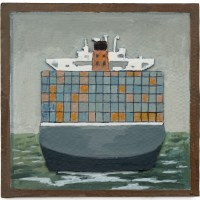
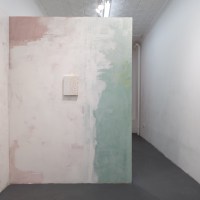
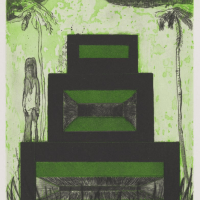
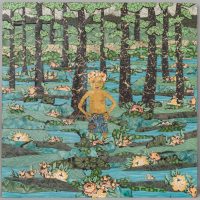
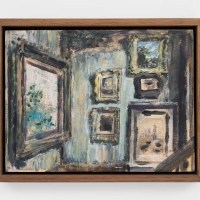
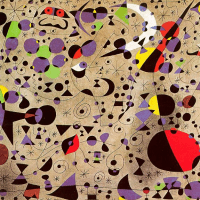
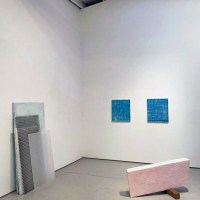
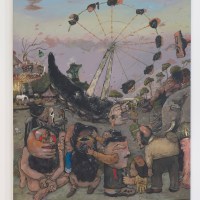
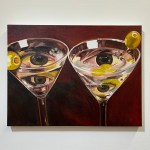
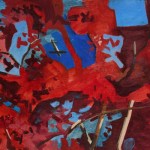
Contributed by Amanda Church / In his exhibition of similarly sized small-scale paintings titled “Sky,” now up at Marinaro, Ridley Howard applies his usual paint-handling panache to celestial expanses of blue. The surfaces are flawless and smooth, as are the porcelain faces of the women he depicts. The skies’ shades vary, and clouds make an occasional appearance, but there’s a pervasive sense of clarity and tranquility punctuated by partial views of treetops, cocktails, and impassive female faces. The usually stark tableaux sometimes border on the surreal. Howard’s Summer Moon, for instance, echoes Magritte’s The Banquet, minus the figure.
Latest articles
Michele Abramowitz’s improbable terrain
Contributed by Suzanne Joelson / I needed to write about Michele Abramowitz to understand the uncanny allure of her paintings, now on view at Kate Werble Gallery. She brings life, or something like it, to familiar conventions. Shifts in figure and ground trick the eye as it negotiates improbable terrain, that looks more like a dream than a product of twentieth-century formalism. Resemblances abound, shift, dissolve, mimic, repeat. Each painting is at once assuring and destabilizing.
Frank Webster: Travels in Austurland
The following are excerpts from the journal and sketchbooks Frank Webster kept when he visited the Vatnajökull ice cap region in Iceland last August.
Lexia Hachtmann’s surreal humanism
Contributed by Chunbum Park / The title of British-German painter Lexia Hachtmann’s solo exhibition “Waiting Room,” at YveYANG in Soho, alludes to David Lynch’s surrealist television series Twin Peaks, in which the “red room” or “waiting room” is an extradimensional space where time does not flow sequentially. The program ushered in the 1990s, when Hachtmann was born. In the moment, the nineties seemed to be the height of the American Century and still evoke nostalgia. Often overlooked is the fact that during this supposedly halcyon epoch, popular culture normalized homophobia, sexism, and racism more than it does now, even when Trumpist backsliding is taken into account. Hachtmann confronts this kind of slippage between memory and reality with subtlety and heart.
Jacqueline Gourevitch: Skying abstraction
Contributed by Jason Andrew / Jacqueline Gourevitch’s resilience stems from restraint and slow observation. From her first solo exhibition in 1958 to the current striking survey of 21 cloud paintings dating from 1965–2018 at Storage Gallery in Tribeca, the nonagenarian has shown that sustained attention to a single subject can yield infinite and dynamic variations.
Tommy White: Dark victory
Contributed by Jonathan Stevenson / Entering Tommy White’s cave-like Crown Heights studio, you’re struck by the fathomless matte black on his canvases, fate knocking at the door. It can serve both to seduce and to dare, drawing you in and pushing you out.
Two Coats Resident Artist Marie Thibeault, June 15–19
Contributed by Sharon Butler / From June 15 to 20, Two Coats of Paint will be hosting LA artist Marie Thibeault for her second residency. Marie has spent years immersed in the world of color and geometry, vividly translating the rigid language of architecture, the logic of technical data, and the unpredictable realm of human emotion onto the canvas. She explores the intersection of science and imagination in visual stories of environmental instability that incorporate references to scientific diagrams, predictive models, cartographic references, geological graphics, weather charts, and photographs. Although she employs abstraction to clear and substantial effect, she considers herself primarily a landscape painter and counts among her strongest influences Paul Cézanne, drawing especially on the dynamic horizontal planes of his work.
On the road: Remote and unexpected in the USA, 2025
Contributed by Kathryn Myers / Having retired after 40 years of teaching in the Department of Art and Art History at the University of Connecticut, I set out in my camper van in late December on the first of what I hope will be a series of annual winter road trips. On this inaugural journey, I decided to avoid larger cities and major highways, heading first to Arizona and California and then taking a month to meander home along the south and east coasts.
Nora Sturges’ sublime dystopia
Contributed by Mark Wethli / “Edgy” is a word we commonly use to describe daring or provocative art. If anything has been a measure of artistic success in the modern era, it’s been the degree to which new art pushes the boundaries of the work that came before. The term is usually rooted in the theoretical and formal aspects of art making, but the paintings of Nora Sturges – now on view at Sarah Bouchard Gallery in Woolwich, Maine – transport us to edges of another kind…
Bettina Blohm and Don Voisine: Affect as subject
Contributed by Adam Simon / Two galleries with a focus on abstract painting, a short walk from each other in downtown Manhattan, currently have exhibitions that share a vocabulary of basic geometric forms, directional brushwork, and an emphasis on color relationships. Both shows present the rectangle as a primary condition of most painting and the dynamic interplay of forms within the rectangle as a drama unfolding. Yet these two shows couldn’t be more different. Seeing one after the other, as I did, was a study of how affect itself, manifested through color choices and paint application, becomes a subject for abstract painting, analogous to but different from a subject for representational painting.
Art versus politics
Contributed by Laurie Fendrich / “Modern Art and Politics in Germany 1910-1945” an exhibition of more than 70 paintings and sculptures on loan from the Neue Nationalgalerie, Berlin to the Kimbell Museum in Fort Worth, runs on three tracks. The first carries the art, two-thirds of which has never before been seen in the United States. The second, via informative and well-written wall texts, follows political developments in Germany during three-and-a-half fraught decades. The third consists of the imaginations of museumgoers who, like me, can’t help but see similarities between Weimar Germany in the years leading up to Hitler’s rule and America during Trump’s rise and authoritarian presidency.
Ted Stamm’s conceptual adventurism
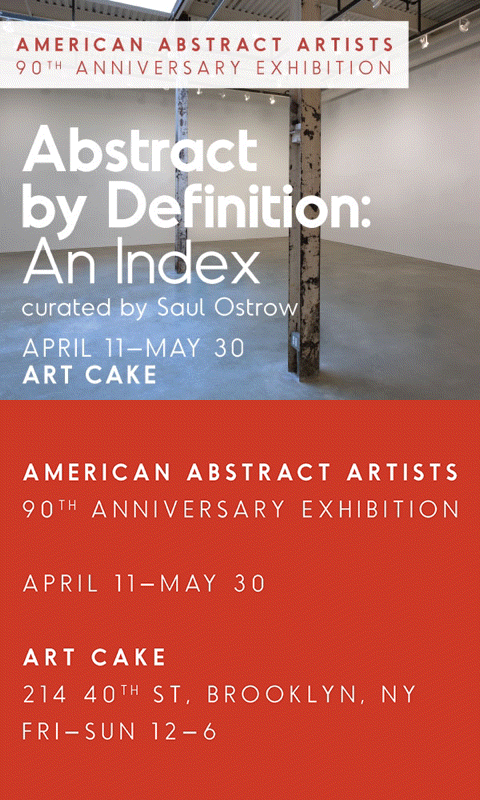
Contributed by Saul Ostrow / When Ted Stamm’s career was cut short by his death at age 39 in 1984, he had already begun to attract attention in the United States and internationally. Critics including Edit deAk, Peter Frank, Robert Morgan, and Kay Larson recognized Stamm’s ability to bridge formal rigor with playful urban references. In 1975, deAk wrote in Artforum that “Stamm’s work confounds its own apparent simplicity; the shape’s tense complexity and stubborn definition of itself make it totally the artist’s like an insignia. The color is equally personal, and the painting’s presence is quietly assertive. This is certainly not the elegant nihilism of reductive solutions.” Conceptual endeavors were central to his ambition of making the border between art and everyday life porous.
Two Coats Resident Artist Katie Butler, June 8–13
Contributed by Sharon Butler / Katie Butler (no relation to me as far as we know) creates vivid still life paintings that dive into the fraught realms of American politics and economics, riffing ironically on the “kitchen-table” and “bread-and-butter” issues affecting average people that political figures are supposed to address. While she establishes a journalistic sense of authenticity by sourcing her imagery from White House archives and the Ohio Statehouse, the discrepancy between reality and painted presentation raises burning questions about the veracity and integrity of the sources.
NYC Selected Gallery Guide: June, 2025
Contributed by Sharon Butler / June, academics’ favorite month, is here. I’m looking forward to checking out Smack Mellon’s“Remains to be seen,” a group show that brings together nine emerging artists whose practices find meaning in waste. Artist Austin Eddy has curated a star-studded exhibition called “A Movable Feast” at Halsey Mckay’s Greenpoint outpost. Abbey Lloyd has a solo at Ptolemy, a newish gallery in Queens. I’m looking forward to seeing some aggressive abstraction, with Iva Gueorguieva’s solo at Derek Eller and…
Meg Lipke and Jeff Williams: Enchantment without sublimation
Contributed by Ben Godward / Meg Lipke and Jeff Williams seem to dance through the fledgling Roundabouts Now Gallery – once a medical office conference room in an industrial park – in Kingston, New York. The central collaboration comprises a large sewn and stuffed canvas with ruin-like drawings enveloping three deliciously odd sculptural objects. This union casts a pervasive spell. Pushing the interior accretion forms further into the unreal are surfaces that appear to be made of dust or remnants of ashes. Spectral in their essence but protected in the upholstered pool, they look as if they could dissolve into a pile if touched.