Museum Exhibitions

Museum Exhibitions

LA PST Report: Toward better social behavior 

Contributed by Peter Plagens / The first edition of the Getty-sponsored “Pacific Standard Time” slate of exhibitions in 2011 was subtitled simply “Art in L.A., 1945 – 1980,” and it aimed to elucidate Southern California’s contribution to American postwar modern art. In 2017, the second iteration was called “LA/LA,” indicating the city’s Latin American art and artists. This time around PST has declared a more specific theme, “Art and Science Collide,” reminiscent of one of those noble Rose Parade rubrics…

Museum Exhibitions

Mildred Blount Hat Competition 2024: A showcase of artful headwear

Contributed by Rosetta Marantz Cohen / Who doesn’t love a hat? Whether you wear them yourself or simply admire them on others, it is hard to deny that a beautiful, handmade hat is a marvelous object. As with all aesthetic creations, where hats sit on the continuum between high art and craft, sculpture and practical headwear, depends on the intention of the hatmaker and the predisposition of the viewer. Certainly there’s an argument to be made for giving certain hats their due as museum-worthy objects. Museums have long displayed all manner of objects intended for wear, from designer shoes to lavish evening gowns. The special display of hats currently on view at The Gallery at the Met Store makes the case that hats constitute a unique blend of high art and commodity. Situated unabashedly inside the museum store, the show is perfectly candid about what it is: a thoroughly delightful inventory of beautiful and artful yet wearable things, with prices attached.

Museum Exhibitions

Dike Blair: The humanity of light

Contributed by David Whelan / The idea for the exhibition “Dike Blair: Matinee,” now at the Edward Hopper House, came from a discussion the artist had with curator Helen Molesworth in front of Edward Hopper’s 1938 painting New York, Movie. The picture is split in two: on the left a black-and-white film plays on a movie screen, and on the right a stairway leads away from the film, perhaps outside. In front of the stairway is a female usher, leaning languidly at the threshold, bathed in ambient light. The usher, the viewer, and possibly even Hopper himself stand at the boundary, resonating an ambivalence towards a life mediated by technology.

Museum Exhibitions

Paula Modersohn-Becker’s modern women

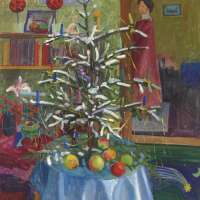
Contributed by Evangeline Riddiford Graham / It sounds suspiciously like Earth Mother art: big nudes, babies, and quite a lot of purple, all underpinned by the conviction that God is female and that the final, necessary stage in becoming a woman is to bear children. But something is off. The nudes are emotionally distant. Preoccupied by breastmilk, the babies show no sign of higher thought. The purple arrives as shadows that renders flesh regal and strange – the purple of 1906, not 1960. And the paintings are extremely good. “Ich Bin Ich / I Am Me,” now up at the Neue Galerie, is the first major US museum show of the paintings of Paula Modersohn-Becker (1876–1907).
Museum Exhibitions

New Spain’s inventive painters

Contributed by David Carrier / When the Metropolitan Museum of Art recently rehung its permanent European collection, the galleries devoted to Spanish art included an abundant selection of work from “New Spain,” as the vast Spanish empire was known during the colonial period. From 1521 to 1821, its territory included, among much more, what is now Mexico, Central America, and the US Southwest. Much of the art consisted of sacred baroque painting – arguably the first truly international art style. “Saints & Santos: Picturing the Holy in New Spain,” on view at the New Mexico Museum of Art, does it justice.

Museum Exhibitions Out of Town

Guillaume Lethière’s historical resonance

Contributed by David Carrier / Guillaume Lethière (1760–1832) was a very good French neoclassical painter. Respected and honored in the French art world, he served as director of the French Academy in Rome and was admired as a teacher. Consistent with this stature, the eponymous exhibition currently on view at The Clark Art Institute is robustly curated. In addition to abundantly contextualizing Lethière’s work, the exhibition materials document a life that embodied much of France’s complicated colonial history. 

Museum Exhibitions Out of Town

Christina Ramberg’s powerfully personal eroticism

Contributed by Laurie Fendrich / The erotically charged art of Chicago Imagist painter Christina Ramberg (1946–1995), whose retrospective is currently on view at the Art Institute of Chicago, aligns chronologically with the second-wave feminism of the 1970s and 80s. Today’s third-wave feminists (some say it’s now fourth-wave) frequently disparage that incarnation of the movement for privileging white women’s worries, and worse, for its obliviousness to institutional misogyny. Fortunately, Art Institute curators Mark Pascale and Thea Liberty Nichols don’t try to pigeonhole Ramberg’s work into that framework. Although she considered herself a feminist, an aggrieved one she was not. Her art was personal, not political, and it doesn’t fit neatly into standardized versions of feminism. Remarkably, the artist found a way to mix together sharp and provocative subject matter about women’s desires with a classical, pristine aesthetic.

Museum Exhibitions

What makes a good painting?

Contributed by David Carrier / What is the present state of painting? For as long as I have been writing art criticism, that question has been much discussed. Some critics have said painting was dead, perhaps to be replaced by Minimalist or conceptual art. Others have argued that because painting is an inherently bourgeois art form, it can continue only as long as it is politically tinged. The Milwaukee Art Museum’s show “50 Paintings” takes an essentially empirical approach to the question. Co-curators Margaret Andera and Michelle Grabner gathered mostly mid-sized recent paintings by artists well-known in the New York art world and demonstrated how varied and how good painting is today. There are abstractions by Peter Halley and Mary Heilmann, a landscape by April Gornik, and figurative paintings by Cecily Brown and Nicole Eisenman. It’s natural for a visiting critic to pick favorites. Mindful of the unhappy fate of Paris, whose judgment about which goddess was most beautiful triggered the Trojan War, I dare to name mine.

Museum Exhibitions Out of Town

Caroline Burton’s compelling in-betweenness

Contributed by Michael Brennan / I took the train to Trenton, New Jersey – TRENTON MAKES, THE WORLD TAKES, the old slogan goes – to see Caroline Burton’s painting exhibition “Way Finding” at the Riverside Gallery in the New Jersey State Museum, which also includes a freestanding library, planetarium, theater, a natural history exhibit, an indigenous peoples’ exhibit, and the obligatory outdoor Calder. The complex, originally designed by Frank Grad and Sons of Newark and constructed in 1965, is a classic example of the liberal utopian/modernist cultural center typically frowned upon these days. But I’m happy to report that the campus, self-contained like Lincoln Center, was teeming with visitors from all walks of life. It is very much a living museum, and ideal for Burton, a reconstructed modernist, who in fact depicts its architecture in some of the works on view.

Museum Exhibitions

Howard Hodgkin’s Indian court collection: enigmatic or just good?

Contributed by David Carrier / Some very successful artists are also collectors, and the art that artists collect can reveal or confirm something about their own work and social attitudes. For example, Edgar Degas’ abundant holdings included works by Édouard Manet, which shows that Degas elevated aesthetic qualities over political beliefs. Unsurprisingly, Pablo Picasso traded art with Henri Matisse. Given Picasso’s obsessive rivalry with the Frenchman, he must have enjoyed keeping score with his frenemy as well as infiltrating Matisse’s collection with his own work. What then are we to make of British painter Howard Hodgkin’s trove of Indian court paintings, now on view at the Metropolitan Museum of Art?

Museum Exhibitions

Emilio Vedova: Venice’s Abstract Expressionist

Contributed by David Carrier / Emilio Vedova (1919–2006), who lived and worked in Venice, was once aptly dubbed the Jackson Pollock of the barricades. Employing that American painter’s gestural technique, Vedova made political art. “Rivoluzione Vedova” – “Revolution Vedova” – is an appreciative retrospective of his work on the third floor of the spacious M9 Museum of the 20th Century in Mestre, a very short train ride from Venice.

Museum Exhibitions

Jammie Holmes’s urgent intimacy

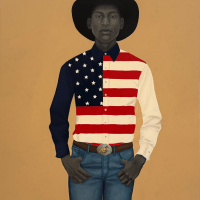
Contributed by D. Dominick Lombardi / Jammie Holmes, a self-taught painter born and raised in Thibodaux, Louisiana, now based in Dallas, is one of the artists currently featured in Marianne Boesky Gallery’s viewing rooms. “Make the Revolution Irresistible,” his first solo museum exhibition, is also up through November 26 at The Modern Art Museum of Fort Worth. I first came across a Holmes painting earlier this year at the Bruce Museum in Greenwich, Connecticut, as part of its exhibition “Then Is Now: Contemporary Black Art in America.” The show carried an explicit message about how little the opportunities for African Americans had advanced in the last 60 years, and how much worse things had gotten since 2016.

Museum Exhibitions

Ed Ruscha’s retro spective

Contributed by Laurie Fendrich / The work of the Los Angeles artist Ed Ruscha is often referred to as a West Coast version of Pop Art. The implication, of course, is that since it didn’t come out of New York, it must be inferior. His retrospective “Now Then,” his first at the Museum of Modern Art and first in New York since 1983, contains over 200 works from 1958 to the present. It includes paintings, drawings, prints, vitrines with selected self-produced photo-documentary books presented for our perusal, and some film (the Getty Research Institute owns a complete set of Ruscha’s artist’s books). The exhibition also includes the installation Chocolate Room, the walls of which are covered top to bottom with gridded sheets of paper silkscreened with chocolate syrup, recreated from its first iteration at the US pavilion in the 1970 Venice Biennale. Ruscha was also the American Biennale representative in 2017.

Museum Exhibitions

Jo Baer: Space, position, and light

Contributed by David Carrier / Five smallish early Jo Baer paintings are on display in one white- walled gallery at DIA Beacon in her exhibition there since 2022. The show is both tantalizing and exasperating. In the 1970s, Baer became famous as a minimalist painter. Then she left New York, published a manifesto in 1983 proclaiming “I am no longer an abstract artist,” and changed her style completely.

Museum Exhibitions

The real deal: James Brooks reconsidered

Contributed by Laurie Fendrich / “A Painting is a Real Thing,” the Parrish Museum’s current exhibition of the work of the Abstract Expressionist painter James Brooks (1906–1992), is his first comprehensive retrospective in 35 years. On the rare occasions I’ve encountered Brooks’s paintings, I’ve paid them scant attention. Like many, I have walked on by, presumptively ranking him well below the likes of Jackson Pollock, Willem de Kooning, and Mark Rothko. With this survey of more than 100 paintings, drawings, and prints, I find myself reconsidering Brooks’s status. With the 176-page catalog containing essays by adjunct curator Klaus Ottmann and artist-writer Michael Solomon, the show makes a case that Brooks’s art is more original and important – both within and beyond the context of the AbEx movement – than most of us thought.