

Contributed by Saul Ostrow / “A Decade: 2012–22” is the first show of Cora Cohen’s work since her death in 2023. It includes a broad range of her late paintings and drawings, which reflect what might perhaps be called her “formalism” – a term that when applied to Cohen, resists any terminal definition, promise of unity, or set of rules. Her 50-year career frustrates linear narration, but what remained consistent across her varied approaches to painting was an unwavering commitment to abstract painting as a process-driven pursuit. Unlike contemporaries who cultivated signature styles, Cohen never acceded to straightforward development or progressive refinement. Her work refuses the codification of a stable vocabulary announcing authorship, but remained restive and recursive, never consolidating her findings. Yet, while her career was idiosyncratic and never programmatically aligned with any artistic trend, contemporary critical debate, and the feminist discourses that shaped the environment in which her work was seen and challenged, had some influence on her.

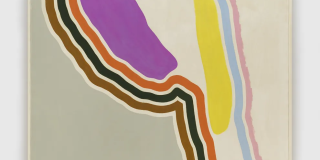
69 x 91 inches (175 x 231 cm). Image courtesy of the gallery.

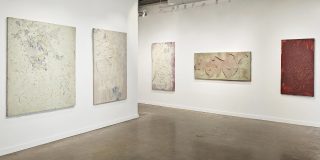
Image courtesy of the gallery.

Cohen’s approach was material and provisional, in perpetual negotiation between the properties of her painting materials and the temporal contingencies of working with them. Though her paintings appear spontaneous and intuitive, in fact they resulted from deliberate, methodical choices involving continual reassessment and revision. The gestures may seem immediate, but they were often erased or recast, with surfaces accumulating through repeated manifestations of doubt and reconsideration rather than expressive impulses. If there is a throughline in Cohen’s oeuvre, it is that her painting insists on remaining open-ended, focused on questioning rather than fixity, privileging the experiential over aboutness. To encounter her late canvases and works on paper is to meet fugitive images, traces, and incomplete gestures interrupted before hardening into claims.
As a student at Bennington College, Cohen was exposed to a doctrinaire version of Clement Greenberg’s modernism implying that painting’s course was already mapped out and its fate sealed. Quietly but resolutely, she rebelled against this logic and instead appeared to subscribe to Harold Rosenberg’s view that a painting should be treated as an event – part of a process that is never complete. For Cohen, painting was not a matter of resolution or conclusion; each work functions as a site of ongoing inquiry, where attention negotiates with material resistance. Paint spreads, pours, lifts, scrapes, and leaves a stain; it asserts itself as much as it obeys. What emerges is not the triumph of the artist’s mastery but the stubborn record of Cohen’s persistence in the face of a medium that resists subordination. Her paintings grow as much through erasure as accumulation, as much through doubt as assertion; they thrive on hesitation, revision, rupture, and even abandonment.

If Cohen’s work has a subject, it is not external to her medium, and she does not strive to actualize the idealized transcendence of modernism or the reduction of painting to brute material fact. Her concern was the physical reality of paint: its viscosity, opacity, and transparency, its shifting will to assert or withdraw itself – what one might call its “stuffness.” Her painterly practice was a dialectical engagement in which paint became both problem and potential. The canvas was never mere passive support but a stage for enacting material inquiries; even when fixed to the surface, she denied it finality. This dynamic is clearest in Cohen’s orchestration of “push-pull,” contrasting control and accident, will, and the inherent tendencies of matter, structure and dissolution. She synthesized these tensions not to resolve or neutralize them, but to showcase what may best be described as her productive dissent. In this regard, Cohen’s approach distinguishes itself from the purifying ambitions of modernism and the reductionist impulses of materialism, producing instead a field marked by flux, open-endedness, and perpetual negotiation.
Art-historical allusions in her work are neither mere citations nor mannerist echoes; they are matters of fact. If the specter of Abstract Expressionism haunts her work, it does so less as a visual template than as an inescapable ethos given that AbEx remains the default reference for gestural abstract painting in the United States, where alternative models such as European L’informale and Lyrical Abstraction are less familiar or recognized. Though much has been made of Cohen’s association with Joan Mitchell, Mitchell’s influence was more intellectual than aesthetic. Cohen more directly recalls Jackson Pollock in treating painting as mutable experimentation without predetermined result. At the same time, she cultivates not the monumentality championed by AbEx’s heroic existential rhetoric, but rather sedimentation and lingering ambiguity more in line with certain European artists. One senses affinities with Per Kirkeby’s time-laden surfaces, the expatriate Don Van Vliet’s meandering intensities, and Sigmar Polke’s willful irresolution. Their work embodies ambiguity or chance not as mere effects but as expressions of indeterminacy – a felt state of doubt, contingency, and instability. No gesture is privileged, no mark definitive; each is subject to erasure, recasting, or dispersal.

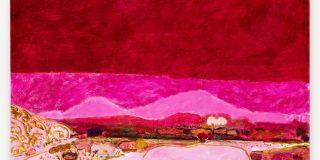
59 x 39 in (150 x 99 cm). Image courtesy of the gallery.
Employing all manner of media, techniques, and skills in struggling for visual and material resolution, Cohen’s work remains both within and against the Abstract Expressionist legacy; deriving energy from process but without any aura of definitive originality. What emerges could be called postmodern formalism, medium-specific yet skeptical of boundaries, process-driven but not content with process alone. Staging dialogues rather than resolutions, her last work makes palpable the reciprocity between painter and medium. With a toolkit ranging from oil to acrylic to Flashe, drawing to watercolor, she experiments with thinness, responsiveness, and resistance. Surfaces coagulate and edges dissolve, images pull away from themselves, forms unpredictably emerge, and boundaries of images remain unstable. Sometimes, transparency prevails, as washes and veils let light slip between layers; at other times, pigments are allowed to pool and congeal. Cohen’s and Brice Marden’s late works share a vision of painting as a field of open inquiry that registers not mastery but discovery, uncertainty, and poetic emergence.
Cohen’s ongoing resistance to closure also situates her within the generational current of post-minimalism (late 1960s through the 1970s) in which material processes, profoundly shaped by Pollock’s drip paintings, became ends in themselves rather than means to an end. One might think here of Jack Whitten, whose experimental use of brooms, squeegees, notched tools and an incremental, cumulative approach similarly presaged the instability, material engagement, and conceptual restlessness of contemporary art. Like Whitten, Cohen developed a process-based practice that reset the terms of abstract painting by resisting codification and yielded works that remained in dialogue with the contingency of their making.

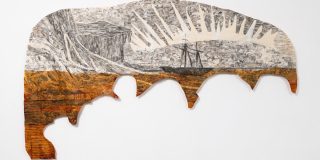
55 x 79 inches (139 x 201 cm). Image courtesy of the gallery.

48 x 77 inches (122 x 196 cm). Image courtesy of the gallery.
It seems fair to say that Cohen’s paintings also inhabit the interval between modernist teleology and postmodernism, rejecting the totalizing claims of the former while resisting the evasive narratives of the latter. She held both in suspension, at home between fact and doubt, continuity and indeterminacy, structure and uncertainty. For Cohen, abstract painting flourished precisely where meaning was never secured, closure was refused, and the medium was an arena for ongoing speculation. As a matter of art history, Cohen’s work stands as a revision of modernism, responsive to postmodern doubt while sustaining painting’s possibilities.

“Cora Cohen: A Decade: 2012–22,” Greene Naftali, 508 West 26th Street, Ground Floor, New York, NY. Through November 1, 2025.
About the author: Saul Ostrow is an independent curator and critic. Since 1985, he has organized over 80 exhibitions in the US and abroad. He has served as art editor at Bomb, co-editor of Lusitania Press, and editor of the book series Critical Voices in Art, Theory and Culture published by Routledge. The exhibition “Building Models: The Shape of Painting,” curated by Ostrow, is at the Milton Resnick and Pat Passlof Foundation in NYC through January 17, 2026.





Excellent review of her painting. Thank you.
Inspiring!
Excellent analysis !