Tag: Samuel Beckett

Solo Shows

Fergus Feehily: Between reductive referentiality and freestyle abstraction

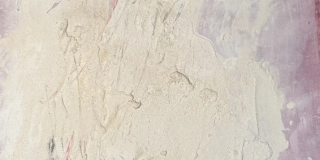
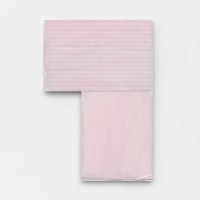
Contributed by Jonathan Stevenson / It’s scarcely enough to label Irish artist Fergus Feehily’s compact abstract paintings, now on view at Post Times, surprising or revelatory. They accomplish more by describing, usually in a succinct vertical rectangle, what seems ineffable, delivering idiosyncratic Hickey-esque frissons of beauty and wit. You take a look, get a feeling, spy the title, and say, “Oh yeah, that’s right.” They’re all ingeniously pithy, some more immediately accessible than others. Windowpane Putty looks like what that name says; the news is how beautiful a sloppy DIY repair, or rain and dirt, can be. The pocket-Rauschenbergian Suburban Sphinx, juxtaposing lightly painted corrugated cardboard and wood components, captures the stolid big-box allusion. And the delicate pink and spare glitter of Midrainbow make ready sense of the title, and with dazzlingly unique lyrical efficiency.
Museum Exhibitions

Friedrich’s contemplative sublime

Contributed by Margaret McCann / “The Soul of Nature”at the Metropolitan Museum of Art is one of many exhibitions dedicated to German Romantic painter Caspar David Friedrich (1774–1840) on the 250th anniversary of his death. Some of his finest are absent – the epic Sea of Ice’s vision of an arctic shipwreck, The Great Enclosure’s resonant view of a Dresden field Napoleon amassed his troops on, or Ruine Eldena, one of Friedrich’s many depictions of the remnants of the powerful Catholic monastery his hometown Griefswald formed around. But there are numerous studies displaying his keen observation of nature, research he used for paintings creatively orchestrated in the studio.

Solo Shows

Adam Simon: Jostle, flux, and instability

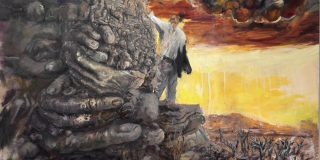
Contributed by Jonathan Stevenson / Brooklyn-based conceptual painter Adam Simon is known for his cagey synthesis of the graphic symbols and tropes of commerce and civic life into elegant visual statements about the zeitgeist and, more grandly, the world as a whole. He can use text to penetrating effect, as in the small paintings he made a few years ago superimposing the edict “STEAL THIS ART” on the vintage silhouette of a policeman. In one not-quite-Hoffman-esque line and an evocative image, he captured the ambivalence and limbo of the art world between the establishment and the counterculture, having himself cultivated a live community in that space by organizing, with several other artists, the collaborative “Four Walls” events in Hoboken in the 1980s and Williamsburg in the 1990s. In “Great Figures,” his solo show now up at Osmos, he has continued in a searchingly ironic vein, now with a bemused fretfulness that affords it epochal resonance.