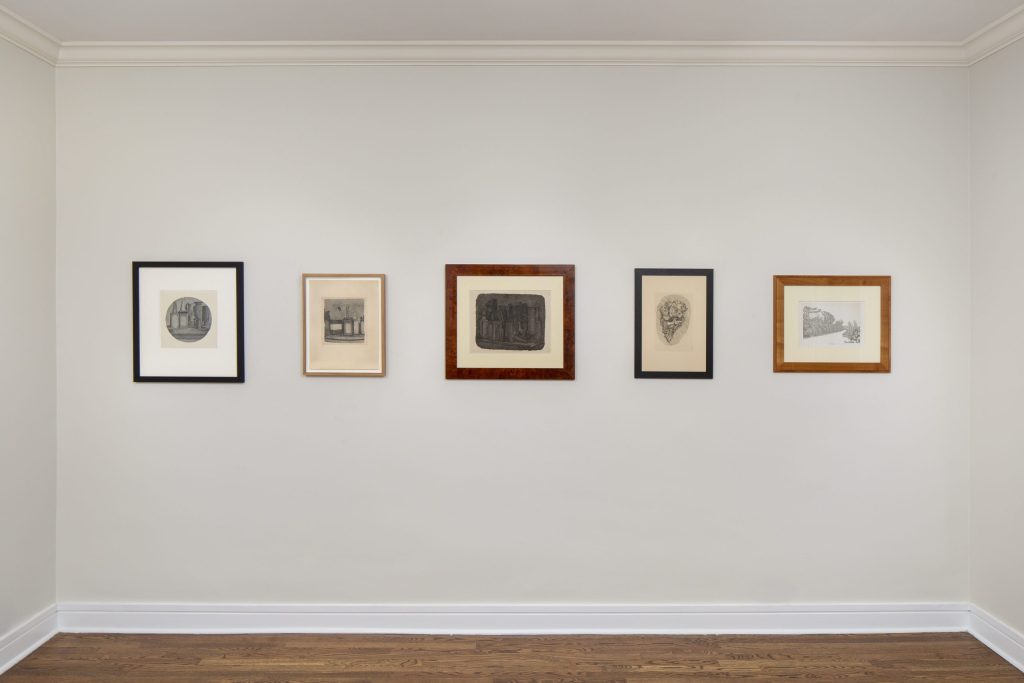
Contributed by David Carrier / Giorgio Morandi was born in 1890 and died in 1964. After the 1910s, when his art had some affinities with that of Giorgio de Chirico, he painted only still lives – bottles or flowers – and landscapes. “Time Suspended, part II” at Mattia de Luca Gallery, part I having been staged earlier in Italy, is a blessedly large presentation of 45 paintings and fifteen works on paper that reveals how little other artists or current events – indeed, anything outside of his studio life – affected his work. It shows no acknowledgment, for instance, of Italian fascism or Italy’s economic miracle of the 1950s. Catalogued still-life paintings from 1927 to 1953 reveal virtually no dramatic developments. His concern with rows of flat containers in some of the late pieces is one change. But without the catalogue numbers, it’s hard to discern that, say landscape V. 135 was painted in1928, landscape V. 482 sixteen years later in 1944, and landscape V. 1247 seventeen years after that in 1961. The curators did not hang the show in chronological order, thus discouraging any search for systematic stylistic changes.
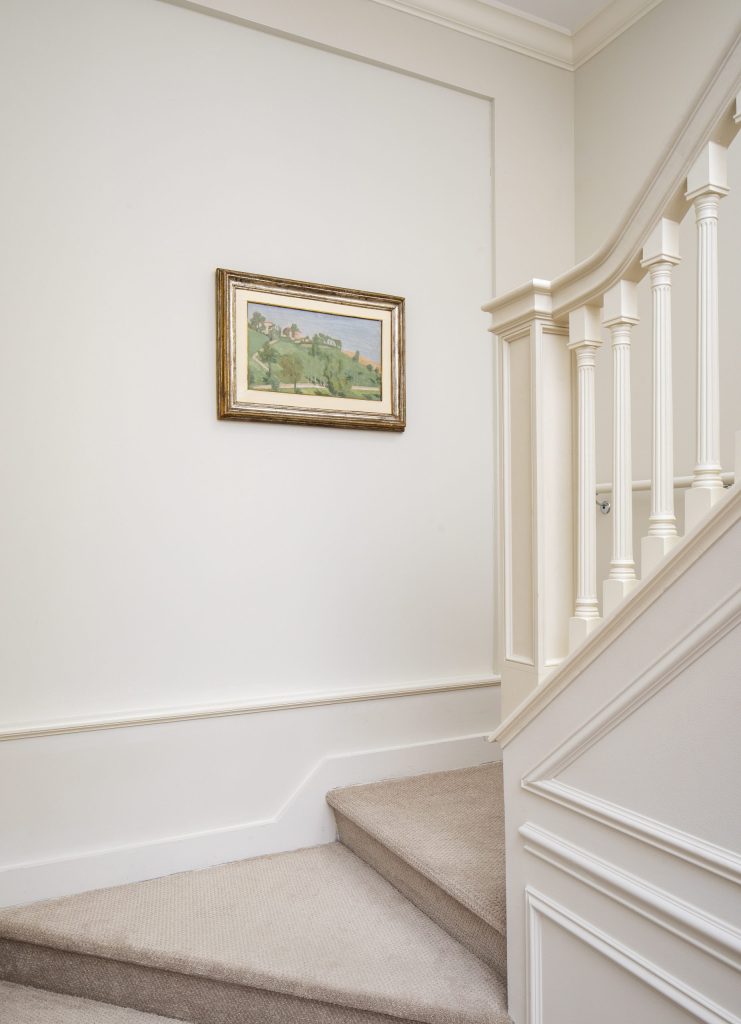
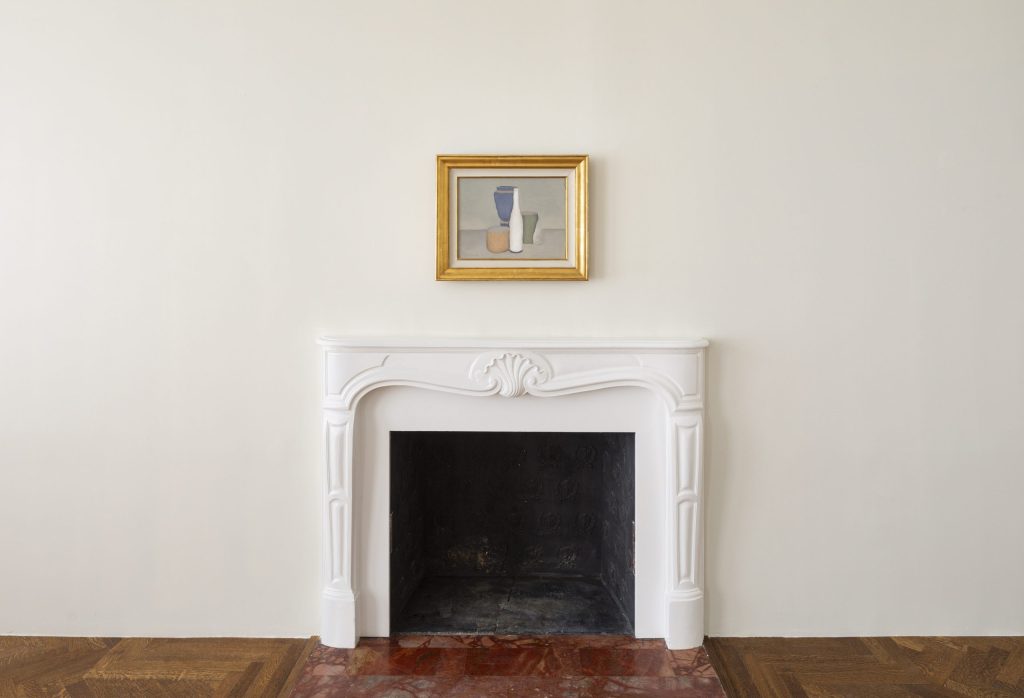
I cannot think of any other major painter who developed so little. Morandi could be compared to the English novelist Ivy Compton-Burnett (1884–1969), whose 19 novels are all set in murderous, Edwardian households in which small children, middle-aged men and women, and senior citizens speak in the same style. Because Morandi’s paintings are small and have unremarkable subjects, how they are perceived depends to an unusual degree on how they are displayed. Having seen Morandi shows at the Guggenheim, the Metropolitan Museum of Art, Bologna, and several New York art galleries, I confidently rate this exhibition as the best I have taken in. On the high white walls of the second and third floors as well as the staircase of Mattia del Luca’s townhouse, his paintings and works on paper have ample room to breathe. The luxurious setting suits the work, perhaps because, by way of contrast, it emphasizes how very bare and sparse his artworks are while allowing the few somewhat idiosyncratic paintings – such as the still life V. 1124, which depicts a large vase frontally – to stand out.
Joan Mitchell is generally admired for her amazing painterly skill, and Joan Brown legitimately appreciated for her extraordinarily inventive figuration. To extol Morandi for the stylistic development of his late still life output or the range of his landscapes – as many and varied artists and critics do – is to extend a very different kind of praise. His art is intently modest compared with theirs. Yet the often contentious Roberto Longhi called Morandi “arguably the greatest Italian painter of the 20th century.” What afforded him this mystique? Sometimes the best way to understand what is right in front of you is to look away at something else. Puzzling over my appreciation for this show, I cast my mind back to a large Arte Povera show that I saw years ago in a midwestern American museum.
By the museum’s account, the Italian artists in that movement had read American Minimalism as seeking “to mobilize the revolutionary potential of outdated and thus anti-modernist objects, structures, materials, processes of production.” Obviously, Morandi was not part of Arte Povera – his late works barely overlap chronologically with its earliest work – but thinking of him as a proto-Arte Povera painter yields a clearer understanding of why his art matters right now. The symbols and materials that Arte Povera sculptors employed – horses, wood, old-fashioned artifacts – memorialized premodern Italy. Morandi likewise looked backward, eschewing the everyday life of his Italy. What makes his images of bottles and flowers and his banal central Italian landscapes appear poetic is, to appropriate an idea from the journal October’s commentary on Arte Povera, his “capacity to fuse sudden epiphanies of historical memory with a simultaneous radicality to critique the present.” As the title of this show very economically says, what we see is time suspended.
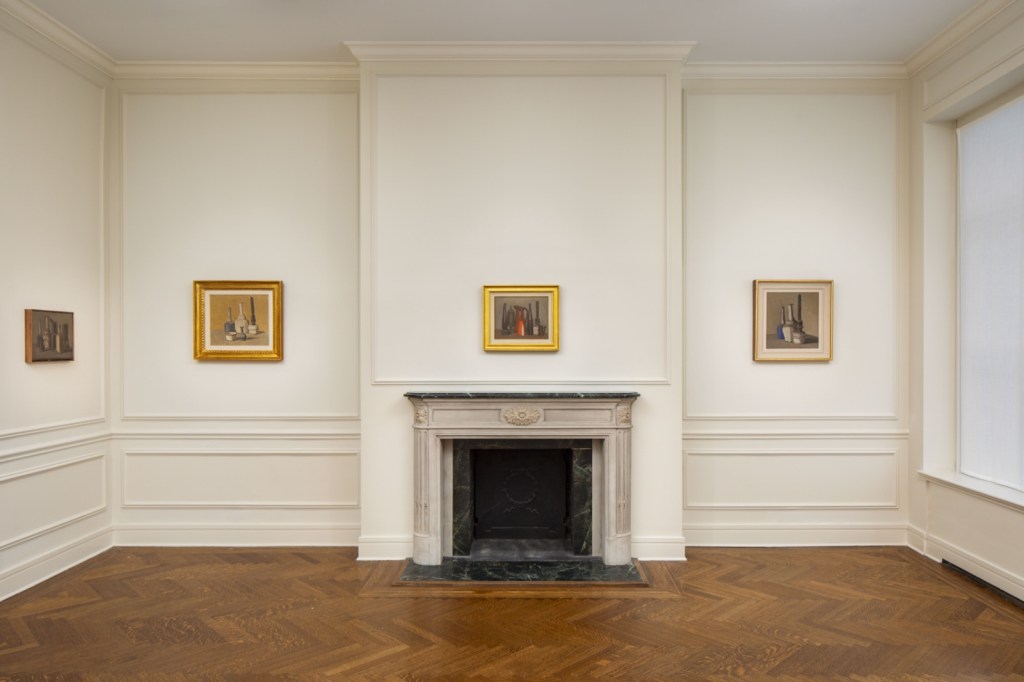
“Giorgio Morandi: Time Suspended, part II,” Mattia de Luca Gallery, 8 East 63rd Street, New York, NY. Through November 26, 2024.
About the author: David Carrier is a former professor at Carnegie Mellon University; Getty Scholar; and Clark Fellow. He has published art criticism in Apollo, artcritical, Artforum, Artus, and Burlington Magazine, and has been a guest editor for The Brooklyn Rail. He is a regular contributor to Two Coats of Paint.
NOTE: We’re halfway through the Two Coats of Paint 2024 Year-end Fundraising Campaign! This year, we’re aiming for full participation from our readers and gallery friends. Your support means everything to us, and any contribution—big or small—will help keep the project thriving into 2025. Plus, it’s tax-deductible! Thank you for being such a vital part of our community and keeping the conversation alive. Click here to support independent art writing.