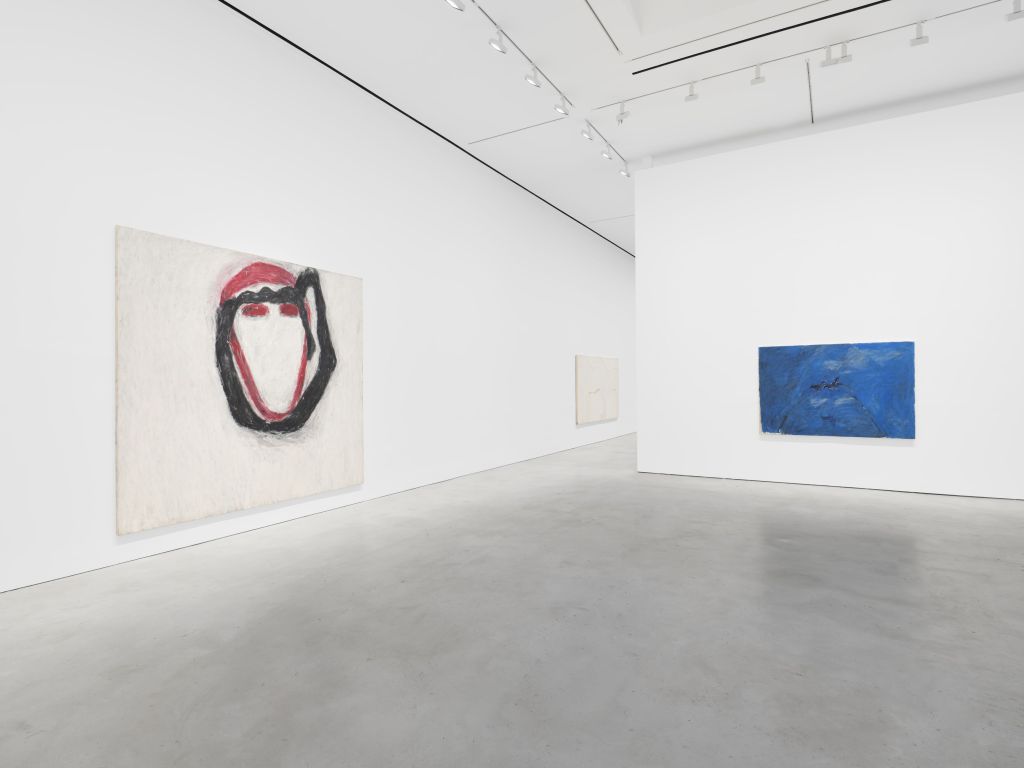
Contributed by Jason Andrew / Susan Rothenberg’s exhibition “The Weather,” now up at Hauser & Wirth, is a rare chance to experience the breadth and intensity of one of most vital influences in American painting. The exhibition gathers fourteen works from across her career – horses, fragmented bodies, and spectral forms – some rarely or never before exhibited. Rothenberg told the LA Times in 1983 that she liked to think of the subjects in her paintings as being “swept along in unconfined space by forces of weather” – rendered in thermal swirls and blizzardy brush marks – and the exhibition is structured around this idea.
After dropping out of graduate school, Rothenberg eventually landed in New York City in 1969. At first, she worked in an abstract idiom focused on the structure and the nature of painting, exploring flatness and figure-ground relationships. But her work was always looser, tilting towards Process Art and Body Art rather than the tidy look of Minimalism that was fashionable at the time. She was inspired by Eva Hesse, assisted Nancy Graves in the fabrication of her camels, and performed in Joan Jonas’ works. Rothenberg told Joan Simon: “I loved dancing and I loved rolling around naked on a mirror with Joan Jonas where the mirror might break and cut our bodies in half.” Emotion and intensity are key to understanding her work. Rothenberg wanted to “catch a moment … to exemplify an emotion,” she told Grace Glueck.
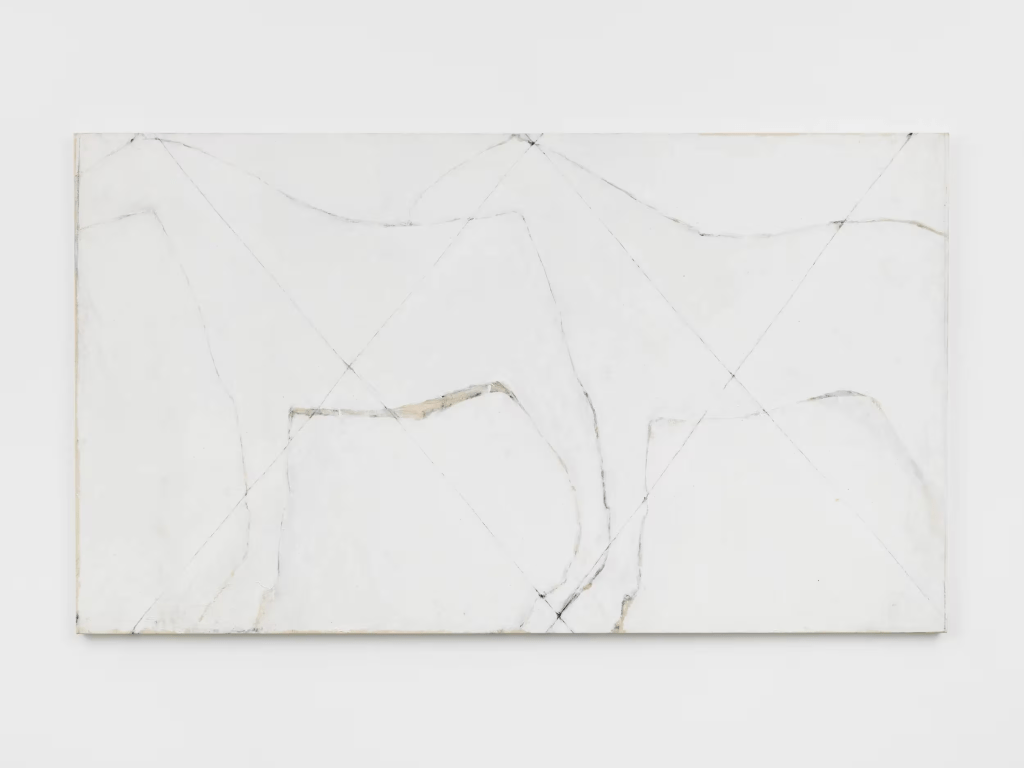
While doodling in 1974, Rothenberg drew a line down the middle of a scrap of canvas. “Before I knew it,” she told The Atlanta Journal, “there was half a horse on either side.” The horse “satisfied my need for an image, but I had so many formal ideas, I never thought about the horse itself.” These paintings broke any Minimalist restraint, capturing the power of figuration and personal symbolism and led the resurgence – along with others like Elizabeth Murray – of painting in New York. Dos Equis depicts two horses standing in static profile, tensely painted in white. Rothenberg placed an X across each horse not to “cancel it out in the manner of painters Cy Twombly or Pat Steir,” observed Joan Simon, “but to emphasize the structural lines of the horses while locking them into place.” The color is notable. During this period, Rothenberg rarely deviated from an earthy sienna, to which she would return in the 20-foot-wide Siena Dos Equis a year later. “Color,” she told the LA Times, “is distracting and sensual: it’s not the essence of the issue.” She was more concerned with merging foreground and background.
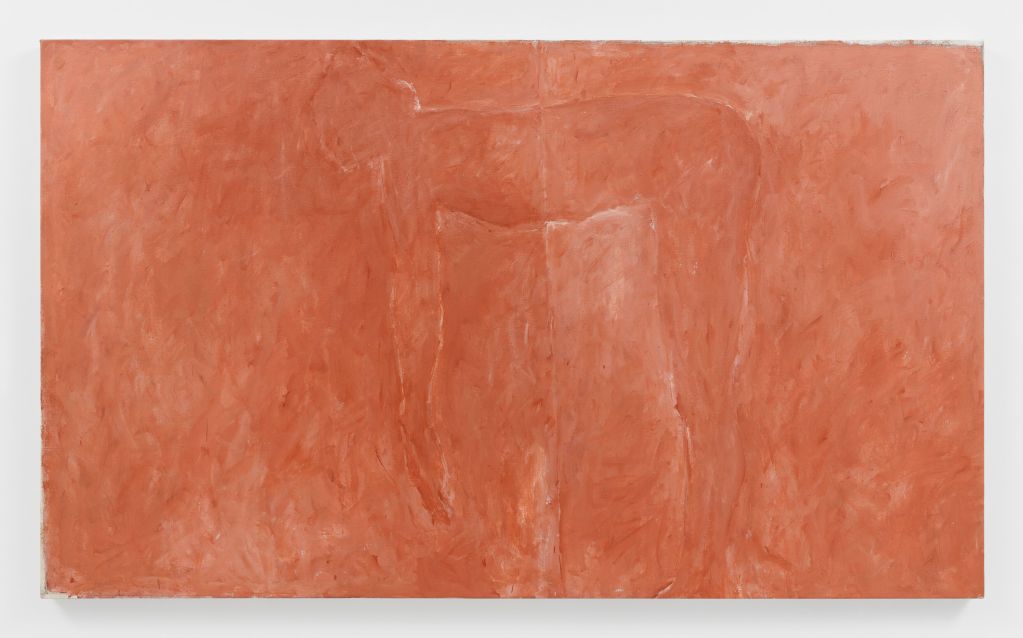
In a rare series of three paintings, two of which are on view, Rothenberg substituted the human figure for the horse. Mary I and Mary II feature her friend Mary Woronov in various positions – bending over, crouched, and on all fours. It was her attempt to see “if the human figure was as strange and compelling” as the horse. The outcome didn’t sustain her. Blue Frontal and Outline track Rothenberg’s change of imagery and perspective: the fracturing of horses into bones and heads. Painted after a rather gloomy stint at CalArts, Blue Frontal is notable for its forward shift and the rather odd framing of horse parts. The paint handling in both works is volcanic and thunderous.

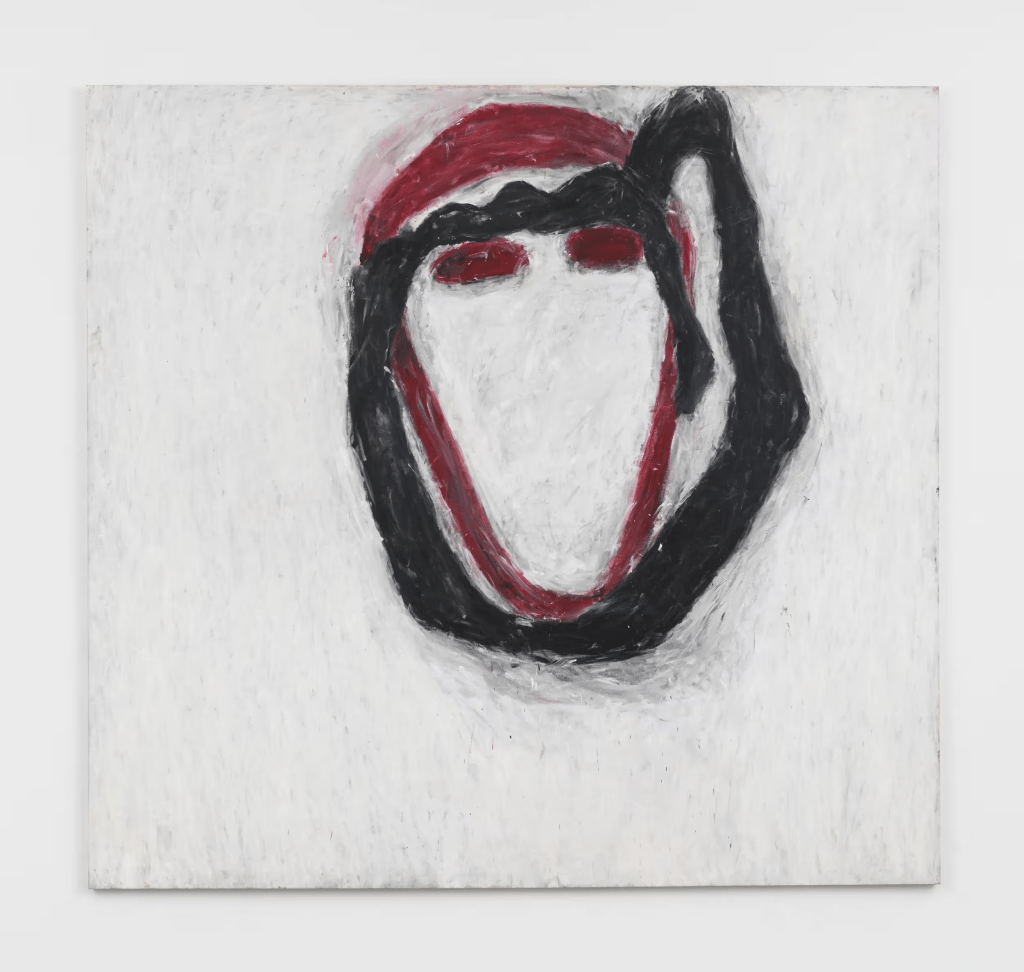
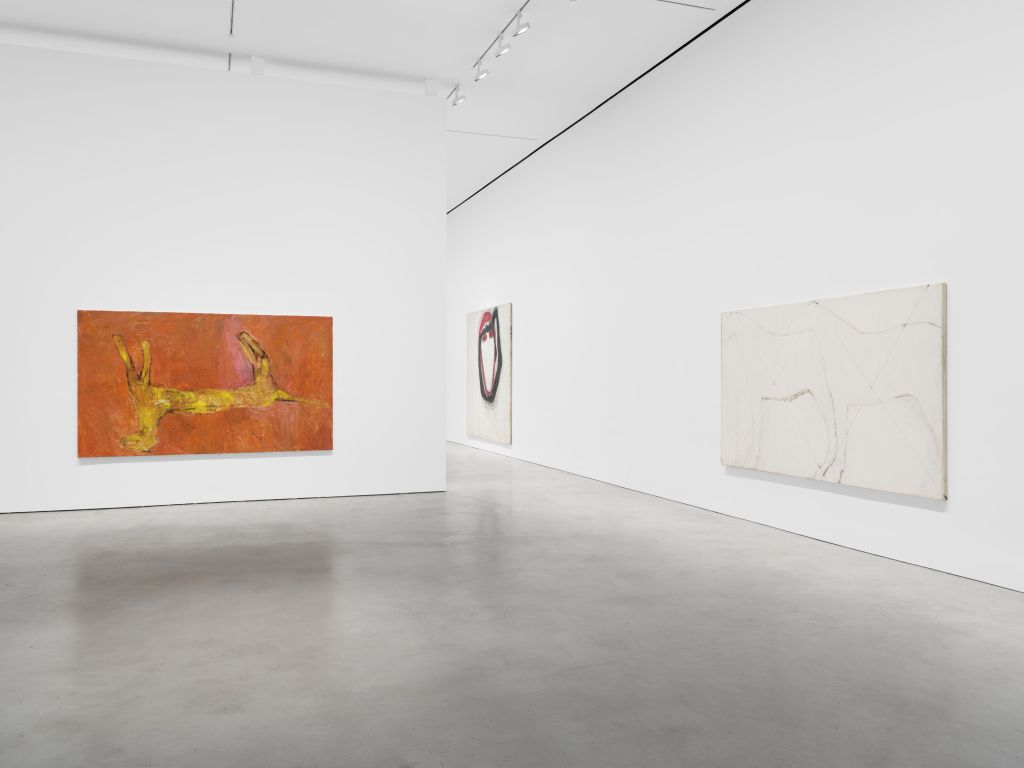
Rothenberg next took on heads, hands, ribs, and bones. Signifying presence and vulnerability in Red Head, the head and ribs appear as fractured, floating forms held up by a charged surface rendered by a frenzy of brushstrokes. Here, as she does in its companion Black Head, in the Munson Museum of Art’s collection, Rothenberg confronts the human figure, dissecting it into elemental parts and rendering them raw. They layer memory, tension, and motion, bridging abstraction and figuration with a barometric measure of visceral sensibility. “I don’t paint the way things are,” she said in 1983, “I paint exactly the way things can’t be.”
She made her later paintings at the New Mexico ranch where she lived with her husband Bruce Nauman from the 1990s until her death in 2020. Her daily encounters with its parched landscape drove painterly experiments in color and perspective. But mostly, it inspired new narratives, like scenes of her dogs tearing into rabbits or rotting corpses of stray cattle. Which hints at the fate that might have befallen the stiff feline featured in Yellow Cat, the largest painting in the show. The composition, tone, and color of this painting is reminiscent of Gauguin’s Yellow Christ, which she fastened onto as a child in Buffalo on her visits to the Buffalo AKG Art Museum.
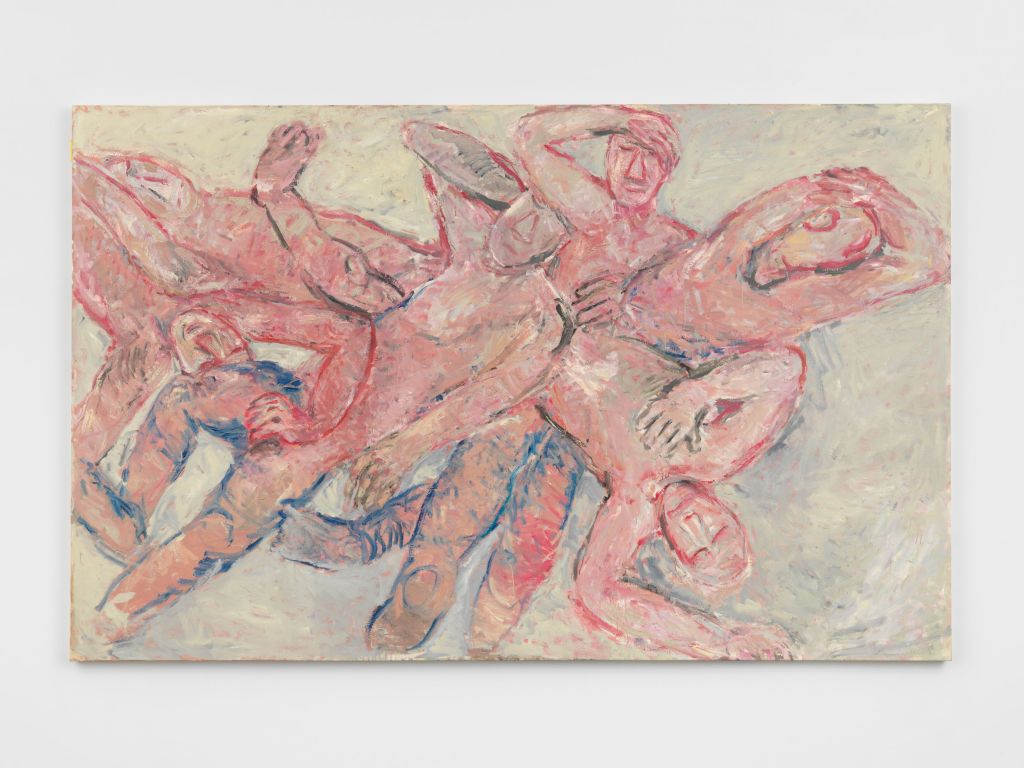
In All Night Long, a corpus of elbowing bodies wrestle in a tension that spills across the canvas. The brush marks reflect irritability, impatience, the fatigue particular to insomnia. She lived just hours from Roswell, NM – the town whose name is both sacred and profane in ufology – so it’s no wonder that the lore eventually found its way into Rothenberg’s oeuvre. In Lift Off, one of the oddest works in the show, and an outliner I remember shown at Sperone Westwater in 2006, alien-like arms reach into the canvas as talon-like fingers pull a rabbit inside out.

Not one for ceremony, Untitled (Band and Hands Green) painted just two years before Rothenberg’s death, exudes a kind of reverence. One gets a laying-on-of-hands vibe as several hands, worn and unsteady, emerge from a densely painted background in support of an imbalanced white sphere. Like the best of her work, we are left with the elements but it’s impossible to predict the direction of the storm.
Rothenberg’s work feels urgent now. Her themes – body, fragmentation, the boundary between interior and exterior, memory and physicality – resonate powerfully in this moment of constant change and instability. They are masterpieces that stand the test of time, and we are lucky to have them as a shelter and mirror during these raging societal storms.
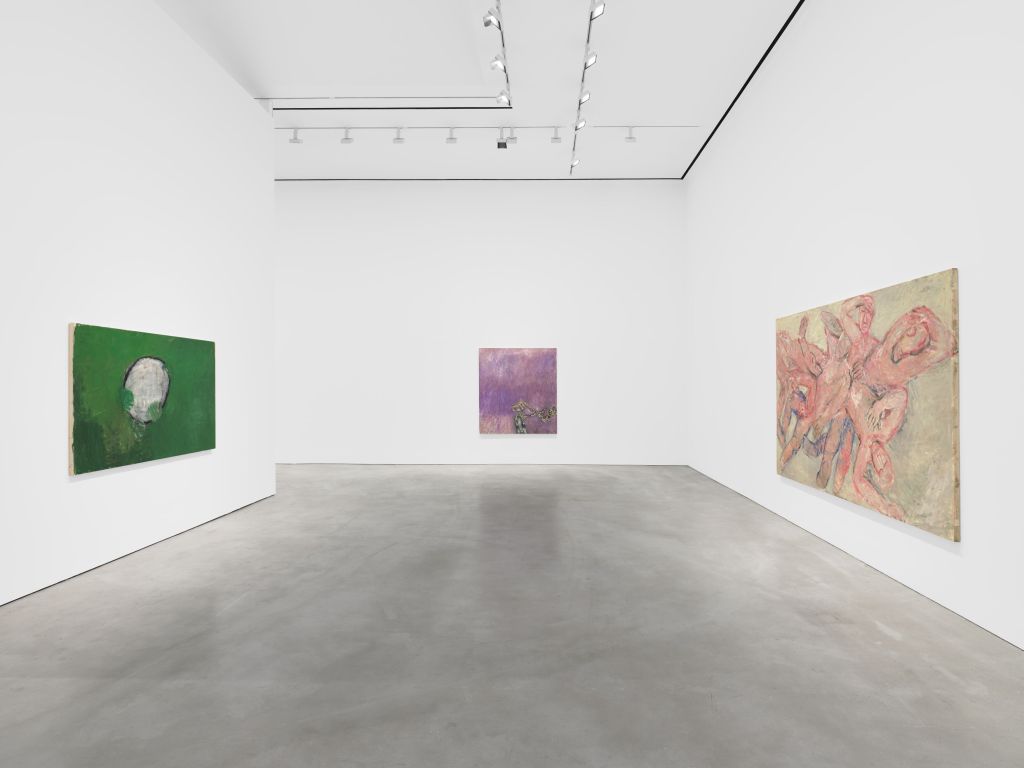
“Susan Rothenberg: The Weather,” Hauser & Wirth, 542 West 22nd Street, New York, NY. Through October 18, 2025.
About the author: Jason Andrew is an independent curator and writer based in Cypress Hills, Brooklyn. Follow him on Instagram: @jandrewarts