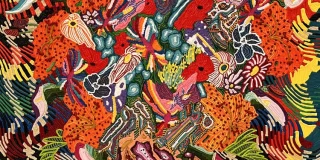
Contributed by Adam Simon / A photographer friend once asked me why painters are always talking about the space in a painting. He wanted to know what this term “space” meant. I talked about the different ways paint on a flat surface could be made to suggest depth, and how the challenge for modern painters was to create depth while also reaffirming the flatness of the support. I probably referred to the elusive concept of the “picture plane” and how simultaneously maintaining mutually exclusive ideas – flatness and depth – could produce a poetic or even a mystical dimension in visual art. Most abstract paintings present shallow space, keeping depth to a minimum. This type of painting is usually non-hierarchical; nothing feels more essential than anything else. The viewer’s eye tends to scan. If you want to both represent depth and reaffirm flatness, shallow space is going to be easier to handle than deep space.
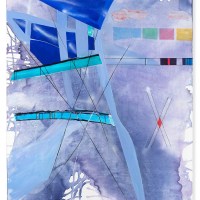
Tag: Orphism
In Conversation: Diana Copperwhite and Erin Lawlor
In this thoughtful exchange, artist Erin Lawlor talks to Diana Copperwhite about the role of intuition and emotion in their work, their love of music, and their mutual interest in painter Howard Hodgkin. Copperwhite’s paintings will be on view alongside Hodgkin’s work at the Auckland Art Fair from May 1-4, and Lawlor ‘s solo “Divining” opens at the Highlanes Municipal Gallery in Ireland on April 26.
Call it Orphism
Contributed by Adam Simon / At a Four Walls event in Brooklyn in the early 1990s, Erik Oppenheim, at that time a young artist, stood up and said, “I’m starting an art movement. Anyone who wants to join, meet me in the back after the show.” It was a hilarious and audacious gesture, in part because no one joins an art movement on a whim, like a list-serve or an exercise class, but also because there hadn’t been any artist-initiated movements for a very long time. They proliferated in the late nineteenth and early twentieth century with the advent of Impressionism, Surrealism, Futurism, and Dada, and enjoyed something of a resurgence in the 1960s with Fluxus in the United States, Supports/Surfaces and Zero in Europe, and the Gutai Group in Japan. Most of what we consider movements were proclaimed by an outside observer, usually a critic or curator, looking to group artists who had similar concerns and made work that fit the designation. For the artists themselves to rally around a specific cause, even an aesthetic one, was not required.
Katy Crowe’s light-and-shadow poetics
Contributed by Mary Jones / Katy Crowe returns to as-is.la with “Lunar Shift,” a superb second show of eleven lively and resonant abstract paintings. All are oil on linen works completed within the last year, six of them 52 x 42 inches and five 24 x 18 inches. A strikingly linear installation puts two opposing walls of the gallery into play, with the paintings equally spaced. The formality of the presentation underscores the dichotomy between window and object inherent in all paintings but Crowe’s especially, and brings out buoyant rhythms from painting to painting.