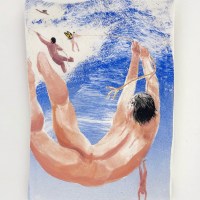
Contributed by Lucas Moran / Making sense of art is not easy. You can’t pin down meaning when it keeps moving. Darren Bader’s new show “Youth,” now on view at Matthew Brown Gallery, vividly illustrates the point. Bader has been called a prankster and an absurdist, elevating the ridiculous into high art. His earlier projects included injecting lasagna with heroin, stuffing a brass instrument with shrimp, and giving away live kittens. He provides bits of text that hint at deeper meaning while refusing to settle into it. Filling a gallery with art that plays conceptual games with history and humor and still looks good is no easy trick. But Bader pulls it off.
Tag: Marcel Duchamp
Clintel Steed’s careful daring
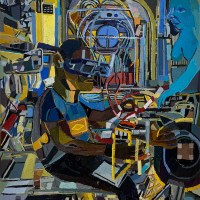
Contributed by Margaret McCann / In Clintel Steed’s show of paintings at Shrine Gallery, “Different Time Zones, Different Dimensions,” temporal experience is evoked through formal language as much as subject matter. In most, dynamic fragmentations of contemporaneity are fixed in static tessellations of paint. Richly varied shapes, packed in shallow space on dense surfaces, lead from abstraction to illusion.
Inside Peter Dudek’s studio
We’re up in the Berkshires of western Massachusetts. The floor of Dudek’s studio is covered wall-to-wall with objects. One can ascertain individual sculptures, or perhaps parts of sculptures that might become sculptures one day. I ask if this is how it always is.
Call it Orphism
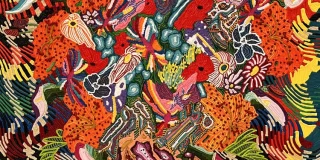
Contributed by Adam Simon / At a Four Walls event in Brooklyn in the early 1990s, Erik Oppenheim, at that time a young artist, stood up and said, “I’m starting an art movement. Anyone who wants to join, meet me in the back after the show.” It was a hilarious and audacious gesture, in part because no one joins an art movement on a whim, like a list-serve or an exercise class, but also because there hadn’t been any artist-initiated movements for a very long time. They proliferated in the late nineteenth and early twentieth century with the advent of Impressionism, Surrealism, Futurism, and Dada, and enjoyed something of a resurgence in the 1960s with Fluxus in the United States, Supports/Surfaces and Zero in Europe, and the Gutai Group in Japan. Most of what we consider movements were proclaimed by an outside observer, usually a critic or curator, looking to group artists who had similar concerns and made work that fit the designation. For the artists themselves to rally around a specific cause, even an aesthetic one, was not required.
Dan Dowd and the folds of memory
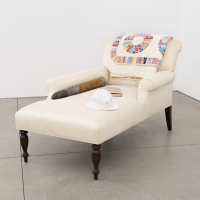
Contributed by Mark Wethli / As I viewed Dan Dowd’s intimate and poetic work, now at Magenta Plains, I considered our inclination to cathect feelings and memories onto objects. Clothing in particular echoes the shapes of our bodies; touches them; connotes gender, time, and economic status; and absorbs everything from our scent to our DNA. Dowd creates small, iconic assemblages out of found materials, including fragments of inner tubes, clothing, rags, and home décor.