Contributed by David Carrier / I have been writing a book about art in the churches of Naples’ historic center. There I also visited the new Kunsthalle Madre, which contains an elaborate two-story permanent installation by Francesco Clemente called “Ave Ovo.” Like baroque Catholic art, Clemente’s work features elaborate symbolism. While the old masters employed it to present church dogma, his symbolism is personal and more elusive. In Naples, however, both exhibit a penchant for sensory overload: more is more. In his splendid show “Summer Love in the Fall,” now at Lévy Gorvy Dayan, Clemente still uses some of the same symbols – male and female body parts, his own portrait – but the colors in its 23 paintings are more subdued. The title may well refer to the psychic place of erotic images in his later life as well as the timing of this exhibition, for now his work seems more serene.
Tag: David Carrier
Morandi’s pointed timelessness
Contributed by David Carrier / Giorgio Morandi was born in 1890 and died in 1964. After the 1910s, when his art had some affinities with that of Giorgio de Chirico, he painted only still lives – bottles or flowers – and landscapes. “Time Suspended, part II” at Mattia de Luca Gallery, part I having been staged earlier in Italy, is a blessedly large presentation of 45 paintings and fifteen works on paper that reveals how little other artists or current events – indeed, anything outside of his studio life – affected his work.
Sylvia Plimack Mangold: Inside to outside
Contributed by David Carrier / As the title “Tapes, Fields, and Trees” indicates, the exhibition of ten works by Sylvia Plimack Mangold at Craig Starr Gallery draws on three bodies of her early work. In the mid-1970s, she made Minimalist paintings of tape measures. Pieces like Taped Over Twenty-Four-Inch Exact Rule on Light Floor, however, reveal a surprising poetry in seemingly prosaic subjects. Then she painted grids, like the one in Painted Graph Paper. Finally, in a remarkable transition, she drew a window looking out on a landscape….
Bernice Bing’s unsung talents
Contributed by David Carrier / Bernice Bing (1936–1998), a gay Chinese American woman, grew up in San Francisco. She had a difficult childhood. Her mother died when she was five and lived in no fewer than 17 predominantly white orphanages. She attended local schools, got her MFA at the San Francisco Art Institute, and actively participated in the local art scene. Her teachers included Richard Diebenkorn as well as celebrated local artists, and Bing exhibited widely in Northern California. Now, thanks to Berry Campbell Gallery, which has provided a magnificent catalogue with a fine essay by John Yau, her work is being brought to New York’s attention.
New Spain’s inventive painters
Contributed by David Carrier / When the Metropolitan Museum of Art recently rehung its permanent European collection, the galleries devoted to Spanish art included an abundant selection of work from “New Spain,” as the vast Spanish empire was known during the colonial period. From 1521 to 1821, its territory included, among much more, what is now Mexico, Central America, and the US Southwest. Much of the art consisted of sacred baroque painting – arguably the first truly international art style. “Saints & Santos: Picturing the Holy in New Spain,” on view at the New Mexico Museum of Art, does it justice.
Guillaume Lethière’s historical resonance
Contributed by David Carrier / Guillaume Lethière (1760–1832) was a very good French neoclassical painter. Respected and honored in the French art world, he served as director of the French Academy in Rome and was admired as a teacher. Consistent with this stature, the eponymous exhibition currently on view at The Clark Art Institute is robustly curated. In addition to abundantly contextualizing Lethière’s work, the exhibition materials document a life that embodied much of France’s complicated colonial history.
Alessandro Twombly: Strikingly original, richly allusive
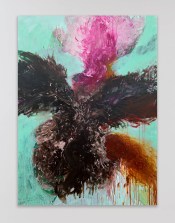
Contributed by David Carrier / Alessandro Twombly’s twelve large new paintings, now on view at Amanita Gallery, all employ one basic, immensely fruitful motif: knots of color resembling enlarged floral forms, depicted in high-pitched, gesturally painted oranges, pinks, reds, and blacks on bright turquoise backgrounds. An artist friend nicknamed these pictures ‘Tiepolo in the Sky,” which accurately describes them. Twombly’s abstract images look like drastically enlarged figures you might find in a work by the eighteenth-century Italian painter Giovanni Battista Tiepolo. They are strikingly original yet richly allusive.
The Wild Art of Barbara Westman
Contributed by David Carrier / Just to the left of my writing desk is a painting of a magnificent tree with bright orange blossoms. Below it is a now faded postcard of a drawing of Barbara Westman, who died earlier this year at age 95, and her husband Arthur Danto sitting on a sofa with their dogs Charlotte and Emilia. To the right, a work on paper shows Danto taking the dogs for a walk in Manhattan. These Westman pieces more than hold their own against the prints of old European master works, Japanese woodcut, and Bill Anthony drawings that surround them. Anytime I feel discouraged by the slow progress of my work or the political news, I need only look at them to be cheerful again.
What makes a good painting?
Contributed by David Carrier / What is the present state of painting? For as long as I have been writing art criticism, that question has been much discussed. Some critics have said painting was dead, perhaps to be replaced by Minimalist or conceptual art. Others have argued that because painting is an inherently bourgeois art form, it can continue only as long as it is politically tinged. The Milwaukee Art Museum’s show “50 Paintings” takes an essentially empirical approach to the question. Co-curators Margaret Andera and Michelle Grabner gathered mostly mid-sized recent paintings by artists well-known in the New York art world and demonstrated how varied and how good painting is today. There are abstractions by Peter Halley and Mary Heilmann, a landscape by April Gornik, and figurative paintings by Cecily Brown and Nicole Eisenman. It’s natural for a visiting critic to pick favorites. Mindful of the unhappy fate of Paris, whose judgment about which goddess was most beautiful triggered the Trojan War, I dare to name mine.
Beatrice Caracciolo: Exquisitely stealthy
Contributed by David Carrier / What does it mean for a contemporary artist to be inspired by an older text or artwork? The Gospel of Matthew 15:14 says: “If the blind lead the blind, both shall fall into the ditch.” Moved by those words in 1568, Pieter Bruegel the Elder painted The Blind Leading the Blind, which hangs in Museo di Capodimonte in Naples. Now stirred by that picture, Beatrice Caracciolo, a young artist who grew up in that city, has drawn The Blind 16: one large image of the blind beggars and several smaller details also derived from the Bruegel. Between Matthew and Bruegel and then Bruegel and Caracciolo, there’s a kind of creative slippage whereby the meaning of the prior statement is transformed. At each stage, Matthew’s basic conception is partly preserved while something is added or subtracted. He doesn’t specify, for instance, that there are six blind men. Caracciolo shows his entire work, but without color, in grisaille. In smaller rectangular works on paper, she focuses on the trees and on some of the individual blind men.
Howard Hodgkin’s Indian court collection: enigmatic or just good?
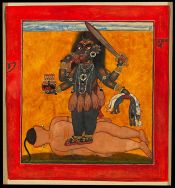
Contributed by David Carrier / Some very successful artists are also collectors, and the art that artists collect can reveal or confirm something about their own work and social attitudes. For example, Edgar Degas’ abundant holdings included works by Édouard Manet, which shows that Degas elevated aesthetic qualities over political beliefs. Unsurprisingly, Pablo Picasso traded art with Henri Matisse. Given Picasso’s obsessive rivalry with the Frenchman, he must have enjoyed keeping score with his frenemy as well as infiltrating Matisse’s collection with his own work. What then are we to make of British painter Howard Hodgkin’s trove of Indian court paintings, now on view at the Metropolitan Museum of Art?
Simon Hantaï: Canonical at last?
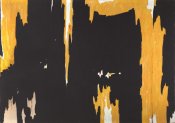
Contributed by David Carrier / What comes after Abstract Expressionism? A couple of generations ago, American art writers were intent on addressing that question. The American color field art of Morris Louis, Kenneth Nolan and Jules Olitski was one plausible answer. Then, of course, came Jasper Johns, Robert Rauschenberg, and much more. The French had a different answer. They were interested in the abstraction of Hungarian-born Simon Hantaï (1922–2008), who moved to France in 1948 and whose work seemed in line with the post-structuralist theory that had taken hold there. His inspirations were Marxism, Catholic tradition, Matisse, Picasso, and Jackson Pollock as seen in Paris exhibitions, and his bête noire was Surrealism. Given these rich and disparate interests and impulses, it goes almost without saying that Hantaï developed a highly distinctive aesthetic. Long famous in France, his paintings recently have been shown in several ambitious Manhattan galleries, notably Timothy Taylor.
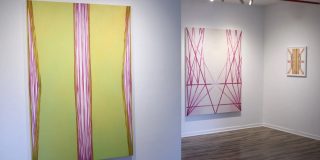
Maki Na Kamura: “Caspar David Friedrich plus Hokusai minus Romanticism minus Japonisme”
Contributed by David Carrier / Born in Japan, Maki Na Kamura was trained in Germany, where she now lives and works. In that light, it’s not too surprising that she describes her work as “Caspar David Friedrich plus Hokusai minus Romanticism minus Japonisme.” Identifying herself as both a traditional painter and a contemporary artist, she notes that she might, on the same canvas, use both tempera and oil paint– two materials traditionally used separately. Her paintings and charcoal-on-paper drawings are poised between figuration and abstraction. The paintings are often centered on figures, but it’s not usually clear what’s happening in the work on view at Michael Werner. It may be hard to tell just what we are looking at, but it is obvious that her central concern is visual pleasure.
Emilio Vedova: Venice’s Abstract Expressionist
Contributed by David Carrier / Emilio Vedova (1919–2006), who lived and worked in Venice, was once aptly dubbed the Jackson Pollock of the barricades. Employing that American painter’s gestural technique, Vedova made political art. “Rivoluzione Vedova” – “Revolution Vedova” – is an appreciative retrospective of his work on the third floor of the spacious M9 Museum of the 20th Century in Mestre, a very short train ride from Venice.
Gandy Brodie’s loaded brush
Contributed by David Carrier / Painting with a loaded brush to create heavy layers of pigment by juxtaposing strands of varied colors is a distinctive, philosophically interesting art form. Eugène Leroy (1920–2000), a notable practitioner of it, had real doubt about the validity of the very act of making paintings. So did Alberto Giacometti. They asked when an artwork was finished, and answering the question is a particularly stiff challenge for one who wields a loaded brush. Such an artist tends to feel compelled keep painting until he or she can “get it right,” which may never happen. Repainting, of course, can also simply manifest love of the activity, and the desire that it never end.