Tag: David Carrier

Solo Shows

Joe Fig’s cagey meta paintings

Contributed by David Carrier / Artist and art writer Joe Fig is interested in how contemporary art is made, viewed, and judged. His book Inside the Artist’s Studio provides a fascinating perspective on the role of the studio. The archly clever paintings in “Contemplating Compositions,” his solo show at Cristin Tierney Gallery, drill down on the presentation of art. Fig’s paintings show people looking at it in museums and galleries. They are small enough to fit into carry-on luggage, and so meticulously painted that they at first appear to be photographs.

News Comment Writing

On “negative criticism”

Contributed by Sharon Butler / Sean Tatol, the art critic who writes a snarky website called Manhattan Art Review, recently penned a piece for The Point about art criticism titled “Negative Criticism, a sentimental education.” In an era in which many critics prefer to describe work rather than judge it, Tatol’s Manhattan Art Review is notable for the “Kritic’s Korner” — short, sometimes scathing reviews that include a star ranking system: five is great, four is good, three is okay, two is bad, and one is awful. At artnet critic Ben Davis took a deep dive into Tatol’s essay in a two-part piece (one and two), that brings in ideas by other critics who have written on the topic. Davis wonders if “’negative criticism’”’ is the right way to frame the solution, or even if ‘the question of judgment’ is really a full picture of what is at stake.” I asked contributors at Two Coats of Paint if they had any thoughts about the essays or the state of art criticism today, and today we are running responses from critic David Carrier and artist-critic Laurie Fendrich.

Museum Exhibitions

Jo Baer: Space, position, and light

Contributed by David Carrier / Five smallish early Jo Baer paintings are on display in one white- walled gallery at DIA Beacon in her exhibition there since 2022. The show is both tantalizing and exasperating. In the 1970s, Baer became famous as a minimalist painter. Then she left New York, published a manifesto in 1983 proclaiming “I am no longer an abstract artist,” and changed her style completely.

Museum Exhibitions

Clyfford Still: A missing link?

Contributed by David Carrier / It’s difficult to imagine a more effective presentation of Clyfford Still’s work than “A Legacy for Buffalo,” now in the brand-new wing of the Buffalo AKG Art Museum. In four very high, white-walled galleries, the 33 paintings – most of them made between 1937 and 1963 and bearing Still’s distinctly prosaic and thematically unenlightening titles – have room to breathe and provide a full picture of Still’s early development.

Solo Shows

Ester Petukhova’s cheerfully tragic key

Contributed by David Carrier / Born in Russia at the very start of this century, Ester Petukhova is a Pittsburgh resident. Her precocious new show includes seven small acrylic paintings, two of them with two parts, on shaped panels. Burgeoning Blue Screen shows a Russian at work on an old-fashioned computer. Indexed Landmarks 1 & 2 depicts a man, naked to the waist, holding a large fish. And Bread with Salt in the Wound presents a large loaf of bread, and is enhanced with glass beads. “It is a customary Slavic tradition,” the gallery label says, “to present bread with salt when welcoming a foreign nation or power.” Welcome, then, to the former Soviet Union. 

Group Shows

The art of the diagram

Contributed by David Carrier / Raphael Rubinstein, who co-curated “Schema: World as Diagram” at Marlborough with Heather Cause Rubinstein, observes in the catalogue that diagrams are important because they sometimes have much greater explanatory power then words. Rather than tell someone directions, which can be tricky, it might be better to draw a diagram. With work by more than fifty artists on two floors, “Schema” presents an extraordinarily full history of this form, reflecting how a diverse range of artists have collectively created and responded to an aesthetic tradition. Using diagrams, of course, is no guarantee of making sense. Indeed, in its preoccupation with thorough description as opposed to subtle evocation, it might suggest lonely, ruminative souls without audiences. But diagrams can also be a rich way of communicating, and this show focuses on that capacity.

Museum Exhibitions

Joan Brown: Endlessly inventive

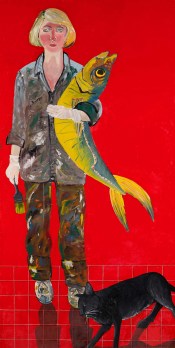
Contributed by David Carrier / Joan Brown’s retrospective at the Carnegie Museum of Art in Pittsburgh includes some 40 paintings, most of them large, and a couple of sculptures. The high, white-walled galleries on the top floor of the museum afford her paintings ample room to breathe.

Solo Shows

Ethel Schwabacher: Canon-adjacent?

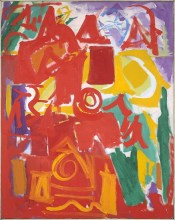
Contributed by David Carrier / Revisionist arguments about who should be counted among the artistic elite, whether they be old masters or modernists, provide essential stimulus in the art world. They proceed in an established manner. Some reasonably influential figure contends that a significant artist has been unjustly excluded from a particular art canon. Commentaries are published and shows organized making the case for supplementing it. The recent amendments to the predominantly white male Abstract Expressionist elite have proven especially tricky, as issues of gender and race enter the picture. Does Alma Thomas belong? Norman Lewis? What about Ethel Schwabacher? With “Woman in Nature (Paintings from the 1950s)”, Berry and Campbell argue energetically, though not entirely convincingly, that she deserves a place.

Museum Exhibitions

Self-taught artists and art history

Contributed by David Carrier / “Gatecrashers: The Rise of the Self-Taught Artist in America” at the Westmoreland Museum of American Art focuses on the pre-Clement Greenberg American art world – before Abstract Expressionism had triumphed, before the high-pressure commercial gallery system had been established, before American painters self-consciously sought to extend the traditions of European modernism, before they assumed the burden of building on Impressionism, Post-Impressionism, and Cubism. Yet it’s important not to exaggerate that admitted hinge-point in art history. In the 1930s, prominent art dealers like Sidney Janis championed some of the outsider cadre as heartily as he would young Abstract Expressionists, and New York galleries hung their work as well as that of future American art stars they would later fete.

Museum Exhibitions

Lucian Freud, authentic modernist

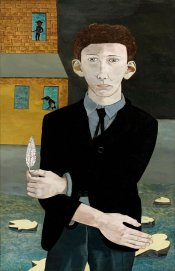
Contributed by David Carrier / The National Gallery’s retrospective celebrating the centenary of Lucian Freud’s birth is first exhibition of his work in a museum of historical art. Freud himself was very familiar with The National Gallery. As the catalogue says, he thought of it “as a doctor to whom, as an artist, one turned for help.” With more than 60 paintings on display, we get a full picture of his career.

Solo Shows

Spencer Finch’s dazzling originality

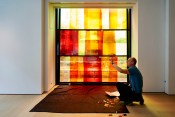
Contributed by David Carrier / Spencer Finch’s new and recent work at Hill Art Foundation in Chelsea are set in dialogue with The Creation and the Expulsion from Paradise, a magnificent 1533 stained-glass window by Renaissance master Valentin Bousch. “Lux and Lumen,” the exhibition’s title, comes from Abbot Suger of the cathedral at Saint-Denis, who praised the power of stained glass to transform natural light, or lux, into sacred light, or lumen. Inspired by that medieval idea, and by his visit to Claude Monet’s pond and garden at Giverny, Finch’s Painting Air, an immersive hanging-glass installation, is a dramatic visual essay on light.

Gallery shows

Lisa Corinne Davis and Shirley Kaneda: Different strokes

Contributed by David Carrier / In the charming traditional galleries of the Studio School, Shirley Kaneda displays six large, vertically-oriented acrylic paintings. Lisa Corinne Davis presents seven oil works of various sizes. Where Kaneda organizes her pictures with playful vertical stripes of high-pitched pale blue or pink, Davis’ pictures are based on grids, disrupted to form swelling nets that enclose but do not entirely capture her forms, which are underneath. These bodies of work thus reveal two distinctly different strategies for pictorial composition. In traditional terms, Kaneda is a painterly artist, a colorist, while Davis works like a draftsperson, in a linear style. Art-historically speaking, if Kaneda renders exquisitely refined images reminiscent of Juan Gris or Sophie Tauber-Arp, Davis maps the structure of the city grid in ways that recall Julia Mehretu.