Contributed by Margaret McCann / “When I Don’t Sleep I Dream” at the Museum of Modern Art traces the odyssey of Afro-Asian Cuban painter Wilfredo Lam (1902–1982). His 20th-century oeuvre encompasses a prescient global combination of influences. Youthful talent afforded him portraiture study in Spain, where he remained for 15 years. But, like Goya, inclination and events pushed his art past appearances. Lam lost his young wife and son to tuberculosis, saw terrible sights resisting fascism in the Spanish civil war, and suffered chemical poisoning. Escaping Franco’s “dark forces,” he left “defeated” with “a deep pain I have never stopped carrying.” Remnants of that inform Annonciation – Nouvelle Bonte. With Kuniyoshi severity, a procreational female coheres amidst fragmentation, recalling Goya’s Disasters of War and Picasso’s Guernica. Yet the configuration also resembles those in Bosch’s fruitful Garden. Lam’s timeless visions bypass judgment or tragedy.
In 1938, Lam found refuge in France – among colonial powers, the most open to Blacks, and a modernist mecca. He met Picasso, and through him Cubists and Surrealists. Lam grew up with diasporic African art, but Picasso’s aesthetic admiration for “primative” art was revitalizing. Lam considered him “an instigator of freedom”. But when the Nazis encroached two years later, Lam fled to Marseille, joining other Surrealists.
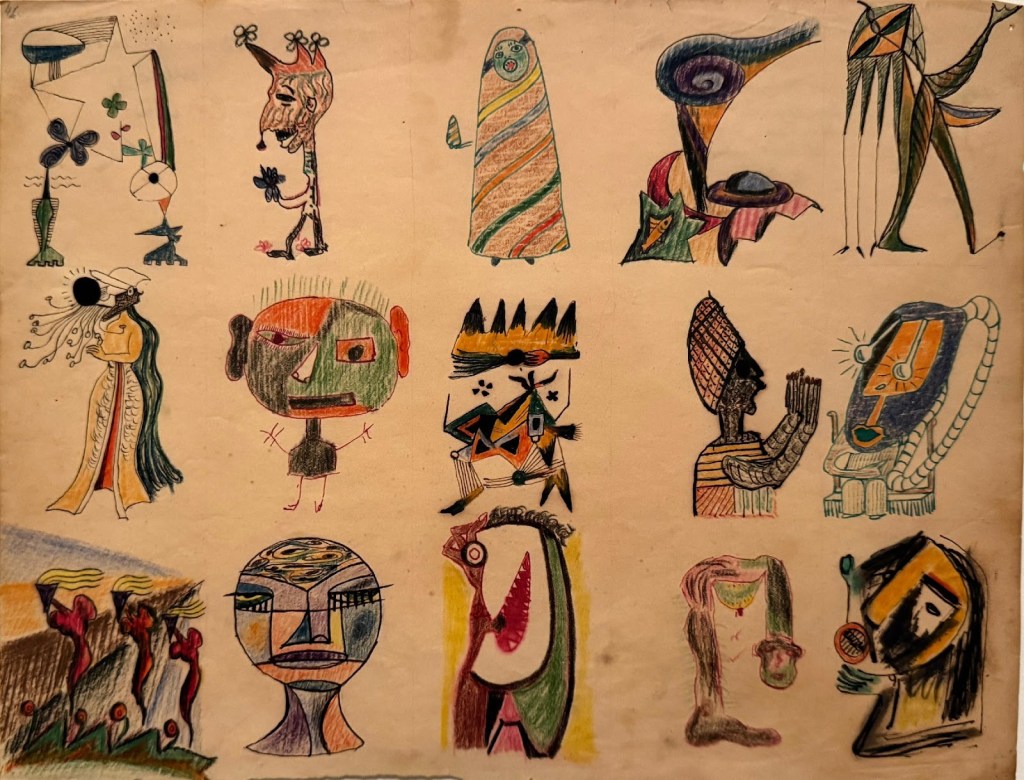
While awaiting passage out of Europe, automatic writing and exquisite corpse relieved their “worries and fears.” Andre Breton collaborated in Collective Drawing – and would provide many titles for Lam. During the ocean crossing with 350 other political refugees, Lam met Aime Cesaire in Martinique, whose poetry he would illustrate. Cofounder of the Negritude movement, Cesaire dubbed Lam a “great Neo-African painter.”
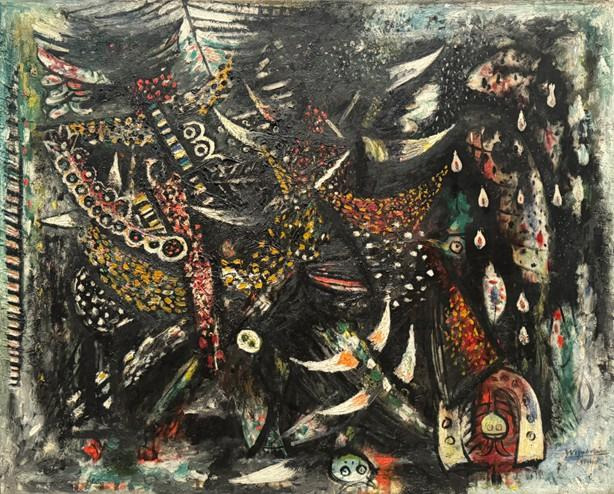
Lam was well-read, intellectually curious, and sociable. Had Mexico granted his visa application, Muralism would have beckoned. In New York, the Harlem Renaissance. Greenbergian formalism was ascendant; Le Nuit, resonant with Motherwell, Gorky, or Gottlieb, suggests that path not taken. Miro-esque dancing forms issue like cosmic stars from a heavy void. But while Miro’s Constellations were escapism, Lam entertained darkness. Despite admitting to “French influence… a certain nervous tendency …opposite of the ‘Spanish roughness’,” Lam’s paintings, like Goya‘s, invoke duende. As Garcia Lorca explained, this Spanish sensibility engages the “possibility of death,” seeking “a straight fight with the creator on the edge of the well [and in] the healing of this wound which never closes is the prodigious, the original.”
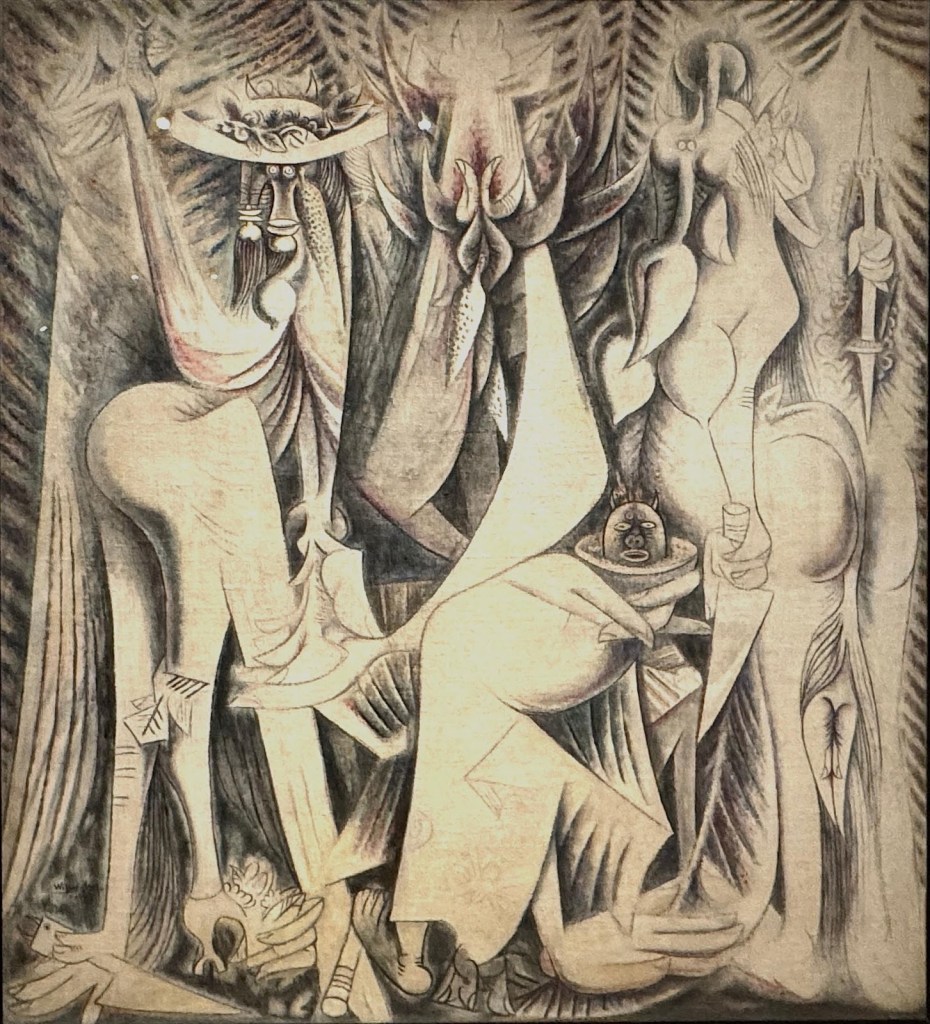
Lam returned to Cuba, unhappy about its Batista dictatorship. With fresh eyes after long travels, he studied Afro-Cuban ethnology. The Eternal Present includes Santeria‘s Changó and eleggua. Though raised Catholic by his Congolese, Spanish, and native Taino mother, Lam’s godmother priestess introduced orishas – African deities, illegal under slavery, and so syncretized with Catholic saints. Lam called the religion “pure surrealism.” Also depicted is a “trinity… the bird of love [and] weapon of destruction …Yin and Yang [with] supreme Tao in the center.” The image recalls Picasso, but Lam’s lighter touch evokes Chinese landscapes. Careful, curving lines echo the calligraphy practiced by his father – a carpenter, scribe, and one of many Chinese immigrants to post-slavery Cuba.
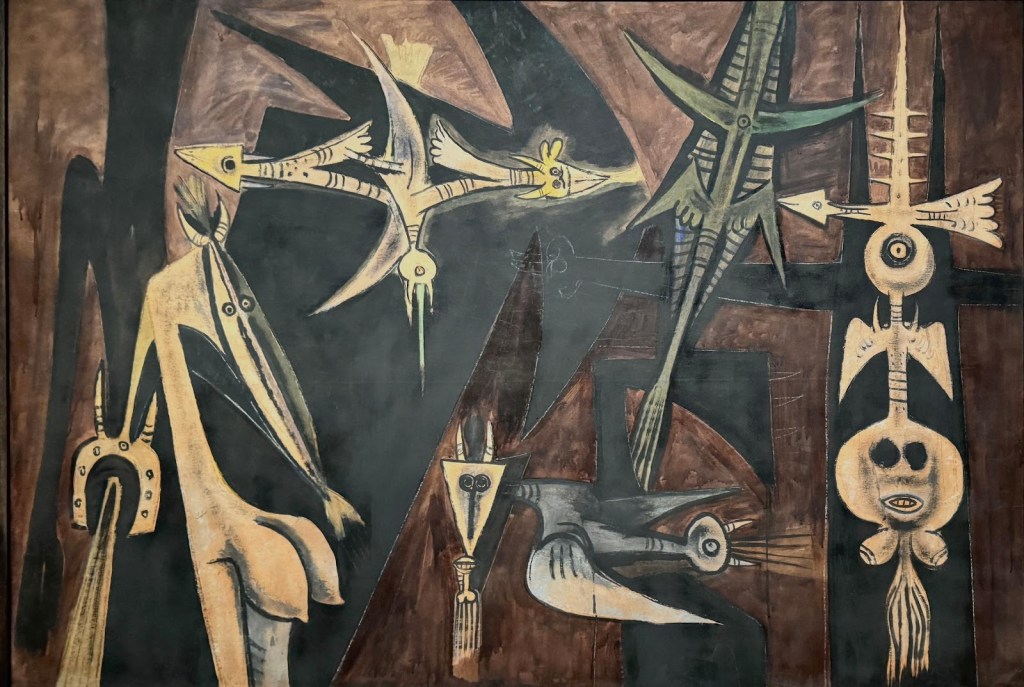
Lam’s collection of African art functioned as both muse and ancestor worship; La Reunion includes an Afro-Chinese ritual weapon. Fueled by automatism, Jung, and duende, the menagerie’s kinetic miasma mingles life and death. Like Gaudi, straight edges or perpendicular axes are avoided. Chance metamorphoses emerge or disintegrate in attentive variations of texture, placement, speed, and scale, moving the eye rhizomatically throughout. While sharing Bacon’s theatricality, Lam’s Confucian harmony slows expressionism into circumspection.
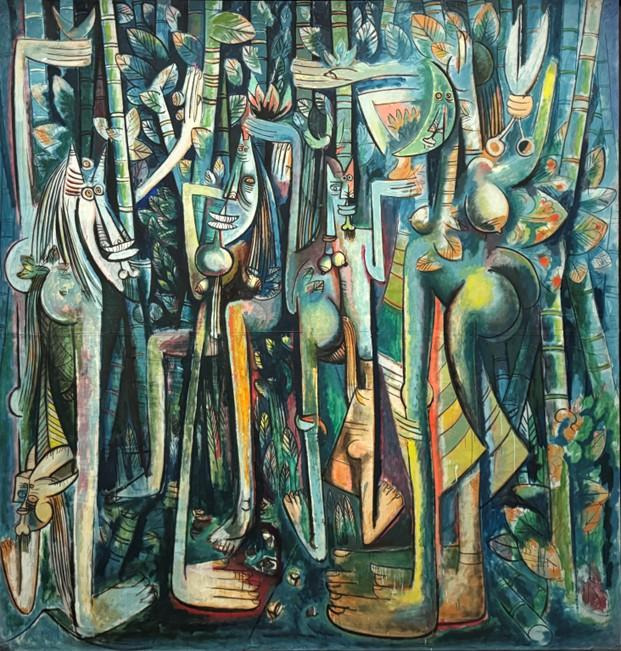
Echoing the class warfare of of Gericault and Courbet, Lam’s references to underclass culture, ignored by Havana’s white nightclub culture, was intended to “disturb the dreams of the exploiters”. Harsh labor of sugarcane, the main Antilles slave crop, features in La Jungla (and in Bad Bunny’s halftime show). The viewpoint reflects childhood memories: when Lam was “very little,” he was surrounded by “my own little jungle” – and by seven older sisters. Though La Jungla’s content was original, its formal language was not, recalling early 20th c. Picasso and Crystal Cubism – Picasso, Metzinger, Gleizes, Delaunay, Popova, etc. It was thus at odds with mid-century MoMA’s anti-communist (thus anti-figurative) dedication to the avant-garde progress of abstraction – an additional explanation for the painting’s awkward placement.

Je Suis features Lam’s horse-woman hybrid. Unlike Miro’s or Ernst’s discrete bodies, Lam’s surrealism conflates convex and concave, preventing the singular creature’s dominance as figure over ground. Her profile is redolent of Egyptian figures, geometric canons that inspired anatomical Greek, Roman, Catholic, and Humanist art; Vitruvian Manembodies rational supremacy. Even Giacometti’s whittled-down humans stand erect or move with purpose. But Lam’s streamlined figures lose western egocentricity, their contingent parts joining a larger pattern. Floating in existential limbos, the mind/body conflict melts into formalist flatness, vanquishing plasticity.
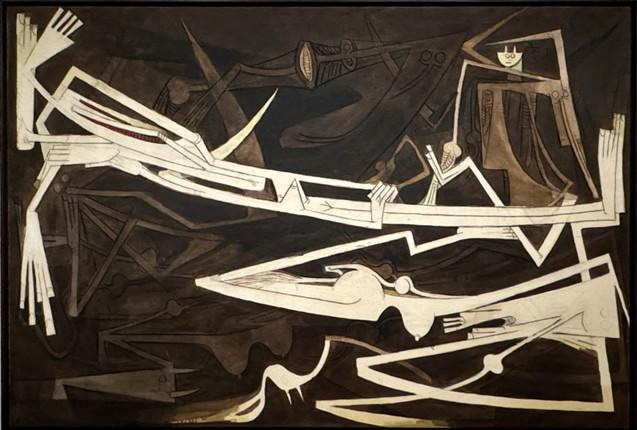
Eventually, Lam leaves western European painting models behind. Looking as alien as ancient geoglyphs, his stunning late paintings pose black and white polarities of positive/ negative within compositional convergences of struggle, contemplation, and mystery. In Le Corps et l’aime, form and space play clever role reversal. Unambiguous from afar, light bodies dissolve up close into raw canvas, empty as blank slates. Marginalized background figures begin to surface. Lam’s subversive “Trojan horse[s]… spewing hallucinating images” challenge like time machines. While fortuitously foretelling contemporary painting’s cultural cross-pollination, they forecast our dislocation into anti-humanist matrices as unpredictable as Lam’s peripatetic journey.
“Wifredo Lam: When I Don’t Sleep, I Dream,” Museum of Modern Art, 11 West 53rd Street, New York, NY. Through April 11, 2026.
About the author: Painter and art writer Margaret McCann teaches at the Art Students League. She has shown her work at Antonia Jannone in Milan and been reviewed in La Repubblica, Corriere della Sera, and the Huffington Post. She edited The Figure (Skira/Rizzoli, 2014) for the New York Academy of Art and has written reviews for Painters’ Table, Art New England, and Two Coats of Paint.