
Style is the answer to everything.
A fresh way to approach a dull or dangerous thing
To do a dull thing with style is preferable to doing a dangerous thing without it
To do a dangerous thing with style is what I call art
From “Style,” by Charles Bukowski
Contributed by Mary Shah / Time is an artist’s friend, muse, and collaborator. An artist’s style develops gradually, and the way to appreciate her work is to look at it over time. Bukowski’s words, which live rent-free in my mind, hypnotically echoed as I took in Melissa Meyer’s absorbing exhibition “Throughlines,” currently on view at Olympia. Comprising ten paintings and an artist book, the show covers the last twenty years and provides a considered, if abridged, look at the evolution of Meyer’s distinctive style up to the present day.
Meyer’s career spans over five decades. Her work from the 1970s through the 1990s saw her communing with her elders – de Kooning, Frankenthaler, Gorky, and Mitchell. Her oils were muscular, dense, and opaque, bustling with energy like bodies dancing on a packed floor. The work from this time was recognized for its achievement, featuring acquisitions by institutions such as The McNay Art Museum, San Antonio, TX, The Brooklyn Museum, Brooklyn, NY, and the Metropolitan Museum of Art, New York, NY.
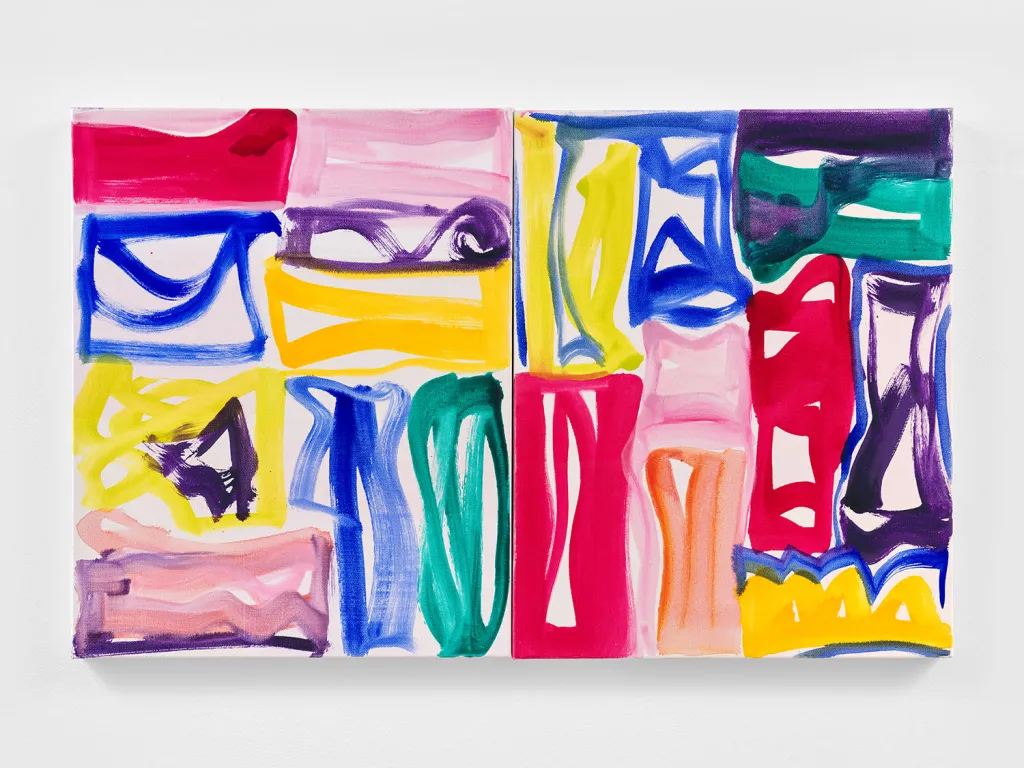
Yet the early 2000s marked a breakthrough for Meyer. As if reaching a clearing in the woods, her paintings became luminous and spacious. Figure and ground were visibly differentiated and glowing with golden light behind translucent violets, magentas, ochers, greens, and ultramarine blues. She was honing her signature style: jewel-toned, calligraphic marks over pale – often yellow- or peach-toned – grids with oil paints thinned to the consistency of watercolor. This shift was well-received, and she garnered several large-scale public art commissions, including multiple mural installations at the Shiodome City Center in Tokyo in 2002 and the Queens Hospital Center 2003.
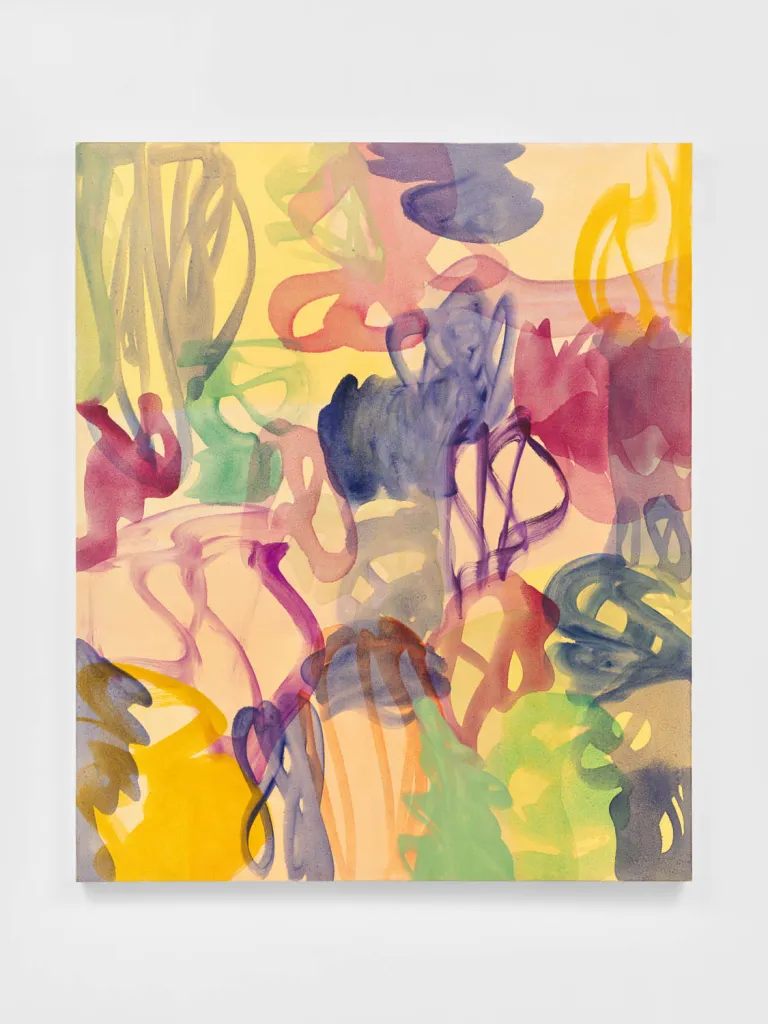
The earliest painting on view in “Throughlines,” She Belongs to Me from 2003, is a shining example of this watershed moment in her work. The colors are warm and floral. The gestural marks become figures in their own right, each occupying its own space on the stage, as it were, sometimes overlapping one another but always with calculated poise and rhythm.
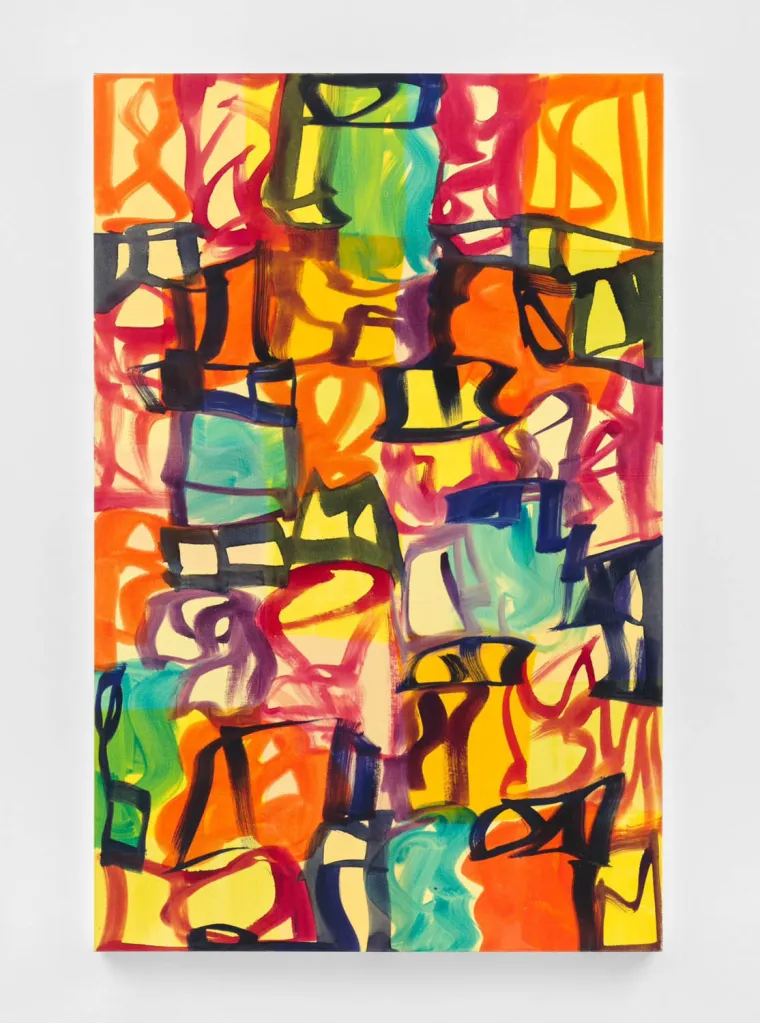

Chronologically, the next painting in the show is Lizzie Hazeldean, an electric, sweeping vertical from 2010. At this point, Meyer had firmly established her own voice in the genre of gestural abstraction. Almost every review or essay on her work refers to her “glyphs” and scrawling, calligraphic marks. Almost ten years later, she reaffirmed this vibrant, musical voice in Flirting.
Five of the ten paintings on view date between 2021 and 2024. Some nuances have changed but key aspects have endured. Meyer’s approach and technique have remained largely the same over the last 25 years. The thin consistency of her oil paint has necessitated a horizontal approach, whereby she composes paintings flat on the floor from above the canvas. This all-over method allows her to balance the composition thoroughly, according due attention to each side and angle with the grace of a choreographer developing a dance or a yoga practitioner in the flow. The subtle yet notable change in these works is the diminishment – sometimes the absence – of the warm grid of patchwork pastels that Meyer invoked for decades. Her jewel-toned characters are now more saturated, in primary and secondary hues against a cool, bright white ground.


Most commanding in this thoughtfully selected group of paintings is the triptych Springtime Trio, which is also the newest. The painting sings with a slightly narrower palette that reads as primary, though her signature phthalo green peeks from her ultramarine blues and a rose-pink blushes behind a thinned cadmium red. The effect is dazzling, the scale bold. The triptych form also feels fresh, possibly a harbinger of further departure and innovation. As a product of Meyer’s meticulously evolved form, this expansive sense of optimism reinforces what Bukowski so keenly observed: that style, when it’s authentic, is the answer to everything.

“Melissa Meyer: Throughlines,” Olympia, 41 Orchard Street, New York, NY. Through June 29, 2024.
About the author: Mary Shah is a Brooklyn-based painter and freelance curator. She shows with Rick Wester Fine Art in Chelsea.





Melissa was one of my art teachers over the years. I am glad to see this great exhibition of her work. Do tell her I say “Mazel Tov” and wish all a long life of more paintings and I send her hugs.
This is the most Exciting and Best work I have seen in Years ! WOW !