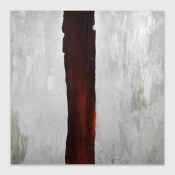
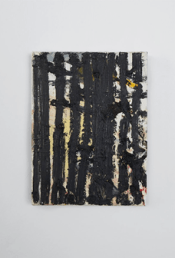
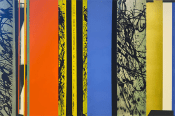
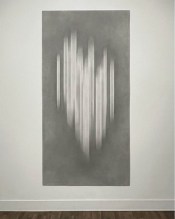
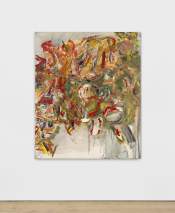
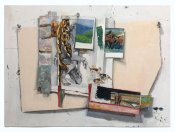
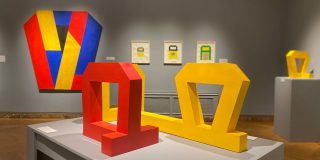
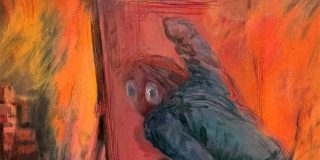
Contributed by Michael Brennan / As a close follower of the emerging art core in South Brooklyn, I seldom miss an exhibition at Yi Gallery. Its shows are invariably interesting and novel, perfectly and poetically installed. The primary space is currently featuring a nicely integrated two-person show of Xingze Li and Sarah Pater’s work, with individual exhibitions for each artist in the back.
Tag: Michael Brennan
Provocative conversations at Platform
Contributed by Michael Brennan / Just over a dozen photographic works, mostly on paper, make up this rewardingly idiosyncratic three-person show “A Matter of Time” at Platform Project Space in Dumbo. Leslie Wayne, a well-regarded and unconventional abstract painter herself, has carefully selected and arranged mostly monochromatic works by Simone Douglas, Joy Episalla, and Beatrice Pediconi. All three artists are engaging with water, time, and photography, and challenging deeply entrenched ideas about how photography can be realized and presented.
Caroline Burton’s compelling in-betweenness
Contributed by Michael Brennan / I took the train to Trenton, New Jersey – TRENTON MAKES, THE WORLD TAKES, the old slogan goes – to see Caroline Burton’s painting exhibition “Way Finding” at the Riverside Gallery in the New Jersey State Museum, which also includes a freestanding library, planetarium, theater, a natural history exhibit, an indigenous peoples’ exhibit, and the obligatory outdoor Calder. The complex, originally designed by Frank Grad and Sons of Newark and constructed in 1965, is a classic example of the liberal utopian/modernist cultural center typically frowned upon these days. But I’m happy to report that the campus, self-contained like Lincoln Center, was teeming with visitors from all walks of life. It is very much a living museum, and ideal for Burton, a reconstructed modernist, who in fact depicts its architecture in some of the works on view.
Nora Riggs: Charming and more
Contributed by Michael Brennan / Nora Riggs tells stories of our modern lives, recording their details. Her mindfully hung exhibition at Tappeto Volante, titled “Uneasy Listening,” traces how her paintings developed, beginning with four small gouaches placed on the lefthand wall of the front chamber. They appear as modest studies. But they also isolate anxious drama, such as that of a young woman searching for a missing earring on the dance floor, in a different way than the larger paintings in the main chamber do. The gouaches feel more interior, spotlighting vignettes, whereas the larger paintings pass searchlights over more expansive tales. Riggs’s gouaches also reveal her penchant for pattern and decoration, leading me suspect that she’s internalized the lessons of Matisse.
Kosuke Kawahara: A heady stew of inspirations
Contributed by Michael Brennan / For a few years now I’ve been following Kosuke Kawahara’s art, which I’ve mostly seen in underground spaces such as Brian Leo Projects, Super Dutchess (now closed), and Culture Lab LIC. These presentations were uniformly fine and intriguing but also truncated and segmented, as was Kawahara’s previous on-line exhibition with RAINRAIN, which has now mounted “Exotic Star” – the artist’s and the gallery’s first true solo exhibition, and the gallery’s inaugural show at its new location on the edge of Chinatown. About a dozen paintings, works on paper, and small sculptures populate this rectangular space, occupying about a half-dozen distinctly crafted stations. It’s a revelation.
Cathy Lebowitz: Restoring the Landscape
Contributed by Michael Brennan / In Cathy Lebowitz’s “Dark Skies, Rocks, her second solo exhibition at Skoto Gallery, about two dozen themed works on paper wrap around the walls of the cinderblock space. Many are washy gouache paintings, others are dash-marked drawings. Her paintings are painterly and her drawings graphic, exemplifying soundly medium-specific discipline. The works are refreshingly small, about the size of a writing tablet or an iPad, inviting closer inspection. I felt an unusually direct connection to the artist through what can be described as microcosmic meta landscapes, extending from her hand through her studio, as if directly sourced in real life
Jane Swavely and the Bowery tradition
Contributed by Michael Brennan / Magenta Plains is located on the Bowery, just as it breaks left onto Canal Street, in Chinatown. Upon entering, viewers are immediately greeted by a washy terre verte Jane Swavely painting, OID #3 Green, hanging above the desk. It sets an organic tone and is indicative of the half-dozen paintings to follow, hanging in the first-floor main gallery. Swavely’s seven canvases are all vertical, and are mostly diptychs, internalized or externalized. They are loosely painted with a 2- to 2 ½-inch flat brush, heavy on the solvent, with some wiping away by hand. Much color mixing happens directly on the surface. Swavely favors flared, phosphorescent hues. She cleverly manipulates paint with rags to create the illusion of light emitting from the ground. Her work glows, appearing backlit.
Eyal Danieli: Embracing history in abstraction
Contributed by Michael Brennan / Israeli-American artist Eyal Danieli passed away earlier this year. I met him a few times, but I didn’t know him. I was impressed by the force of his personality, or more specifically of his presence. It was not that he was intimidating. In fact, he struck me as a tender soul – a gentleman – but also a man weighted with a distinct and uncommon gravity. His painting, in its blunt sensitivity, is similar. Sadly, Danieli’s first exhibition with 57W57 Arts, solemnly called “Preoccupied,” is effectively a memorial show. But nothing can diminish the innate power of his small pieces.
Michael Brennan’s moving images
Two Coats of Paint invited painter Kim Uchiyama to sit down with Michael Brennan to discuss “Floating Weeds,” Brennan’s fourth solo show at Minus Space. In their wide-ranging conversation, they discuss Japanese film, Russell Lee’s photographs, Charles Olson’s poetry, Venetian lagoons, architect Carlo Scarpa, Homer, and more.
Nola Zirin and the march of abstraction
Contributed by Michael Brennan / It has sometimes been assumed that abstraction is unlimited in its possibilities. While that’s still broadly true, abstraction also has been exhaustively explored over the course of a century or more. All painting is organized around some kind of form. Abstraction is burdened with establishing form in the absence of figuration, the readiest and most natural source. There are only a few ways to define form without a figure – for instance, through geometry or gesture. It’s a limited playbook. Much of the success of Nola Zirin’s new paintings, on view at Mosaic Artspace in Long Island City, comes down to her bold expansion of the index of abstraction. Many are striking in their recombination of form and unusual mix of materials.
Taney Roniger and the miracle of charcoal
Contributed by Michael Brennan / I spent spring break at Studio 34 with Taney Roniger, mostly silent, measuring the depth of her drawings. Her solo show there, “Drawing is a Verb,” includes eight works on paper, mostly made of charcoal drawn on slightly textured hot-press watercolor paper. Each drawing is mounted directly on the wall, unframed, using hidden magnets. Her presentation of drawing as a primary medium – not something to be imported into painting or something else later, not for studies – is authoritative. Too often, drawing shows read as frame shows. Drawings presented like these, unmediated by glass or frame, preserve subtle surface incident that would be lost if they were conventionally sealed-off and protected. The collective series title, Myyrmaki, refers to a Lutheran church in Finland, a source of inspiration for the artist, known for its architectural engagement with fluted light.
Paul Mogensen’s ordering formulations
Contributed by Michael Brennan / Paul Mogensen dismisses the Renaissance. Not its considerable artistic achievements, of course, but rather its excessive emphasis within conventional art history. Mogensen is experiencing a renaissance himself with “Paintings: 1965-2022,” at Karma, a de facto mini-retrospective that includes 20 paintings and works on paper. Karma, a gallery known for its adventurous curatorial program and savvy publishing arm, has done a great deal more than most museums to sustain a variety of NYC-specific historical discourses since its inception in 2011. In the case of Mogensen, along with fabled colorist Robert Duran, Karma’s program is potentially the second coming of the legendary Bykert Gallery. This is a considerable achievement in a contemporary art world often characterized by “context collapse.”
Kim Uchiyama’s quasi-sacred spaces
Contributed by Michael Brennan / The seven large paintings in Kim Uchiyama’s solo show “Heat and Shadow” at The Lobby Gallery were inspired by Greek temples located in Sicily. They are rigorous, modernist, and abstract. But what might ancient sacred spaces have to offer anyone in midtown Manhattan in 2022?
Cora Cohen’s thoroughbred abstraction
Contributed by Michael Brennan / The virtues of some art emerge only when it steps out of its own time. Hilma af Klint’s 2018 retrospective at the Guggenheim is an example. Another is Lou Reed’s album Berlin, released and widely panned in 1973, only to be performed and filmed by Julian Schnabel 35 years later, celebrated by an unforeseen audience, and subsequently considered a canonical masterpiece. Cora Cohen did exhibit her work in the 1980s and has been showing regularly, at a high level, since the 1970s. She’s a well-known, well-regarded painter. But the eight large abstract paintings from the 1980s, now on display at Morgan Presents, haven’t been shown together until now. They are a revelation that couldn’t have fully registered in its own time.
Hank Ehrenfried’s painterly erudition
Contributed by Michael Brennan / “Fold Upon Fold,” the title of Hank Ehrenfried’s first solo exhibition in New York, at Auxier Kline on the Lower East Side, is an expression borrowed from a sonnet by French Symbolist Stéphane Mallarmé. It succinctly describes the creative premise behind every painting presented. Working in the trompe l’oeil style, Ehrenfried paints realistic images of his own collages, made mostly during the pandemic. Making the collages the subject of the paintings lends the show a lightly but distinctly meta character, reflecting both the claustrophobic intensity and the intellectual expansiveness of his endeavor.