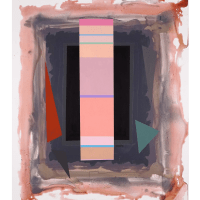
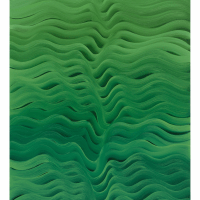
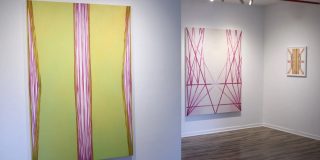
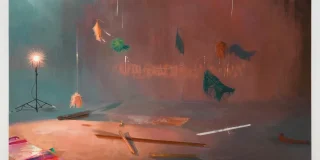
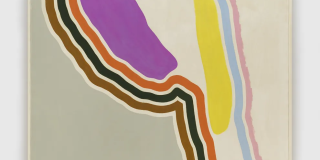
Contributed by Amanda Church / Conjuring The Cure’s 1987 song Just Like Heaven – which proclaims “you’re just like a dream” – Karin Davie’s eight new large-scale paintings on view at Miles McEnery Gallery, all oil on linen, transport us to a realm of sensation and association. Here her wavy imagery, which she has been developing in one form or another since the 1990s, immediately evokes the swells and dips of the ocean’s surface as well as recalling the fluid lines essential to the work of painters like Sol LeWitt, Brice Marden, Bridget Riley, Moira Dryer, and late de Kooning, albeit to varying effect.
Tag: Brice Marden
Chris Martin: Staring into the sun
Contributed by Sharon Butler / Chris Martin is deep into a nearly five-decade-long artistic odyssey fueled by an unrelenting passion for process, spontaneity, and embracing the unexpected. His prolific energy, both physical and creative, melds into his broad knowledge of painting history and an insatiable desire to share his thoughts, feelings, and vast collection of everyday ephemera and small objects by embedding them in paint on canvas. Martin’s paintings are bursts of assemblage showcasing the power of proximity – vibrant cacophonies of glitter, pages ripped from textbooks books, magazine remnants, letters, and newspaper clippings. “Speed of Light,” his second solo exhibition with Timothy Taylor, draws inspiration from the dark night sky in the Catskills, inflecting profound questions about the universe with a comedian’s flair for the seriously absurd. The results are thought-provoking, funny, and, at times, ecstatic.
Jill Nathanson: Beyond Color Field painting
Contributed by A.V. Ryan / Jill Nathanson’s solo show “Chord Field” opened in late June at Berry Campbell Gallery. It is her fourth at the gallery but her first in its spacious, skylit new space. It seemed a fine opportunity to talk to her about her work, new and old.
A (mostly appreciative) response to Saul Ostrow
Contributed by Adam Simon / I was struck by the last two sentences of Saul Ostrow’s essay, “Painting simulacra: Brice Marden, David Reed, and Gerhard Richter.” He writes: “Marden, Reed, and Richter have sustained abstract painting’s aesthetic and cultural value as a mode of resistive thinking. In most cases, though, this has been misread or at least subsumed by its own model, thereby giving rise to the kind of acritical aestheticism and nostalgia that bolsters painters who promote gestural abstraction as a genre or motif rather than a mode of inquiry.” It took a minute to unpack this statement and allow it to sink in. Ostrow’s critique is dense, and appears to implicate most contemporary gestural abstract painters as well as contemporary criticism that dismisses the possibility of radical formalism.
Painting simulacra: Brice Marden, David Reed, and Gerhard Richter
Contributed by Saul Ostrow / “Let the Painting Make You,” the exhibition of Brice Marden’s last paintings; at Gagosian Gallery, set me to thinking about the relationship between Marden’s earlier gestural works and Gerhardt Richter’s process-oriented abstract paintings, which in turn led me to consider the connection of their works to those of David Reed and then to the French artists Simon Hantai and Bernard Frize who, like Reed, creates the illusion of an impossible spontaneity. Slowly, I came to focus on the question of why Richter is identified with post-modernism, while Marden and Reed’s works are most often critically identified as being quintessentially modernist and formalist. While Hantai (the modernist?) and Frieze (the post-modernist?) fit the question of what constitutes post-modern abstract painting, their references and histories are different for consideration here. Instead, I decided I would focus on Richter, Reed and Marden all who seem to transgress the formalist and modernist dictums that were generated in the 1950s and 1960s in the United States and then exported abroad, as such Hantai and Frize are part of another genealogy.
Beyond time: Brice Marden’s last paintings
Contributed by Kim Uchiyama / The dreamtime, as understood in Aboriginal culture, is a fully integrated reality lived daily, a total experience that holds past, present, and future in balance. From this perspective, the late Brice Marden’s last paintings feel both old and new, evoking an ancient mindset while embodying a new sentience and haptic presence born of the vulnerability and fragile urgings that arose as he grappled with his aging body and the ravages of cancer. The show’s title, Let the painting make you, is apt. It is fundamental to Marden’s work that painting spoke through him from the inside out: although he always adhered to his own set of rules, he never imposed an intellectualized concept on his creations.
Brice Marden’s valedictory courage
Contributed by David Rhodes / Brice Marden died at the age of 84 in August 2023. His first exhibition was in 1966 at the Bykert Gallery, located on East 81st Street, only a few blocks northeast of his current exhibition at Gagosian. A long life, years in the studio, immeasurable time spent with other artists’ work, travel, and an abundance of courage led to the paintings he made at the end of his life.
How long does it take Brice Marden to make a painting?
In this 2009 conversation with Harry Cooper, curator at National Gallery of Art in Washington, DC, that was recorded at Brice Marden’s (Manhattan) studio, Marden […]
Holland Cotter: Unadventurous painting is everywhere (at least in New York)
In the NY Times Holland Cotter reviews “The Jewel Thief,” an exhibition that explores new ways to think about and experience abstract art at Skidmore’s […]
Studio Update: So long, little shack
When I recently vacated my summer studio shack at Habitat For Artists, Simon Draper, creator/curator of the unusual HFA residency project in Beacon, NY, asked […]
Studio update: Itinerant painter
Contributed by SHaron Butler / Every professor has a wildly optimistic, first-day-of-summer-vacation “List of Things To Do.” Here’s mine. The most significant decision has been […]
IMHO: Don’t stop me if I’m repeating myself
“Deja Vu? Revealing Repetition in French Masterpieces,” organized by Eik Kahng. Walters Art Museum, Baltimore, MD. Through Jan. 1. Phoenix Art Museum, January 20 through […]