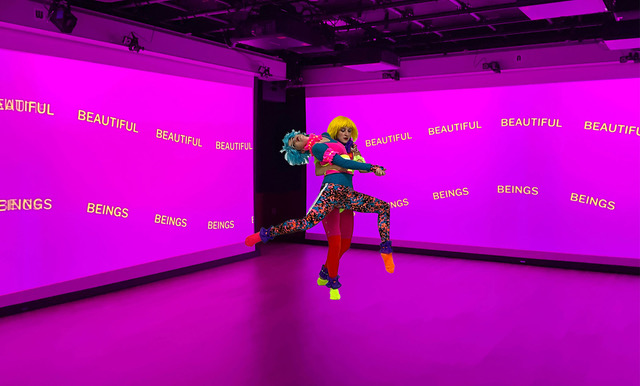
Contributed by Susan Silas / Sculptor and inter-media installation artist Michelle Jaffe creates time-based experiential works at the intersection of sculpture, sound, video, and performance. Sound has been the connective tissue of her work since 2003. Susan Silas is a visual artist working in video, sculpture, and post-photographic media. Her primary subject for the past 30 years has been embodiment. From that perspective, she talked with Jaffe about her video-and-sound installation GRIFTER’s Gambit.
SUSAN SILAS: Your new work GRIFTER’s Gambit begins with: “Flesh of my flesh, how could you kill/crush those beautiful beings your children are.” This theme hearkens back to mythology – Cronus eating his children. One has only to think of Goya’s painting Saturn Devouring His Son to feel both the power and the persistence of the Greek myth. This feels like the jumping-off point for all that follows. Can you talk a little about how you shaped the work around this concept?
MICHELLE JAFFE: The first lines of the libretto are indeed the launching pad, and do hark back to the mythology you’ve identified. GRIFTER’s Gambit is rooted in the personal, the archetype of the narcissistic authoritarian alpha personality, a very insecure type. The family unit is the micro version of the social structures we collectively create and inhabit. GRIFTER’s Gambit and Soul Junk explore the effects of the patriarchy, toxic masculinity, the alpha male: the one who believes he alone is right, that he, over and above everyone else, knows best. This personality type can also extend to women. Yet women make up the largest oppressed global group. To date, most societies are governed by patriarchy and strong male figures. Both works seek to present the deep hurt felt in the wake of this dominance. The hope of democracy has been to encourage society to flourish in a thoughtful, creative, inquisitive, joyful manner, allowing a wider range of intelligent voices to contribute to global social discourse. Over the past 22 years, four of my large-scale projects have tracked the power shifts in American political life and discourse.
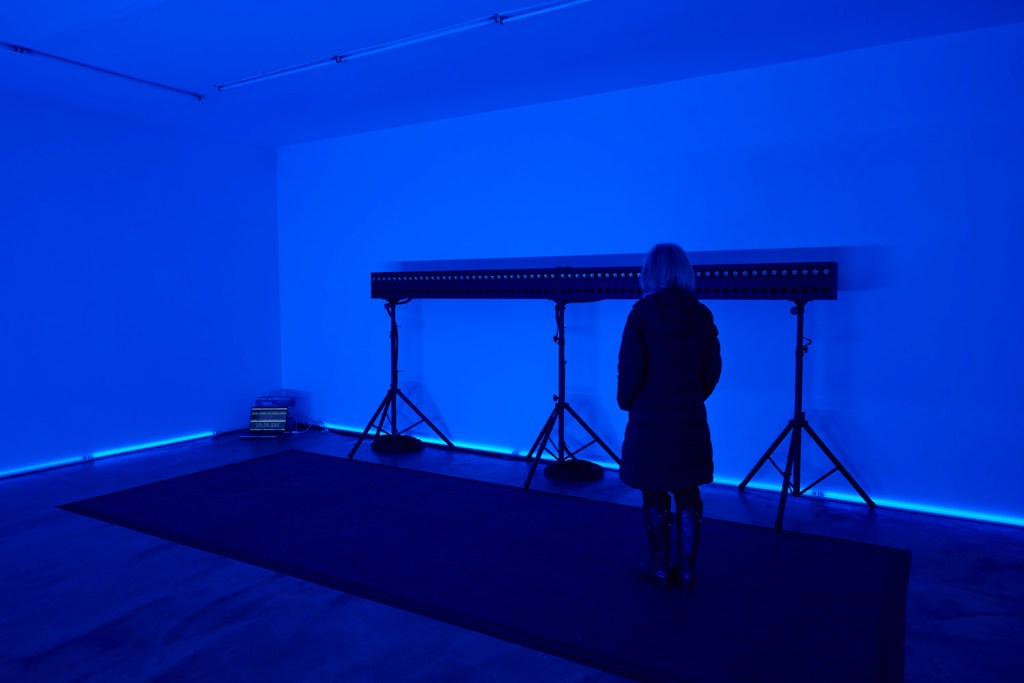
SS: I first encountered your work at White Box in New York in 2019 in a show curated by Lara Pan that included Soul Junk. It shares some elements with GRIFTER’s Gambit, just installed at NYU. There is video projection, spatially directed sound, and the creation of an immersive environment. In the new work, the narration is set to music, becoming a libretto and thus creating an operatic feel. My experience of this work, and past projects of yours including Murmer/Mutter/Yell from 2019–2021, is that I have fallen into a vortex, receiving fragments from a political consciousness that I have become enveloped by. Is it your intention that the audience feel this in a visceral way, or do you intend for the audience to come away with a specific linear political narrative?
MJ: I never expect people to walk away with a linear or specific idea because people bring their own life experience into the space I present. My work offers propositions, inviting people to make connections they may not make otherwise. Having said that, I appreciate that you feel enveloped when you experience my work. That is intentional. I want to facilitate multi-sensory encounters, engaging mind and body simultaneously, creating a three-dimensional experience.

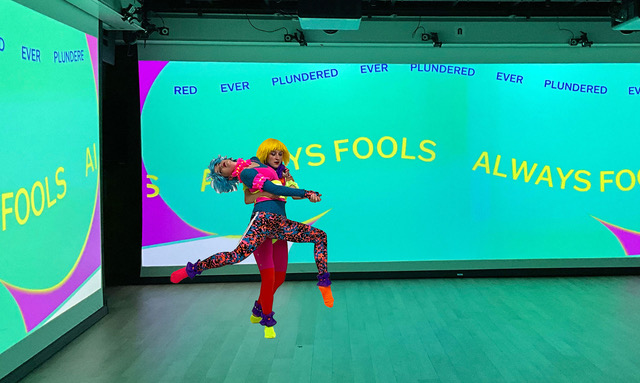
SS: GRIFTER’s Gambit has elements I don’t think you have used before. The narrative is affixed to a musical score, becoming a libretto. Do you feel that the content is altered in any way by this? Are the phrases we see on the walls in all those luscious colors meant to narrate, or rather to be seen as symbols or signposts pointing us in a direction without necessarily spelling out a position?
MJ: I wrote the piece as a kind of tragicomic opera. The text in the video mirrors and grounds the vocal composition, as subtitles do at the opera. My hope is that people synthesize information in a way that is meaningful to them, fostering deeper engagement in the world.
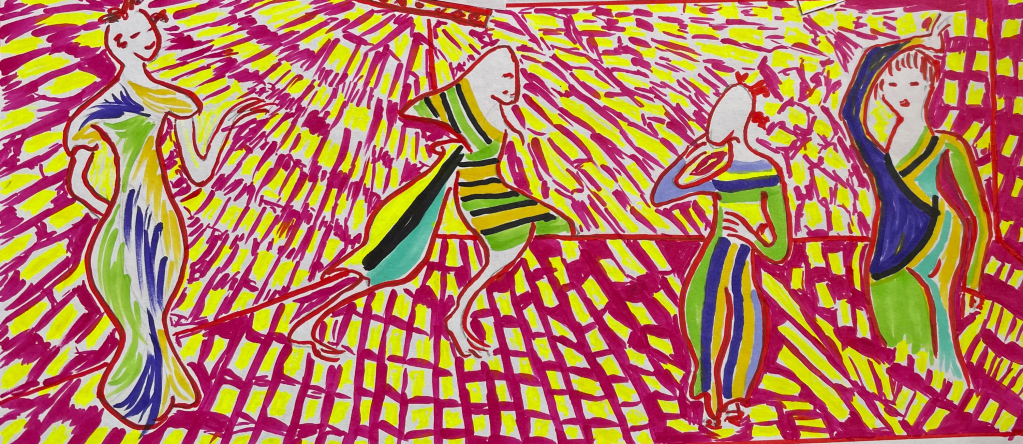
SS: In addition to the libretto, you have a choreographed element in this work. You’ve employed video projections in the past, but on this occasion, the projection is of dancers, somewhat reminiscent of the cyborgs in Blade Runner. How did you decide on dance as part of the installation, and do you imagine having live dancers at some point as part of your immersive environments?
MJ: From the beginning, I imagined dancers as central to GRIFTER’s Gambit. I have wanted to work with them since I was in my twenties. For a variety of reasons, this is the first project where that vision came to life. I do see dancers performing live with the vocalists. This could happen in a variety of ways. They could thread through a gallery or a large-scale media venue or perform in a more formal presentation in a theater.
SS: Sound has played a very important part in your work over the years. Is it the building block on which everything else rests? Do you start with sound and build out from there?
MJ: Sound has been a pivotal medium for me as a sculptor for over 20 years. It is, as you suggest, fully integrated into each work from concept to realization, just as warp is dependent upon weft in the weaving of fabric. I hope the work is richer for it.
“Michelle Jaffe, GRIFTER’s Gambit – Composition 1,” video/sound installation,13:17 minutes, NYU 370 Media Lab, New York, NY.
About the interviewer: Susan Silas is a visual artist working primarily in video, sculpture, and photography. Her work, through self-portraiture, examines the meaning of embodiment, the index in representation, and the evolution of our understanding of the self.