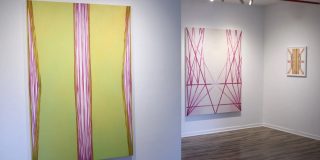
Contributed by John Goodrich / The act of painting is enough to befuddle the ordered mind. We can grasp its basic ingredients: the lines that divide a surface, directing the eye and locating forms and details; the tones that lend mysterious weight to light, fleshing out volumes and intervals; the colors that recast tones with a new dimensionality of hues and intensities. But each of these ingredients continuously rejiggers the others. Where to begin? How to finish? The challenge is hardly new. In 1765, addressing the jury of the Académie Française, the great painter Chardin pictured how “a thousand unhappy painters have broken their brushes between their teeth out of despair.” Every artist, of course, ends up finding their own way, favoring one or another of these ingredients. For some, the actions of color are especially crucial, and do more than cast objects in a luminous light; the pressures and intervals of color leverage an overall design, illuminating how objects occupy the world framed by a painting. Judging by the work now on display at Lori Bookstein Projects, Susannah Phillips is one such colorist.
Tag: Mark Rothko
Friedrich’s contemplative sublime
Contributed by Margaret McCann / “The Soul of Nature”at the Metropolitan Museum of Art is one of many exhibitions dedicated to German Romantic painter Caspar David Friedrich (1774–1840) on the 250th anniversary of his death. Some of his finest are absent – the epic Sea of Ice’s vision of an arctic shipwreck, The Great Enclosure’s resonant view of a Dresden field Napoleon amassed his troops on, or Ruine Eldena, one of Friedrich’s many depictions of the remnants of the powerful Catholic monastery his hometown Griefswald formed around. But there are numerous studies displaying his keen observation of nature, research he used for paintings creatively orchestrated in the studio.
Julie Beaufils: New painting for end times
Contributed by Jason Andrew / It’s easy to associate the new paintings by Julie Beaufils, now on view at Matthew Brown Gallery in Tribeca, with a post-apocalyptic world. The sixteen paintings suggest fractured architectures and abandoned fields, sun baked and rising from a humming radioactive haze. Beaufils lives and works in Paris, and her precise lines and delineated spaces capture its curving promenades, narrowed boulevards, and sinking perspectives. Travels to Los Angeles and the American Southwest have also influenced this new work.
Force field: Myron Stout’s drawings
Contributed by Natasha Sweeten / In the early 2000s, among the pines and solace of an artist residency, Polly Apfelbaum shared with me a small, well-thumbed through book. Right off the bat I took the isolated black-and-white image on its cover to possess talismanic powers. Such was my introduction to the work of Myron Stout.
David Hornung’s whispered secrets
Contributed by Natasha Sweeten / There should be a word for the glorious sensation you get when you realize the art in front of you is better than you’d expected, having initially seen it on a screen. You may scoff, “Isn’t everything better in person?,” but I beg to differ. These illuminated contraptions we carry around everywhere are remarkably good at turning life to 11. When I’m rewarded with this aforementioned word-I-don’t-yet-have, I chalk one up for being there. So it was when I stepped into David Hornung’s “New Work,” the inaugural exhibition at JJ Murphy Gallery on the LES.
Rothko edits Rothko
In The Independent Claire Dwyer Hoggs talks to Chris Rothko, Mark Rothko‘s son and editor of The Artist’s Reality: Philosophies of Art, a new book […]
Rothko’s Chapel: Everyone’s missing the suicidal artist’s point
In The Guardian Jonathan Jones reports that his visit to the Rothko Chapel in Houston left him impressed, but troubled that Rothko‘s project is so […]