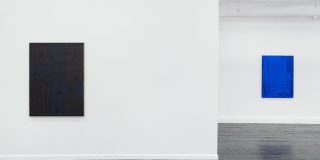
Contributed by David Carrier / Brice Marden, who died in 2023, has always had an astonishing mystique. Two generations ago, when painting was often pronounced dead, he identified as a rare heroic survivor and continued to make abstractions. It was possible then to see him as the true successor to Jackson Pollock and Jasper Johns – the one artist who kept the New York School alive. But now, in a very different environment, his work has to be understood differently. Gagosian’s museum-scale retrospective “I Am Plane Image,” an exemplary exercise in curatorship, lets us appreciate at once his range and his discipline, both remarkable.
Tag: Edouard Manet
Barbara Friedman’s exquisite grotesquery
Contributed by Adam Simon / The modus operandi behind much of Barbara Friedman’s work, including her current exhibition “All Rude and Lumpy Matter” at Frosch & Co., has a name, pareidolia, which refers to finding images within abstraction. Think of the age-old pastime of finding faces in clouds.
Berthe Weill: The gallerist who loved art too well
Contributed by John Goodrich / Hindsight, of course, is 20/20. Looking back at the early decades of modernism, we may sense something inevitable about the ascent of Picasso and Matisse. Weren’t both driven, gifted artists poised to take advantage of their cultural moment? And wasn’t the time ripe for Matisse’s upending of expectations of color, and Picasso’s overturning of pictorial structures? Of course, life is not so tidy and linear for the artists operating in the moment. As the luminous exhibition “Make Way for Berthe Weill: Art Dealer of the Parisian Avant-Garde” at NYU’s Grey Art Museum demonstrates, none of the early modernists had a monopoly on talent or a singularly dominant vision of what painting had to be.
Hung Liu’s timeless twentieth century
Contributed by Rosetta Marantz Cohen / Rare among contemporary artists, Hung Liu, who died in 2021, chronicled the trauma experienced by the Chinese diaspora in the aftermath of the Cultural Revolution. Her paintings, currently on view at Ryan Lee, vividly depict a female artist’s efforts to reconcile the terror of China’s recent past and the “otherness” she experienced after her emigration to the United States. The exhibit seems especially poignant now as questions about homeland, memory, and trauma resonate with such immediacy.
Alessandro Twombly: Strikingly original, richly allusive
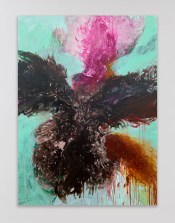
Contributed by David Carrier / Alessandro Twombly’s twelve large new paintings, now on view at Amanita Gallery, all employ one basic, immensely fruitful motif: knots of color resembling enlarged floral forms, depicted in high-pitched, gesturally painted oranges, pinks, reds, and blacks on bright turquoise backgrounds. An artist friend nicknamed these pictures ‘Tiepolo in the Sky,” which accurately describes them. Twombly’s abstract images look like drastically enlarged figures you might find in a work by the eighteenth-century Italian painter Giovanni Battista Tiepolo. They are strikingly original yet richly allusive.
Howard Hodgkin’s Indian court collection: enigmatic or just good?
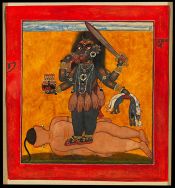
Contributed by David Carrier / Some very successful artists are also collectors, and the art that artists collect can reveal or confirm something about their own work and social attitudes. For example, Edgar Degas’ abundant holdings included works by Édouard Manet, which shows that Degas elevated aesthetic qualities over political beliefs. Unsurprisingly, Pablo Picasso traded art with Henri Matisse. Given Picasso’s obsessive rivalry with the Frenchman, he must have enjoyed keeping score with his frenemy as well as infiltrating Matisse’s collection with his own work. What then are we to make of British painter Howard Hodgkin’s trove of Indian court paintings, now on view at the Metropolitan Museum of Art?
Hank Ehrenfried’s painterly erudition
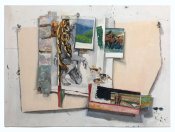
Contributed by Michael Brennan / “Fold Upon Fold,” the title of Hank Ehrenfried’s first solo exhibition in New York, at Auxier Kline on the Lower East Side, is an expression borrowed from a sonnet by French Symbolist Stéphane Mallarmé. It succinctly describes the creative premise behind every painting presented. Working in the trompe l’oeil style, Ehrenfried paints realistic images of his own collages, made mostly during the pandemic. Making the collages the subject of the paintings lends the show a lightly but distinctly meta character, reflecting both the claustrophobic intensity and the intellectual expansiveness of his endeavor.