Contributed by Jonathan Stevenson / A great asset of abstract art is its capacity to accommodate in a single picture phenomena that don’t readily fit together in real life and make some kind of sense out of them. There are as many ways to exploit that capacity as there are artists. In her solo show “Loggia” now on view at Helm Contemporary, comprising three large pieces and several smaller ones, Kim Uchiyama distills visual tropes of nature – water, shoreline, forest, desert, and more – into configurations of color that project an idealized but grounded spatial relationship between outside and inside, broadly construed. It’s a quietly ambitious agenda, and she is successful in no small part because her brand of geometric abstraction is so egalitarian: no single element seems more or less important than another.

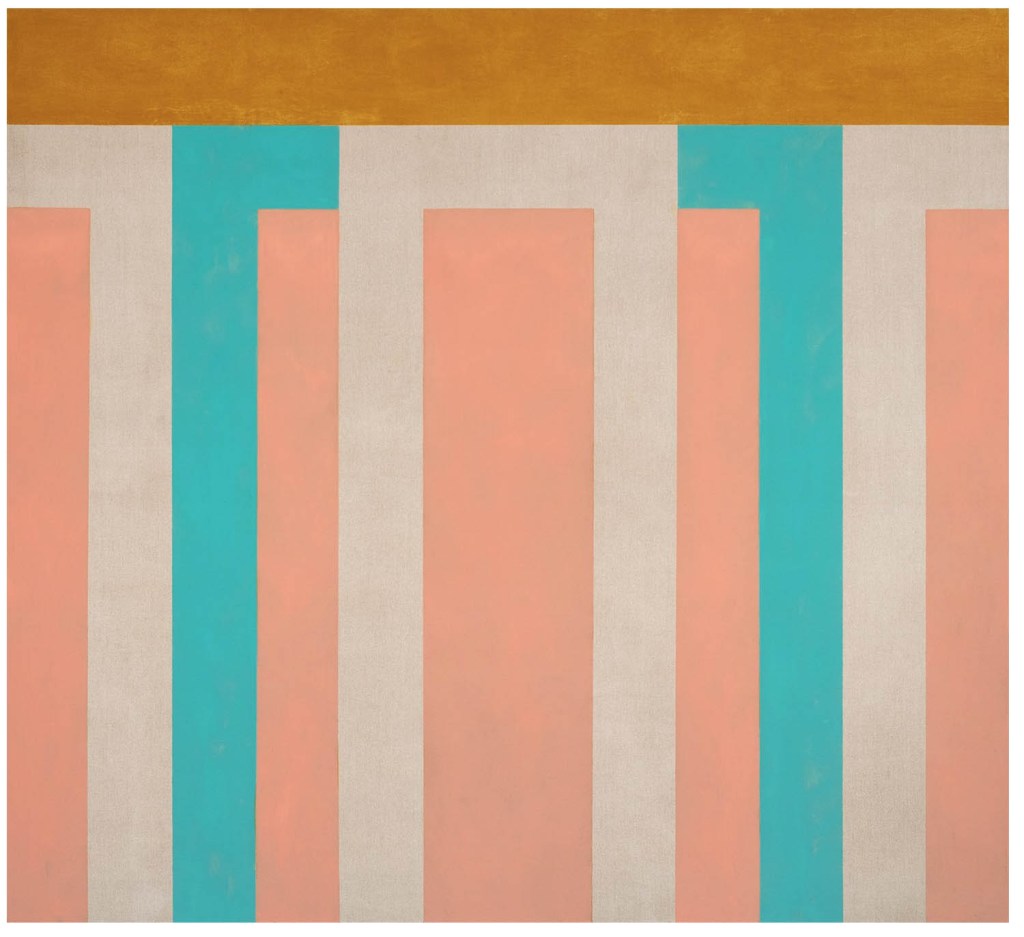
That quality could embed a political viewpoint, but Uchiyama’s primary intention is likely more philosophical and less argumentative. The natural and the artificial are not in overt conflict – the titular fabricated construct being an open-air one – and the premium is on harmony and seamless transition, starkly underlined by the elegantly architectural cast of Equinox. In the consummately complex Threshold, which occupies center stage in the gallery, serifed vertical strips of turquoise infiltrate columns of adobe pink and raw linen, moored by a murkily enigmatic ocher banner, incongruously Marden-esque, across the top of the painting. It’s a resolutely non-objective work, yet it holistically summons such subtle existential pairings as liberation and security, serenity and suburbia, idyl and ennui.
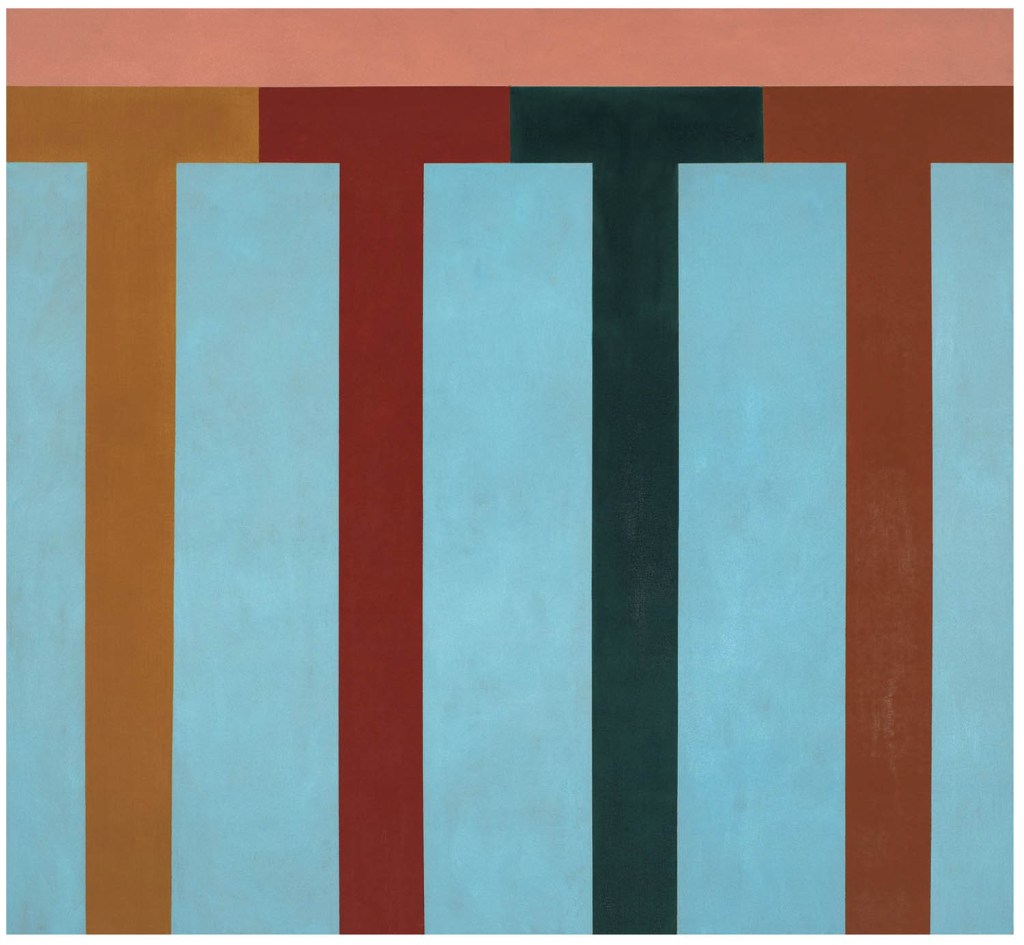

No mere formalist, Uchiyama is explicitly interested in the fluidity of inside and outside space, which broadly aligns with that of comfort and risk. For all their structural calmness, her paintings – especially the predominantly blue Portico 4 – can convey the paradoxically languid emotional turbulence of, say, Antonioni’s L’Avventura. This characteristic derives from Uchiyama’s carefully gauged gradients of paint – more pronounced in Blue T, a small work on paper – and her incisive deployment of colors, which range from intense green and soulful burnt sienna to more delicate blues and pinks, as well as her choice, at times, of no paint at all. On account of color, three geometrically identical paintings– Abaton, Golden T, and Stoa – are leagues apart in mood and implied season. While regimented symmetry can impart flatness and confinement, here, with such nuance, it captures life’s depth and variability in a paean to baseline contentment.
“Kim Uchiyama: Loggia,” Helm Contemporary, 132 Bowery, 3rd Floor, New York, NY. Through June 29, 2024.
About the author: Jonathan Stevenson is a New York-based policy analyst, editor, and writer, contributing to the New York Times, the New York Review of Books, and Politico, among other publications, and a regular contributor to Two Coats of Paint.