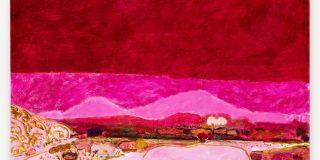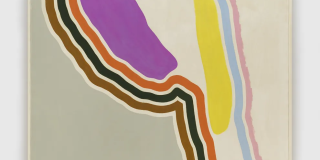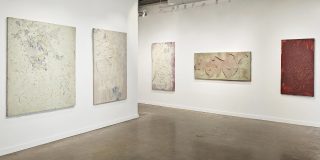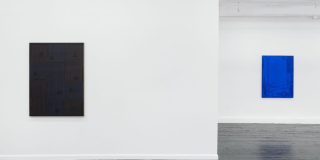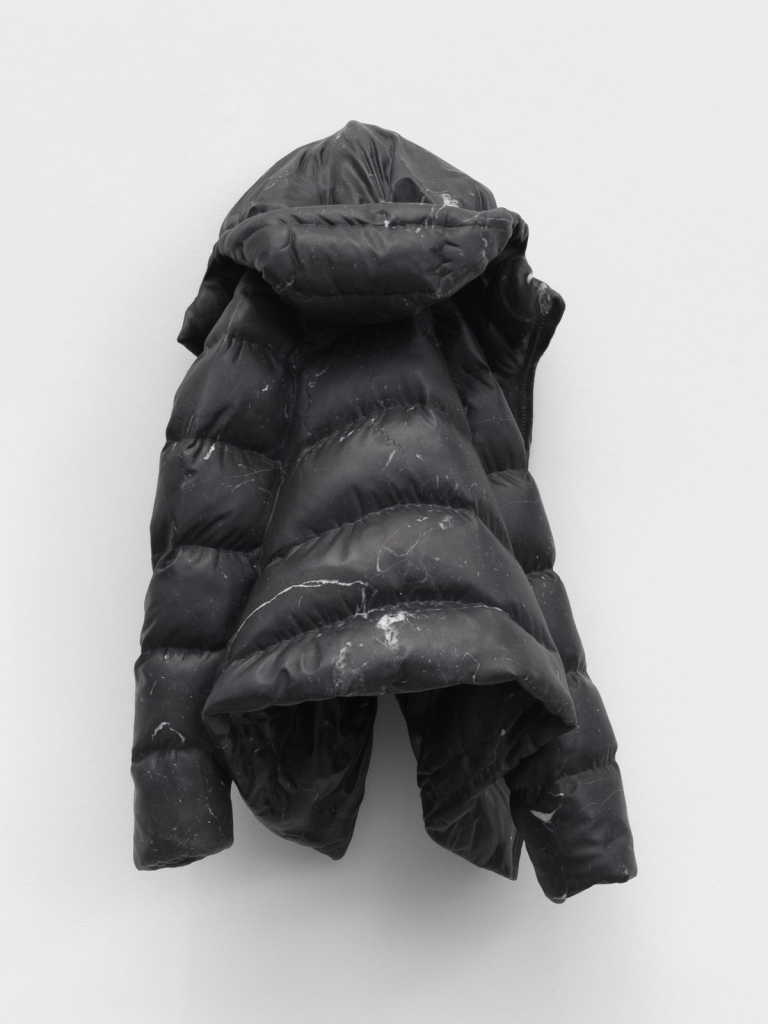
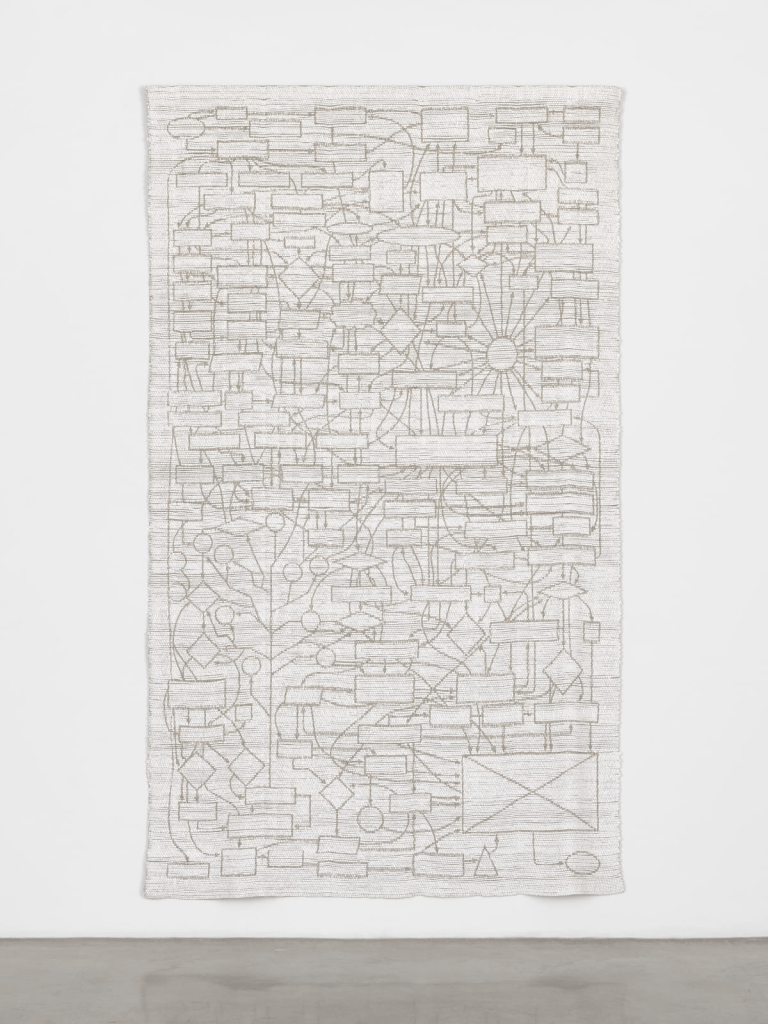
Contributed by David Carrier / Arriving at the Tanya Bonakdar Gallery, I was surprised that someone had hung a puffer jacket on the entry wall. Such galleries are usually immaculate. I walked on, for there was a lot to see in Analia Saban’s extraordinary show “Flowchart.” Upstairs, Core Memory, Plaid (Black, White, and Fluorescent Orange), a woven paint construction on a walnut frame, visually alludes to both weaving and magnetic-core random-access memory, a building block of early computing. In the downstairs gallery, five large tapestries picture playful flowcharts – hardly the traditional subjects of woven art – that marry the handmade and the digital. The next room contains 18 Studio Notes, graphite-on-laser sculpted notebook paper reflecting Saban’s working processes in geometric patterns and miscellaneous doodles. Yet just as I do not understand the inner workings of the computer on which I am composing this review, I didn’t know exactly how Saban constructed her very varied designs. Nevertheless, they enchanted me.
Contribute to the Two Coats 2025 Year-end Fundraising Campaign!

32 x 32 x 1 1/4 inches; 81.3 x 81.3 x 3.2 cm (walnut frame)
44 1/2 x 32 x 1 1/4 inches; 113 x 81.3 x 3.2 cm (overall)


Some of her images, I learned later from the gallery website, are of the fan blades dissipating the heat created by humming computers. Others diagram the structures of AI technologies. Without fully comprehending all this, I am fascinated with the variety of images she teases out of digital technologies with her consummately old-fashioned weaving techniques. However they function together, they are oddly beautiful. What I do know, I think, is that Saban is revealing the visual form – the aesthetics – of essential, usually hidden science that propels everyday life. Certainly the idea that there are visual affinities between computer memory elements and the grid of a loom is intuitively appealing and, brought to the surface, deserving of consideration.
In her marvelous books, Anne Hollander, explains, for instance, how Titian captured the sumptuous Venetian fabrics of privileged sitters. His work, of course, is a long way from Saban’s. But about a decade ago, Joachim Pissarro and I published two books on what we called “wild art.” We were interested in the variety of worthy artworks which, for whatever reason, were not taken seriously within the gallery and museum worlds. Why, we asked, were food art, graffiti, and tattoos not accepted alongside paintings and sculptures? To the many examples we gathered I would add Saban’s. Earlier I had apprehended the puffer jacket at the entrance as just an incongruous garment. In fact, it’s a hi-tech carving Saban made from marble. “Flowchart” is a great show, boldly imaginative and philosophically sophisticated, enlarging our visual thinking and our awareness of the aesthetics embedded in the world around us.

“Analia Saban: Flowchart,” Tanya Bonakdar Gallery, 521 West 21st Street, #1, New York, NY. Through December 18, 2025.
About the author: David Carrier is a former professor at Carnegie Mellon University; Getty Scholar; and Clark Fellow. He has lectured in China, Europe, India, Japan, New Zealand, and North America. He has published catalogue essays for many museums and art criticism for Apollo, artcritical, Artforum, Artus, and Burlington Magazine. He has also been a guest editor for The Brooklyn Rail and is a regular contributor to Two Coats of Paint.
Contribute to the Two Coats 2025 Year-end Fundraising Campaign!