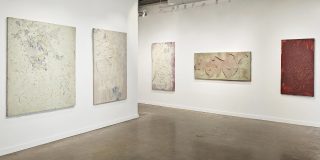
Contributed by Anna Gregor / Ian Myers’ paintings blur the lines between art, nature, and miracle, asking what painting’s vocation is at a moment when anything can be art, nature is under threat, and miracles are unfathomable. His five paintings, on view in his solo show “immortal flub” at New Collectors Gallery, are obviously art. Rectangles do not occur in nature, nor do the white gallery walls on which his rectangular paintings hang. But these rectangles don’t act like windows that allow us to enter an illusionistic space, as we expect from mimetic paintings. Nor do they reveal the human hand or thought processes that we assume to be involved in making abstract work. They eschew the exhibitionist gesture of Abstract Expressionism, the clarity of hard-edge abstraction, and the planned step-by-step process of much contemporary abstraction.

All five paintings are 9 x 12 inches. From a distance, they appear to be quiet, dark, dense, and abstract. The compositions seem simultaneously arbitrary and contrived, casual and stiff. They don’t lure viewers near with the lusciousness of paint or color, nor do they promise intelligibility with recognizable imagery. They find themselves hanging on the wall as rocks find themselves perched on a mountainside, and like rocks, resist interpretation.
If one chooses to approach them, a world of a different scale comes into focus, like that of fossilized bacteria under a microscope or cross-cut gems. The paintings’ surfaces, from a distance dark and muted, reveal themselves as many thin layers of color built up and then eroded. It’s as if they were formed over hundreds of years, like rock strata – and, in a sense, they have been. The paintings are made from organic and inorganic matter – egg yolk, marble dusk, rabbit skin glue, organic pigments, and wood – reconstituted in new forms. The surfaces even look like cross sections of stones: compressed, polished, and ordered by variable physical and chemical processes. The immediate cause of this reorganization is Myers, but he doesn’t claim authorship. It’s as if he were just another material involved in the paintings’ formation, governed by natural laws. Painter and viewer are simply elements of the process of forming, trying to make sense of their material circumstances.
Beyond the matte, earth-toned organic pigments of ochers and umbers, one catches glimpses of purple iridescence from certain angles. The refracted light seems a glimmer of something beyond natural matter, dematerializing the landscape-like topography of the painted surfaces. What was once an earthly stone appears lit by an inner light. While the materials Myers uses to make his paintings come from the earth, they are also anchored in the tradition of Christian icon paintings, which, like his work, were typically made on gessoed panels using egg tempera and pointed beyond nature to the divine. The tiny brushstrokes that compose Myers’ often awkward abstract forms recall the cross-hatching techniques that conjured the stiff figures of Christian iconography. While neither Myers nor the abstract paintings he makes are Christian, his apparent commitment to the process of painting indicates a kind of painterly faith.

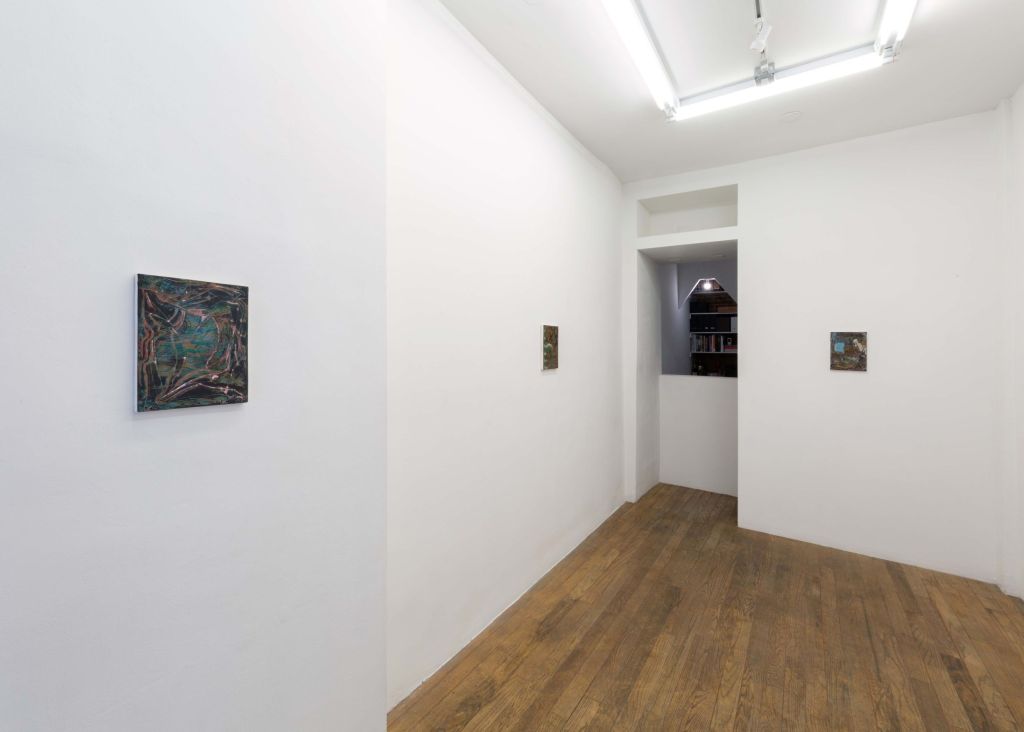
But the faith expressed in Myers’ paintings is not in some truth that flows from natural law or divine revelation. Bogged down by matter and confined to a rectangular support hanging on white walls, his paintings acknowledge doubt in such things. The world they are made in is fundamentally irrational, without ready answers to climate change, political crises, war, and human rights violations. In Meyers’s rendering, each action involved in making a painting (paint application, brushstroke, drip) is to some extent canceled out (scraped, covered, wiped), as if uncertainty plagued the paintings themselves. Yet their very existence is a testament of faith. Human-made objects that are neither merely natural nor wholly divine, Myers’ paintings suggest that a painter’s endeavor closely echoes human existence itself: unable to see far enough ahead or from far enough away to make complete sense of the world, the artist marches on in the belief that something significant will reveal itself.
“Ian Myers: immortal flub,” New Collectors Gallery, 191 Henry Street, New York, NY. Through May 12, 2024.
About the author: Anna Gregor is a painter pursuing her MFA at CUNY Hunter College.