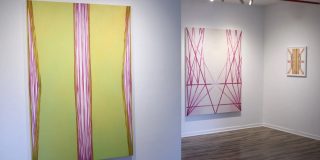
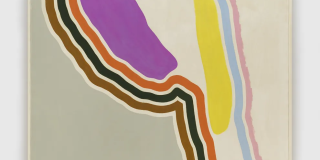
Contributed by Sharon Butler / At this stage, abstraction is no longer considered confusing or iconoclastic. So what kind of abstract work might earn the […]

 Award-winning NYC blogazine with a focus on painting
Sunday, October 11, 2026
Award-winning NYC blogazine with a focus on painting
Sunday, October 11, 2026
Contributed by Sharon Butler / At this stage, abstraction is no longer considered confusing or iconoclastic. So what kind of abstract work might earn the […]

UPDATE: The show has been extended through February 21, 2016. Images of the paintings on view are available here. Big thanks to all the critics […]

Contributed by Sharon Butler / When I stopped by the Florence Griswold Museum during a snowstorm in mid-March to see Peter Halley‘s retrospective, the glowing […]

Contributed by Sharon Butler / This weekend at Hyperallergic Thomas Micchelli reviews Dying on Stage: New Painting in New York, the Garis & Hahn […]

Contributed by Sharon Butler / At the Walker Art Center in Minneapolis, curators Eric Crosby and Bartholomew Ryan have organized “Painter Painter,” an exhibition comprising work by fifteen artists, some of whom are working with painting materials in ways that are often labeled “painting” but may be more firmly rooted in Minimalism and Process Art than with the formidable history of painting and abstraction. Considering the work presented in this show as well as the work selected for the deCordova Museum’s “Paint Things,” perhaps we aren’t experiencing an expansion of painting as the curators have proposed, but rather a return to handmade sculptural objects…that sometimes have paint on them or are hung on the wall.

Contributed by Sharon Butler /Back in the 1920s during the early days of industrialization, the Precisionists were drawn to the welded geometric forms of steel mills, bridges, water towers, smoke stacks, factory complexes, and coal mines.

Contributed by Sharon Butler / And now, a shameless plug for my show at Real Art Ways in Hartford, Connecticut, which is up through November […]

On Sunday, “Prison,” Peter Halley’s first exhibition in the Northwest, opens at Disjecta, a non-profit space in Portland. The site-specific installation is a digitally generated […]

Contributed by Sharon Butler / The pioneers of abstraction — the Cubists, the Abstract Expressionists, the Minimalists — emerged from firm and identifiable aesthetic roots […]

The other day I stopped by Winkleman Gallery to see Joy Garnett’s new paintings, and then hurried up to the Cort Theater where I had […]

Adolph Gottlieb (American, 1903-1974), “Blast, I,” 1957, oil on canvas, 7′ 6″ x 45 1/8.” The Museum of Modern Art, New York. Philip Johnson Fund […]

Contributed by Sharon Butler / I spent the week-long residency creating circle charts, which represent the point in my work where words and images intersect. […]

Contributed by Sharon Butler / In the July/August issue of The Atlantic Nicholas Carr wonders how the Internet is affecting our brains. “What the Net […]

This essay, which examines the evolving studio needs and expectations among contemporary artists, originally appeared in the June 2008 issue of The Brooklyn Rail.——- Contributed […]

The fiercely-contested presidential election, energized by the Iraq debate, is bombarding us with patriotic imagery: the waving flags, the campaign buses plastered with candidate logos […]