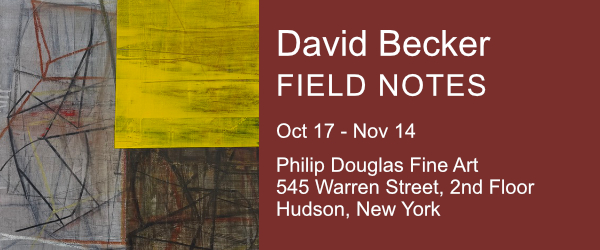
Contributed by Bill Arning / Years before Hudson became an international art destination, there was Time & Space Limited, a cavernous space on Columbia Street, […]

 Award-winning NYC blogazine with a focus on painting
Saturday, October 17, 2026
Award-winning NYC blogazine with a focus on painting
Saturday, October 17, 2026
Contributed by Bill Arning / Years before Hudson became an international art destination, there was Time & Space Limited, a cavernous space on Columbia Street, […]

Contributed by A.V. Ryan / Jill Nathanson’s solo show “Chord Field” opened in late June at Berry Campbell Gallery. It is her fourth at the gallery but her first in its spacious, skylit new space. It seemed a fine opportunity to talk to her about her work, new and old.

Contributed by David Carrier / What is the present state of painting? For as long as I have been writing art criticism, that question has been much discussed. Some critics have said painting was dead, perhaps to be replaced by Minimalist or conceptual art. Others have argued that because painting is an inherently bourgeois art form, it can continue only as long as it is politically tinged. The Milwaukee Art Museum’s show “50 Paintings” takes an essentially empirical approach to the question. Co-curators Margaret Andera and Michelle Grabner gathered mostly mid-sized recent paintings by artists well-known in the New York art world and demonstrated how varied and how good painting is today. There are abstractions by Peter Halley and Mary Heilmann, a landscape by April Gornik, and figurative paintings by Cecily Brown and Nicole Eisenman. It’s natural for a visiting critic to pick favorites. Mindful of the unhappy fate of Paris, whose judgment about which goddess was most beautiful triggered the Trojan War, I dare to name mine.

Contributed by Adam Simon / I was struck by the last two sentences of Saul Ostrow’s essay, “Painting simulacra: Brice Marden, David Reed, and Gerhard Richter.” He writes: “Marden, Reed, and Richter have sustained abstract painting’s aesthetic and cultural value as a mode of resistive thinking. In most cases, though, this has been misread or at least subsumed by its own model, thereby giving rise to the kind of acritical aestheticism and nostalgia that bolsters painters who promote gestural abstraction as a genre or motif rather than a mode of inquiry.” It took a minute to unpack this statement and allow it to sink in. Ostrow’s critique is dense, and appears to implicate most contemporary gestural abstract painters as well as contemporary criticism that dismisses the possibility of radical formalism.

Contributed by Saul Ostrow / “Let the Painting Make You,” the exhibition of Brice Marden’s last paintings; at Gagosian Gallery, set me to thinking about the relationship between Marden’s earlier gestural works and Gerhardt Richter’s process-oriented abstract paintings, which in turn led me to consider the connection of their works to those of David Reed and then to the French artists Simon Hantai and Bernard Frize who, like Reed, creates the illusion of an impossible spontaneity. Slowly, I came to focus on the question of why Richter is identified with post-modernism, while Marden and Reed’s works are most often critically identified as being quintessentially modernist and formalist. While Hantai (the modernist?) and Frieze (the post-modernist?) fit the question of what constitutes post-modern abstract painting, their references and histories are different for consideration here. Instead, I decided I would focus on Richter, Reed and Marden all who seem to transgress the formalist and modernist dictums that were generated in the 1950s and 1960s in the United States and then exported abroad, as such Hantai and Frize are part of another genealogy.
Curator Gary Garrels worked with six abstract painters”Mark Grotjahn, Wade Guyton, Mary Heilmann, Amy Sillman, Charline von Heyl, and Christopher Wool” to select one of […]
Mary Heilmann’s exhhibition at Zwirner & Wirth features paintings and works on paper from the last three decades. Heilmann draws inspiration from her own experience, […]
Giorgio Morandi: 1890–1964, Metropolitan Museum, New York, NY. Sept. 16–Dec. 14.“When the master of quiet still lifes died in 1964, he was unfashionable in New […]
For painters like me, curating group shows, although time consuming, helps articulate more specifically what what we’re investigating in our own work. Here are three […]
Jerry Saltz writes that the Whitney Biennial curators obviously have eyes for installation, sculpture, and video only. “There are 81 artists in this show, only […]
In New York, Jerry Saltz writes that the art market bubble has enabled long-overlooked but hard-working artists to move a little closer to the limelight. […]
In the Brooklyn Rail, Deborah Kass remembers how NYC’s Second Wave Feminists changed the course of painting history in the 1970’s: “When I served burgers […]
Mary Heilmann: To Be Someone,”curated by Elizabeth Armstrong. Orange County Museum of Art in Newport Beach, CA. Through Aug. 26, 2007; Contemporary Art Museum, Houston, […]