
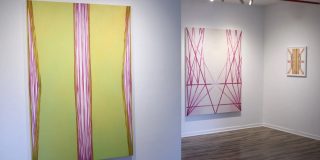
Contributed by Marjorie Welish / The group show “Fold, Drape, Repeat” now up at Ceysson & Bénétière does what it says. A select showing of work by the loosely aggregated French collective Supports/Surfaces, the exhibition embodies the very assembly involved in making art. Offbeat maneuver never succumbs to product or merchandise. Put another way, each individual artist emphasizes how the construction of art respects the commonplace materials at hand.
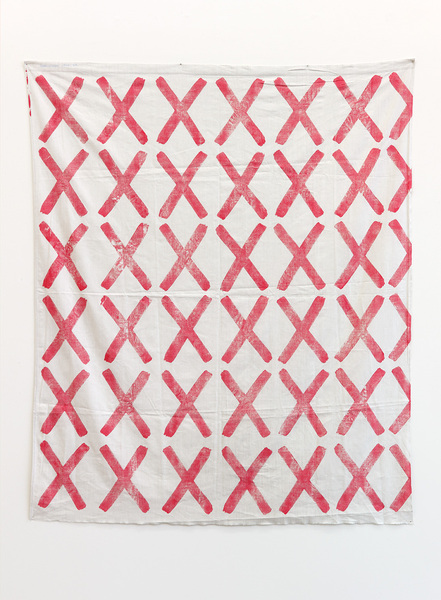

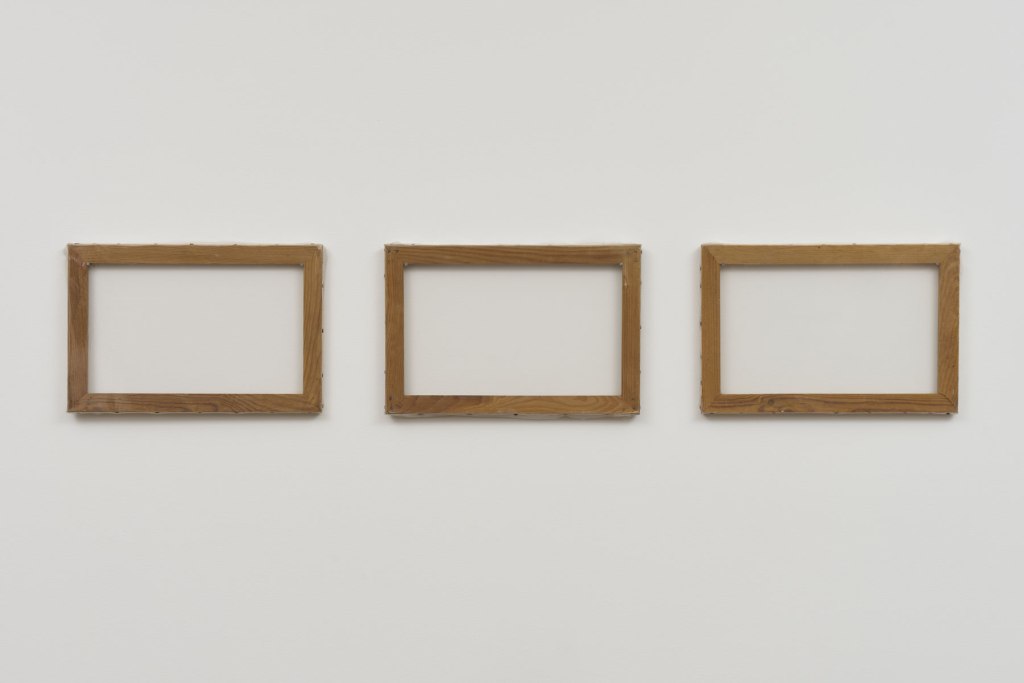
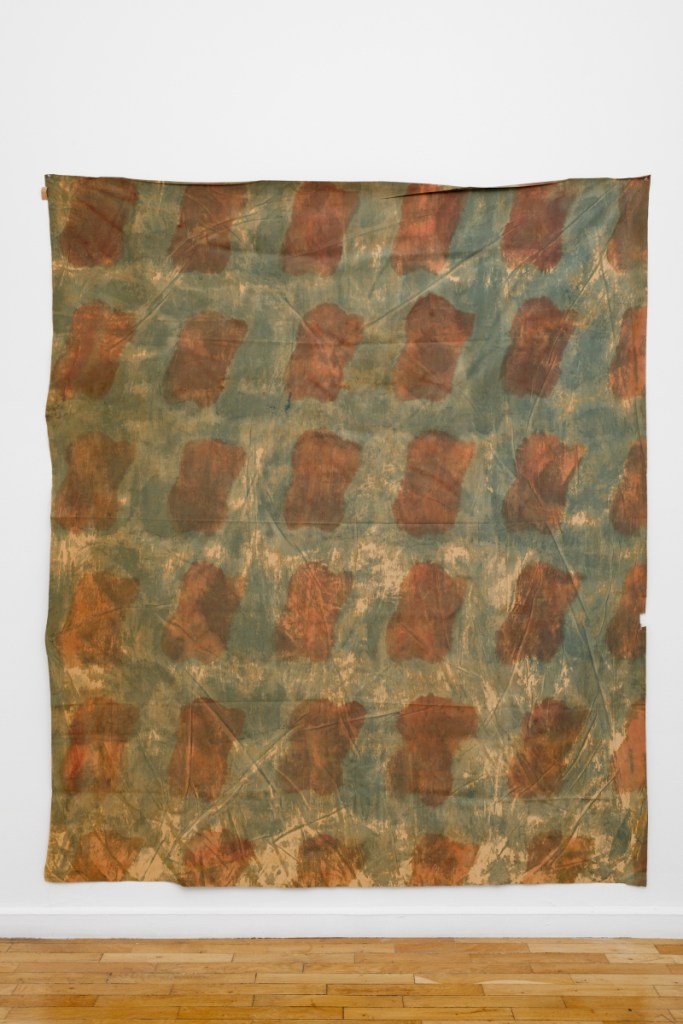
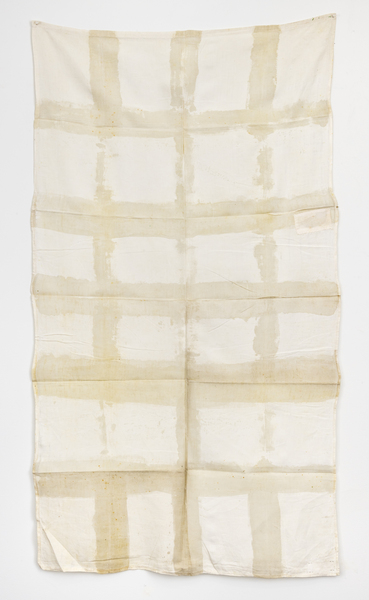
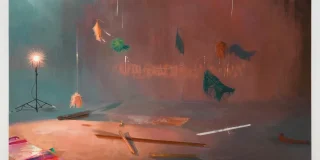
Louis Cane’s Toile tamponnée [Stamped canvas] gives the unstretched linen canvas surface a manifest presence simply by marking it. Daniel Dezeuze’s Châssisinv. no. 859 consists of plastic-wrapped stretchers, at once defamiliarized and self-reflexive, to give the support its due. Marc Devade’s HO23 reflects abiding dedication through its ink marks on paper. For Noël Dolla’s Etendoir aux Serpillères [Mop Rack] ordinary household towels hanging down and draping as they will do, recapitulate the site of production – the studio. Patrick Saytour’s Pliage renders starch and acrylic palpable. And in 1975/205, Claude Viallet’s signature pattern of indifference – its self-same shapes dyed on canvas – is hidden within a surface that discloses an homage to the fold, here derived from crushing and crushing canvas, honoring a tutelary spirit in Simon Hantai.
The subtitle of the show is “Material and Gesture as Revolt,” declaring Supports/Surfaces’ cultural raison d’être. It is well known that its aesthetic stems from an ethos that could be called countercultural with respect to both commerce and doctrinaire formalism. It was bought forth in the cultural politics of protest, revolt, and self-determination throughout the 1960s that reached a critical point in May 1968, when unjust wars abroad fused with social inequity at home and erupted in radical action. The remarkable thing is that the artifacts created through an essentially ideological movement do not look dated. Yes, we can discern their alignment with a certain cultural period; but no, these works do not read as “period pieces.” The work is timely in the contemporary context of monopolistic capitalism.
That is not all. Its enduring quality is intellectual penetration of salient art-historical narratives inherited through modern art’s ways and means. Presupposed is the question: What is intrinsic to the work? The answer: to manifest the nature of painting by making a necessity of procedures that are provisional and contingent. Embodied in acts, these involve the recall of flung paint and techniques for pouring, soaking, and staining that extend the world of art informel but also change it. In addition, Supports/Surfaces connects with post-minimalist handmade manufactures, though it eschews the metaphysical reach of American earthworks and cosmic gestures.

In its continuing relevance, the movement proves that innovation within tradition can both change and substantiate a definition of art. At the same time, the consequential nature of procedure is undeniable. The advantage of display, a few pieces presented together, is that it encourages us to imagine implications yet to materialize. This aggregate of approaches demonstrates the social value of situations and conditions specific to the here and now, and how to work with them.
“Fold, Drape, Repeat: Material and Gesture as Revolt,” Ceysson & Bénétière, 956 Madison Avenue, 2nd Floor, New York, NY. Through December 6, 2025.
About the author: Marjorie Welish is a New York-based painter and art critic, whose most recent solo exhibitions have occurred at The Flow Chart Foundation Hudson, New York, and at Jesus College, Cambridge University, Cambridge, England.







I really appreciated this insightful review of work that interests me a great deal. Many thanks.