

Contributed by Wells Chandler / Skin is the largest organ of the body, home to over four million pores, each one a threshold. The epidermis is not merely a boundary but a porous membrane between self and environment, a breathing eye through which consciousness meets the world. The canvas, like the body, is an envelope of sensation, holding a field of awareness that does not end at its edges. Erika Ranee’s generous and life-affirming paintings embody this expansive understanding. As figurative representations, they depict the liminal space beneath the surface of skin. In her abstract works, color and material, channeled by an intuitive process, point to a primordial knowing. As both literal and metaphorical portals, her exuberant paintings suggest the farther in you go, the farther out you get.
Ranee’s work emerges from a rich lineage of artists who have used abstraction as a liberating strategy. For minority and historically marginalized artists, abstraction has often served as a necessary refusal, a resistance to the flattening gaze of representation, which too often reduces “the other” to objects of trauma or exoticism. The evolution of Ranee’s work – from early representational engagements with racist propaganda and oppressive stereotypes to her current process-based abstractions – reflects a shift from the outwardly facing image to inwardly felt truth. This inversion of the gaze, from surface to source, dissolves spectacle and performance, inviting intimacy with space itself. Abstraction picks up where narrative fails, conveying the uncontainable complexity and multiplicity of being.


Cinema is an unexpected influence in Ranee’s practice. An aficionado of Japanese New Wave film, Ranee cites Kaneto Shindo’s Onibaba (1965) and Hiroshi Teshigahara’s The Woman in the Dunes(1964) as two of her favorite features. In both, identity is stripped bare, transformed and ultimately surrendered through a confrontation with elemental forces. Sand, sweat, mask, and flesh serve as agents of karmic revelation, pressing characters into contact with the primal layers of self underlying social form. The protagonists of each film undergo a slow undoing that leaves the ego flayed and porous. This molting process echoes Ranee’s themes of transformation and unworlding. Her abstractions do not escape identity but compost it, such that personal and cultural psychic debris become fertile ground for new self-knowledge. Ego is not destroyed; it is diffused and recirculated into a larger field of awareness.
Jack Whitten, one of Ranee’s mentors, likewise saw abstraction not as an escape from identity but as a quantum field through which Blackness could thrive. In Wet: On Painting, Feminism, and Art Culture, Mira Schor further explores this function, exhorting minority artists to critically engage with and transform the traditions that once excluded them. Working within the language of abstraction – historically, a white, male-dominated arena – Ranee invoked Schor’s vision of painting as critique and self-inscription in her solo show “My Saturn Return” at Klaus von Nichtssagend Gallery, infusing her work with lived experience while documenting the failure of the medical system. Like Whitten’s work, Ranee’s is layered through pouring, scraping, obscuring, and embedding to form a repository for both presence and posterity.


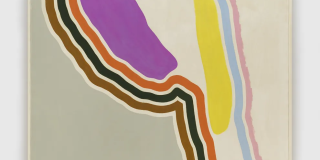
Alongside Ranee, we might consider Sun Ra, whose Afrofuturist cosmology offered not a rejection of the present but an escape from its constraints. Ranee’s paintings vibrate with celestial purples, veined neons, and luminous blacks. Her use especially of purple carries a distinct frequency, associated with the crown chakra, royalty, spirituality, and mourning. At the same time, purple is non-spectral, between red and blue, absent from the visible light spectrum, a construct conjured by the eye and brain. Ranee’s purples undulate, bleed, and echo across her canvases, suggesting both the corporeal and cosmic, wound and aura, shadow and atmosphere. The color operates as a means of unfolding, allowing her to explore identity not as something fixed, historical or measurable but as a somatically registered phenomenon beyond perception.
Ranee’s surfaces are energetic matrices, activated through gesture, medium, and attention. Shellac, ink, spray paint, and acrylic fuse with found materials and botanical forms. Shellac, in particular, is a living material – a biological secretion collected from tree bark where lac insects formed colonies. Once scraped, it is processed into flakes and sold in orange, amber, or clear forms, often with its arthropod manufactures entombed. It seals porous materials, binds mixed-media layers, and creates shine and depth. In Ranee’s work, shellac evokes superlunary ectoplasm that links the somatic with intergalactic, vegetal, and entomological states. The material specificity of this gooey membrane suggests gestation and labor. As a hardener and beautifier, it reflects preservation and transformation.


Ranee’s paintings often resemble cross-sections of the body or the land, featuring veins, roots, braids, cracked sidewalks and floral membranes. There is a sense of descent in the work – a sinking into intuition to allow knowledge to arise from inside. This is where Ranee’s practice intersects with what might be called a soul-based epistemology: a way of knowing that transcends the linearity of narrative and instead taps into somatic intelligence. Her improvised gestures are acts of listening, rendering abstraction a spiritual technology. It is how the body speaks before it has been named, how the soul arrives before the story is told. Ranee casts the body as a conductor of ongoing revelation, inseparable from earth and sky. Each painting becomes a kind of cosmogram, a visceral archive capturing what the thinking mind cannot hold.

“Erika Ranee: My Saturn Return,” Klaus von Nichtssagend Gallery, 87 Franklin Street, Ground Floor, New York, NY. May 29–July 11, 2025.
About the author: Wells Chandler is a Bronx-based artist and writer who explores ecology, community, gender and queer iconography through the mediums of crochet, embroidery, drawing, and cake






YUM. great painting!.
This is also good writing on painting as the spiritual practice of freedom.
What could be better?