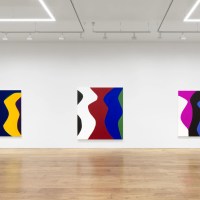
Contributed by Amanda Church / Marina Adams has long been exploring the range of allusions that can be conjured by various color combinations and the scale and placement of simple shapes, which press up and vibrate against each other in subtle, sexy ways. Curvy configurations, interspersed with diamonds and triangles, hint at myriad aspects of nature and the female form. In Adams’ current show “Cosmic Repair” at Timothy Taylor, variations on this trajectory continue in nine paintings, all new and acrylic on linen except Singing to the Highest Deity from 2020 hanging by itself in the back room. Influences range from Matisse to, according to the press release, “Uzbek textiles, Indigenous American Southwest pottery, and the Great Pyramids.”
Tag: Timothy Taylor
Chris Martin: Staring into the sun
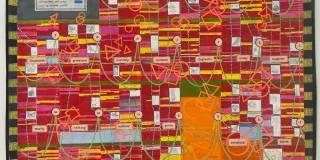
Contributed by Sharon Butler / Chris Martin is deep into a nearly five-decade-long artistic odyssey fueled by an unrelenting passion for process, spontaneity, and embracing the unexpected. His prolific energy, both physical and creative, melds into his broad knowledge of painting history and an insatiable desire to share his thoughts, feelings, and vast collection of everyday ephemera and small objects by embedding them in paint on canvas. Martin’s paintings are bursts of assemblage showcasing the power of proximity – vibrant cacophonies of glitter, pages ripped from textbooks books, magazine remnants, letters, and newspaper clippings. “Speed of Light,” his second solo exhibition with Timothy Taylor, draws inspiration from the dark night sky in the Catskills, inflecting profound questions about the universe with a comedian’s flair for the seriously absurd. The results are thought-provoking, funny, and, at times, ecstatic.
Simon Hantaï: Canonical at last?
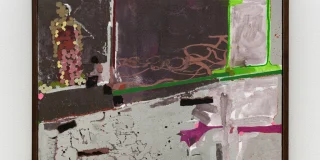
Contributed by David Carrier / What comes after Abstract Expressionism? A couple of generations ago, American art writers were intent on addressing that question. The American color field art of Morris Louis, Kenneth Nolan and Jules Olitski was one plausible answer. Then, of course, came Jasper Johns, Robert Rauschenberg, and much more. The French had a different answer. They were interested in the abstraction of Hungarian-born Simon Hantaï (1922–2008), who moved to France in 1948 and whose work seemed in line with the post-structuralist theory that had taken hold there. His inspirations were Marxism, Catholic tradition, Matisse, Picasso, and Jackson Pollock as seen in Paris exhibitions, and his bête noire was Surrealism. Given these rich and disparate interests and impulses, it goes almost without saying that Hantaï developed a highly distinctive aesthetic. Long famous in France, his paintings recently have been shown in several ambitious Manhattan galleries, notably Timothy Taylor.