Contributed by Sharon Butler / Next month, Two Coats of Paint Residency Program welcomes Ithaca, NY, artist Ariel Bullion Ecklund. Ecklund creates ceramic objects and photographs that draw from the memories she accumulates as she moves through the world. Universal themes such as absence, impermanence, memory, and yearning inform work that is also deeply personal. For our next resident, our bodies hold memories as much as our minds do. This understanding is the foundation for everything she makes.
Tag: Richard Serra
Cyrilla Mozenter: The quieting of industrial material
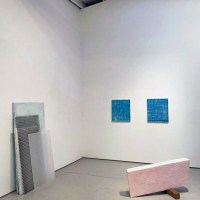
Contributed by Michael Brennan / To my mind, the cultivation of art is mainly about making distinctions, and Cyrilla Mozenter’s solo show “Problems of Art” at 57W57 Arts hits that mark. She is essentially a sculptor – and a great one – in that she makes beautiful objects. Much as I admire her approach to volume, though, it’s her novel transformation of drawing into predominantly felt sculpture – decisive cuts made with sewing shears, silk whipstitching like super-sutures – that generates the greatest sense of adventure.
Painting simulacra: Brice Marden, David Reed, and Gerhard Richter
Contributed by Saul Ostrow / “Let the Painting Make You,” the exhibition of Brice Marden’s last paintings; at Gagosian Gallery, set me to thinking about the relationship between Marden’s earlier gestural works and Gerhardt Richter’s process-oriented abstract paintings, which in turn led me to consider the connection of their works to those of David Reed and then to the French artists Simon Hantai and Bernard Frize who, like Reed, creates the illusion of an impossible spontaneity. Slowly, I came to focus on the question of why Richter is identified with post-modernism, while Marden and Reed’s works are most often critically identified as being quintessentially modernist and formalist. While Hantai (the modernist?) and Frieze (the post-modernist?) fit the question of what constitutes post-modern abstract painting, their references and histories are different for consideration here. Instead, I decided I would focus on Richter, Reed and Marden all who seem to transgress the formalist and modernist dictums that were generated in the 1950s and 1960s in the United States and then exported abroad, as such Hantai and Frize are part of another genealogy.
Looking at the Serra show from a painter’s perspective
Blogger Joanne Mattera writes: “The mottled and scratched surface texture, always interesting, reveals itself in daylight to be something more like skin: thick here, thin […]