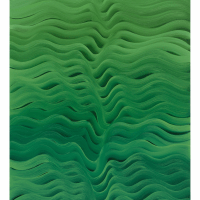
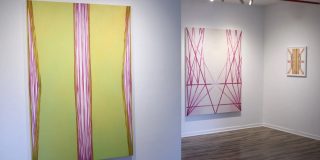
Contributed by Amanda Church / Conjuring The Cure’s 1987 song Just Like Heaven – which proclaims “you’re just like a dream” – Karin Davie’s eight new large-scale paintings on view at Miles McEnery Gallery, all oil on linen, transport us to a realm of sensation and association. Here her wavy imagery, which she has been developing in one form or another since the 1990s, immediately evokes the swells and dips of the ocean’s surface as well as recalling the fluid lines essential to the work of painters like Sol LeWitt, Brice Marden, Bridget Riley, Moira Dryer, and late de Kooning, albeit to varying effect.
Tag: Frank Stella
A legacy of color: Golden Foundation annual art benefit and auction
In the heart of central New York, nestled among the rolling hills of New Berlin, stands a unique testament to artistic collaboration, friendship, and innovation: The Sam and Adele Golden Foundation for the Arts. Established in 1997, the Foundation honors the legacy of Sam and Adele Golden, the visionary co-founders of Golden Artist Colors, a company dedicated to producing fine paint for fine art. We invite you to join us there in celebrating the profound impact that art and community have on our lives at the Foundation’s annual art benefit and auction on August 3rd from 4:30 to 8:00 PM. It promises to be our most exciting event yet.
Canceling abstract art in Santa Barbara
Contributed by Laurie Fendrich / While there have always been easily discreditable philistines who dismiss abstract art as a fraud, many leaders in today’s art world marginalize it for other reasons. They see it as anachronistic, irrelevant, boring, or, most unforgivably of all, shackled to its white European origins. It’s not far-fetched to think that th
Elizabeth Gilfilen: De-defining the gesture
Contributed by Vittorio Colaizzi / “I vehemently reject the claim that mark making by itself harbors any potential.” This was Isabelle Graw in conversation in 2010 with Achim Hochdörfer. The previous year, the latter had published his essay, “A Hidden Reserve”, chronicling a persistent but transformed and inquisitive use of the gesture by artists such as Joan Snyder and Simon Hantaï, after the myth of its unrestricted access to the inner self had been thoroughly critiqued by virtue of the encaustic and enamel regimentations of Jasper Johns and Frank Stella. It is not certain, however, whether mark-making can ever be “by itself,” as Graw puts it. Certainly, it carries with it endless associations and ever-shifting positions. Upon her first encounter with Abstract Expressionism, a young Louise Fishman saw in it a queer language suitable to her own alienation, in contradiction to its macho orthodoxy, while Amy Sillman similarly emphasizes painting’s potential to transgress categories. Hochdörfer’s corollary thesis, relevant to this day, is the dialectic between “literalism and transcendence,” or the acknowledgement of art’s concrete materiality versus the expectation and oft-reported experience of transformation, metaphor, or perceptual intensification.