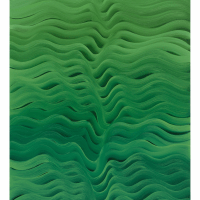
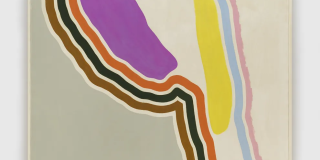
Contributed by Amanda Church / Conjuring The Cure’s 1987 song Just Like Heaven – which proclaims “you’re just like a dream” – Karin Davie’s eight new large-scale paintings on view at Miles McEnery Gallery, all oil on linen, transport us to a realm of sensation and association. Here her wavy imagery, which she has been developing in one form or another since the 1990s, immediately evokes the swells and dips of the ocean’s surface as well as recalling the fluid lines essential to the work of painters like Sol LeWitt, Brice Marden, Bridget Riley, Moira Dryer, and late de Kooning, albeit to varying effect.
Tag: Amanda Church
Marina Adams: Patches of sun in a shadowy world
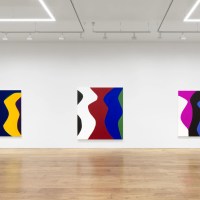
Contributed by Amanda Church / Marina Adams has long been exploring the range of allusions that can be conjured by various color combinations and the scale and placement of simple shapes, which press up and vibrate against each other in subtle, sexy ways. Curvy configurations, interspersed with diamonds and triangles, hint at myriad aspects of nature and the female form. In Adams’ current show “Cosmic Repair” at Timothy Taylor, variations on this trajectory continue in nine paintings, all new and acrylic on linen except Singing to the Highest Deity from 2020 hanging by itself in the back room. Influences range from Matisse to, according to the press release, “Uzbek textiles, Indigenous American Southwest pottery, and the Great Pyramids.”
We happy few: Band of sisters at Lubov
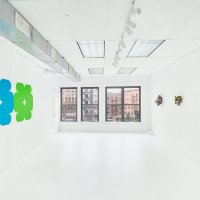
Contributed by Amanda Church / Happiness is … three dynamic, joy-producing artists under one roof, a phenomenon realized by curator José Freire in the three-person show “Acquaintance” – Episode One of the Happiness Project – at Lubov Gallery in Chinatown. The show brings together Linda Daniels, Marilyn Lerner, and Jill Levine, all of whom showed at some point with Freire at Fiction/Nonfiction in the East Village in the late 1980s or thereafter after at Team in Soho. This show marks Freire’s first curatorial project since Team closed in 2020, and the spirit is upbeat and sanguine, in line with Pharrell Williams’ exhortation to “clap along if you know what happiness is to you.”
Ridley Howard: Sky high
Contributed by Amanda Church / In his exhibition of similarly sized small-scale paintings titled “Sky,” now up at Marinaro, Ridley Howard applies his usual paint-handling panache to celestial expanses of blue. The surfaces are flawless and smooth, as are the porcelain faces of the women he depicts. The skies’ shades vary, and clouds make an occasional appearance, but there’s a pervasive sense of clarity and tranquility punctuated by partial views of treetops, cocktails, and impassive female faces. The usually stark tableaux sometimes border on the surreal. Howard’s Summer Moon, for instance, echoes Magritte’s The Banquet, minus the figure.
Camilla Fallon: Womanizer
Contributed by Amanda Church / Following the fleshy path of Rubens, Lucian Freud, Joan Semmel, and Cecily Brown, among many others, Camilla Fallon has recently focused her loose, lush brushwork on the female body’s midsection, specifically the navel. “The Navel Is the Center,” her current show at The Painting Center, consists of eight medium-scale paintings and four very small ones, most providing an intimate view of this inverted body part. Under such close scrutiny, it becomes symbolic, implying vulnerability, contemplation, and introspection.
Andrew Mer: All things obscure and oblique
Contributed by Amanda Church / What do we not see every day even when we are looking? Andrew Mer, aka @bigfusss on Instagram (where these photographs were first discovered), considers the question in his current show “Agog” – the filmmaker’s first exhibition of photography since moving to New York 30 years ago – at Mitchell Algus Gallery. The show consists of thirty 14 x 11-inch digital prints, shot on an iPhone starting in 2020, in editions of five with two artist’s proofs. The spontaneous photos of street scenes are in one sense classic Instagram moments, evanescent and transient. At the same time, they capture the so-easy-to-overlook minutiae of urban existence in precise compositions.
Amanda Church: The contemporary gaze
Contributed by Adam Simon / One of the under-appreciated aspects of art viewing is the way that a given work establishes a certain relationship with a viewer. Mark Rothko famously claimed that “lots of people break down and cry when confronted with my pictures.” He may have been trying to fend off a formalist reading of his work, but I can’t help wondering about the type of relationship he posits in that quote. In Amanda Church’s fine exhibition “Recliners” at High Noon, a very different type of relationship is established, in which the object playfully attunes the viewer to the knowledge and predilections he or she might bring to the experience of looking. Don’t expect to cry, but do prepare to be winked at.