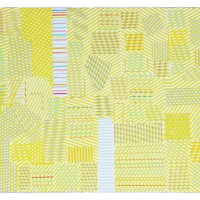
Contributed by Sharon Butler / In 2014, a single phrase reshaped the trajectory of contemporary abstract painting. When the late Walter Robinson – painter, critic, and veteran of the Pictures Generation – coined the derogatory term “zombie formalism” in an essay for Artspace, he set off a chain reaction that would stigmatize a generation of young abstract artists and cast a long shadow over abstraction in general. More than a decade later, the story of zombie formalism reads as a pungent example of aesthetic cynicism and jadedness – a case study in how criticism, commerce, and cultural anxiety can converge to distort and ultimately damage an entire movement.
Search Results for "label/painting"
Richard Bosman at Headstone Gallery
Contributed by Bill Arning / Long-time Bosman watchers often recall his work as a firehose of imagery—gunfights and car chases, sinking ships, kidnappings, and robberies pouring out in rapid succession. Fans might therefore be surprised when entering his first solo show at Kingston’s beloved Headstone Gallery, a venue known for its ambitious program of younger artists. In inviting an older master like Bosman, the gallery has delightfully broadened its scope.
Ted Stamm’s conceptual adventurism
Contributed by Saul Ostrow / When Ted Stamm’s career was cut short by his death at age 39 in 1984, he had already begun to attract attention in the United States and internationally. Critics including Edit deAk, Peter Frank, Robert Morgan, and Kay Larson recognized Stamm’s ability to bridge formal rigor with playful urban references. In 1975, deAk wrote in Artforum that “Stamm’s work confounds its own apparent simplicity; the shape’s tense complexity and stubborn definition of itself make it totally the artist’s like an insignia. The color is equally personal, and the painting’s presence is quietly assertive. This is certainly not the elegant nihilism of reductive solutions.” Conceptual endeavors were central to his ambition of making the border between art and everyday life porous.
Maureen Dougherty’s collectors: Pride without greed
Contributed by Natasha Sweeten / Maureen Dougherty brings her paintings to life with quiet assurance. For “The Completionists,” her current exhibition at Mendes Wood DM in Germantown, she presents portraits of solitary collectors showcasing their collections in muted yet elegant tones not unlike Luc Tuymans’, with dabs of paint nestled into shadows and on tips of asparagus. Objects such as dog figurines, serving dishes, Picasso’s ceramics, skulls, and books are dutifully balanced on horizontal bands of shelving stretching across the picture plane, providing a fixed compositional framework. Perhaps Dougherty’s years of working in abstraction cultivated the acuity and freedom in her brushstroke. Nearly every one of the nine paintings on view fills the expanse of canvas as if to suggest that we’ve zoomed in on a larger presentation, singling out this particular person with this particular array of belongings while also understanding the moment as memory.
Matthew Miller: Hand to a humble god
Contributed by Jonathan Stevenson / For over twenty years, Matthew Miller rendered arduously meticulous yet mysteriously otherworldly portraits, mainly of himself as subject and almost always against a maximally opaque black background betraying no brushstrokes, evidently free of human imperfection.
Rachel Ruysch: Late bloomer
Contributed by David Carrier / Significant twentieth-century artists occasionally depicted flowers. Andy Warhol was one, Ellsworth Kelly another. But it’s hard to think of any major painter today who focuses predominantly on them. Rachel Ruysch (1664–1750) lived in a very different world. Thanks to the bountiful worldwide empire of Golden Age Holland, even this stay-at-home painter could obtain an amazing variety of imported flowers. The Toledo Museum of Art’s “Nature into Art,” drawn from her 150 surviving works, is, improbably, the first major exhibition devoted to her. Botany thrived in Ruysch’s time due in part to Dutch imperialism. Flower painting became a major artistic genre, and she and her rivals enjoyed access to an enormous variety of exotic flowers (and insects). Critics rightfully consider her pre-eminent. “At her best,” the catalogue says, “Ruysch painted like a novelist, creating scenes within a framework at large.“ Indeed, her intricately crafted, remarkably varied paintings convey the story of Dutch capitalism.
Corriero, Segre, Seidl: Open, enveloping, searching
Contributed by Michael Brennan / I have long admired the work of the three artists Michelle Segre and Guy Corriero, whose work is now on display at “Fly like a Flea, Sink like a Stone” at Springs Projects, as well as Claire Seidl, whose show “Days Like These” is up at Helm Contemporary.
The new Frick: A somewhat sentimental reaction
Contributed by David Carrier / Rebuilding seems to be a cyclical occurrence for older art museums. The collection expands, styles of display change, more capacious restaurants and shops may be needed. Older museums have to construct new galleries. To the original European galleries, entered atop the stairs at the entrance, the Metropolitan Museum of Art added space for Islamic art, contemporary work, and Asian paintings. Alternatively, a wealthy museum can rebuild almost from scratch, as MoMA has repeatedly done. Yet, for most of the time I have been going to art museums, New York’s Frick Collection has been basically unchanged, an island of stability. I remember once being shocked that one of its masterworks – Rembrandt’s The Polish Rider – was away on loan. No other major New York art institution has remained basically the same over such a lengthy period, celebrating idiosyncratic displays that mix sacred and secular works in a luxurious setting. Henry Clay Frick had a great eye.
Diebenkorn at Gagosian: A remarkable curatorial accomplishment
Contributed by David Carrier / For a long time, I have always thought of Richard Diebenkorn as a great painter. A couple of his paintings were in my local museum, the Carnegie Museum of Art in Pittsburgh, where I treasured seeing them. But he was, so I believed, someone whose development was straightforward, even a little boring. I arrived at Gagosian’s large upstairs gallery on Madison Avenue with low expectations of a thick array of Diebenkorns in that one room. Maybe it had been a mistake, inspired by misguided nostalgia, to take on this assignment. In the event, the exhibition was revelatory, holding me spellbound. This is one reason why I love being an art critic – the surprise.
Elias Wessel: Exposing social media
Contributed by Chunbum Park / At Picture Theory in Chelsea, Elias Wessel has assembled provocative installations titled “It’s Complicated” and, with composer and musician Natalia Kiёs, “Systems at Play.“ In “It’s Complicated,” busy photographs that document surfing and scrolling behavior stand on pedestals. Holstered at their sides are headphones piping cacophonic sounds and words – styled “Is Possibly Art” – that AI-based text-recognition software has distilled from the long-exposure images.
Jo Baer: Space, position, and light
Contributed by David Carrier / Five smallish early Jo Baer paintings are on display in one white- walled gallery at DIA Beacon in her exhibition there since 2022. The show is both tantalizing and exasperating. In the 1970s, Baer became famous as a minimalist painter. Then she left New York, published a manifesto in 1983 proclaiming “I am no longer an abstract artist,” and changed her style completely.
LA PST Report: Toward better social behavior
Contributed by Peter Plagens / The first edition of the Getty-sponsored “Pacific Standard Time” slate of exhibitions in 2011 was subtitled simply “Art in L.A., 1945 – 1980,” and it aimed to elucidate Southern California’s contribution to American postwar modern art. In 2017, the second iteration was called “LA/LA,” indicating the city’s Latin American art and artists. This time around PST has declared a more specific theme, “Art and Science Collide,” reminiscent of one of those noble Rose Parade rubrics…
Beatrice Caracciolo: Exquisitely stealthy
Contributed by David Carrier / What does it mean for a contemporary artist to be inspired by an older text or artwork? The Gospel of Matthew 15:14 says: “If the blind lead the blind, both shall fall into the ditch.” Moved by those words in 1568, Pieter Bruegel the Elder painted The Blind Leading the Blind, which hangs in Museo di Capodimonte in Naples. Now stirred by that picture, Beatrice Caracciolo, a young artist who grew up in that city, has drawn The Blind 16: one large image of the blind beggars and several smaller details also derived from the Bruegel. Between Matthew and Bruegel and then Bruegel and Caracciolo, there’s a kind of creative slippage whereby the meaning of the prior statement is transformed. At each stage, Matthew’s basic conception is partly preserved while something is added or subtracted. He doesn’t specify, for instance, that there are six blind men. Caracciolo shows his entire work, but without color, in grisaille. In smaller rectangular works on paper, she focuses on the trees and on some of the individual blind men.
Ester Petukhova’s cheerfully tragic key
Contributed by David Carrier / Born in Russia at the very start of this century, Ester Petukhova is a Pittsburgh resident. Her precocious new show includes seven small acrylic paintings, two of them with two parts, on shaped panels. Burgeoning Blue Screen shows a Russian at work on an old-fashioned computer. Indexed Landmarks 1 & 2 depicts a man, naked to the waist, holding a large fish. And Bread with Salt in the Wound presents a large loaf of bread, and is enhanced with glass beads. “It is a customary Slavic tradition,” the gallery label says, “to present bread with salt when welcoming a foreign nation or power.” Welcome, then, to the former Soviet Union.
Trade secrets: How much should a painter reveal?
Contributed by Bonnie Morano / I consider myself an open book. The secret ingredient to my zesty salad dressing is cumin. Avoiding parking tickets in NYC involves a finely worded note on the windshield. But ask me how I get my oil paint to stay so shiny when dry, I hesitate….In this social media age of oversharing, does the aura of the heroic painter today rest on magic and mystery or up front transparency?
Past, present, and future: The complementary visions of Jodi Hays and Michi Meko
Contributed by Jenny Zoe Casey / In a fascinating and inspired pairing, “The Burden of Wait” at Susan Inglett brings together painters Michi Meko and Jodi Hays and explores the different ways in which inhabitants of a particular region – here the American South – can experience it. Landscape is an important influence for both artists, but their approaches are mostly in opposition.
Elisabeth Condon: Beautiful complexity
Contributed by Sharon Butler / To understand Elisabeth Condon’s paintings, it seems important to know that she grew up in California in a highly decorated house where she spent hours staring at the wild patterns of the fabrics and wallpapers. The experience certainly informs her exuberant paintings, in which pattern, flower, landscape all co-exist, as she says in her artist statement, in living, breathing presence.
Armin Kunz: Presentism and art history
Contributed by Armin Kunz / �Can we ever look at Titian�s paintings the same way again?� asked Holland Cotter when he reviewed the reunion of […]
Lisa Hoke’s unconfined vision
Restricted to her studio during lockdown and cut off from large spaces in which to create site-specific work, Lisa Hoke felt the need to fashion pieces that were more portable and more presumptively permanent. What resulted is a scintillating revelation.
Cezanne’s pursuit
If theres one word that sums up Paul Czanne (1839-1906), the subject of this massive MoMA exhibition, its struggle.