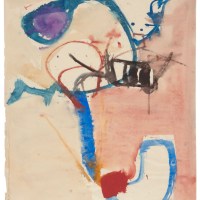
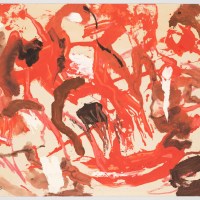
Contributed by Jonathan Stevenson / Branded a degenerate artist for his “insane childish scrawling” by the Nazis, Paul Klee, once anointed at the Bauhaus, left Germany for Switzerland in 1933. Scleroderma was already affecting his will and ability to paint, and his theretofore prodigious output waned. But as Germany’s onslaught in Europe effloresced into World War II, he regained purpose and productivity, yielding over 1,250 works in 1939, the year before his death. During this period, he downplayed his signature sublimation via color in favor of succinct line to expose the toxicity of fascism. Everything that concerned him as a citizen of the world seemed to catch light in his art. This valedictory turn is the subject of “Other Possible Worlds,” the Jewish Museum’s superbly curated show, uniquely centered on his final decade.
Search Results for "label/artists' rights"
Diebenkorn at Gagosian: A remarkable curatorial accomplishment
Contributed by David Carrier / For a long time, I have always thought of Richard Diebenkorn as a great painter. A couple of his paintings were in my local museum, the Carnegie Museum of Art in Pittsburgh, where I treasured seeing them. But he was, so I believed, someone whose development was straightforward, even a little boring. I arrived at Gagosian’s large upstairs gallery on Madison Avenue with low expectations of a thick array of Diebenkorns in that one room. Maybe it had been a mistake, inspired by misguided nostalgia, to take on this assignment. In the event, the exhibition was revelatory, holding me spellbound. This is one reason why I love being an art critic – the surprise.
Ted Stamm’s conceptual adventurism
Contributed by Saul Ostrow / When Ted Stamm’s career was cut short by his death at age 39 in 1984, he had already begun to attract attention in the United States and internationally. Critics including Edit deAk, Peter Frank, Robert Morgan, and Kay Larson recognized Stamm’s ability to bridge formal rigor with playful urban references. In 1975, deAk wrote in Artforum that “Stamm’s work confounds its own apparent simplicity; the shape’s tense complexity and stubborn definition of itself make it totally the artist’s like an insignia. The color is equally personal, and the painting’s presence is quietly assertive. This is certainly not the elegant nihilism of reductive solutions.” Conceptual endeavors were central to his ambition of making the border between art and everyday life porous.
Corriero, Segre, Seidl: Open, enveloping, searching
Contributed by Michael Brennan / I have long admired the work of the three artists Michelle Segre and Guy Corriero, whose work is now on display at “Fly like a Flea, Sink like a Stone” at Springs Projects, as well as Claire Seidl, whose show “Days Like These” is up at Helm Contemporary.
Jo Baer: Space, position, and light
Contributed by David Carrier / Five smallish early Jo Baer paintings are on display in one white- walled gallery at DIA Beacon in her exhibition there since 2022. The show is both tantalizing and exasperating. In the 1970s, Baer became famous as a minimalist painter. Then she left New York, published a manifesto in 1983 proclaiming “I am no longer an abstract artist,” and changed her style completely.
Past, present, and future: The complementary visions of Jodi Hays and Michi Meko
Contributed by Jenny Zoe Casey / In a fascinating and inspired pairing, “The Burden of Wait” at Susan Inglett brings together painters Michi Meko and Jodi Hays and explores the different ways in which inhabitants of a particular region – here the American South – can experience it. Landscape is an important influence for both artists, but their approaches are mostly in opposition.
Elisabeth Condon: Beautiful complexity
Contributed by Sharon Butler / To understand Elisabeth Condon’s paintings, it seems important to know that she grew up in California in a highly decorated house where she spent hours staring at the wild patterns of the fabrics and wallpapers. The experience certainly informs her exuberant paintings, in which pattern, flower, landscape all co-exist, as she says in her artist statement, in living, breathing presence.
Armin Kunz: Presentism and art history
Contributed by Armin Kunz / �Can we ever look at Titian�s paintings the same way again?� asked Holland Cotter when he reviewed the reunion of […]
Cezanne’s pursuit
If theres one word that sums up Paul Czanne (1839-1906), the subject of this massive MoMA exhibition, its struggle.
Les Gommes: Becky Brown and Annette Cords at PS122
Contributed by Axel Bishop / In a collaboratively constructed two-person exhibit at PS122, Brown and Cords experiment with the interplay of image-experience vs. knowing through written language.
The stories we choose to tell: “Fall Reveal” at MoMA
Contributed by Laurie Fendrich / The Museum of Modern Art�s �Fall Reveal� marks the second phase of the museum�s re-telling of the story of Modern […]
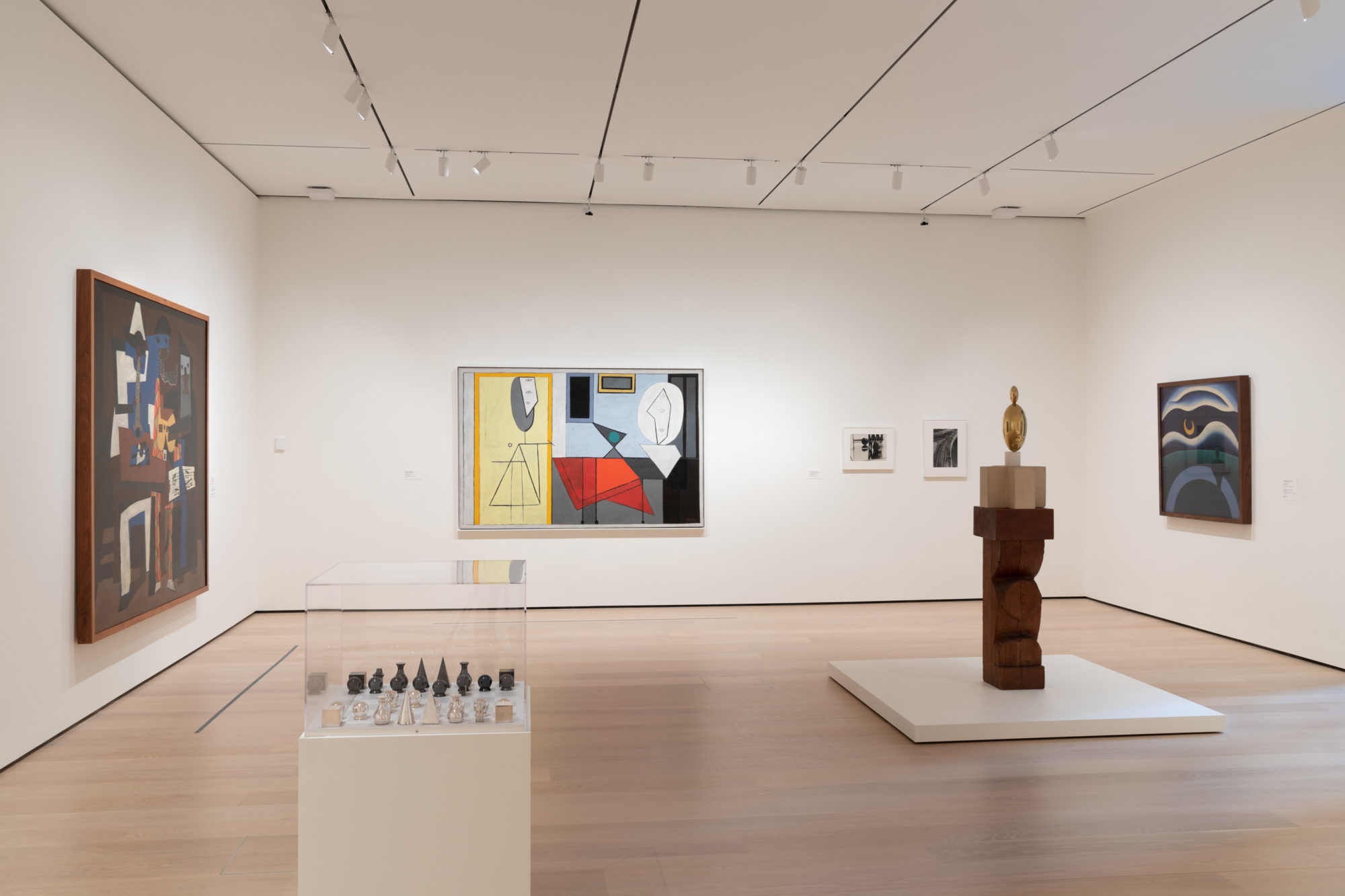
Finding Esphyr Slobdokina
Contributed by Peter Plagens / When the annual The Armory Show art fair — which takes place on the piers on the Hudson River in […]
Catalogue essay: Abstract Art Does Not Stop an Hour
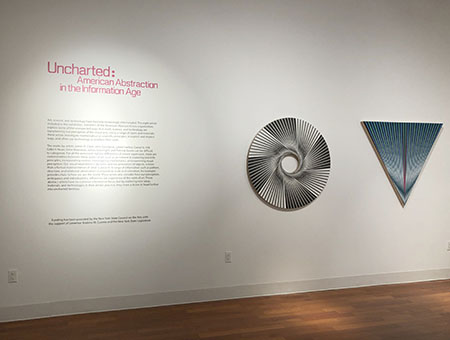
Contributed by Laurie Fendrich / The works in Uncharted: American Abstraction in the Information Age are, for all their reliance on what we call “technology,” […]
Carter Ratcliff: Art in the age of Trump
Contributed by Carter Ratcliff / Let�s begin with a painting�not sure it�s a work of art�that could have been painted only now, during Trump�s presidency. This […]
Presidents’ Day video: The unveiling of the official Obama portraits
In this video, watch the unveiling of the magnificent portraits of President Obama and the former First Lady Michelle Obama at the National Portrait Gallery. […]
A better bonfire at the Whitney: Painting from the 1980s
Contributed by Jonathan Stevenson / “Fast Forward: Painting from the 1980s,” the Whitney’s trenchant exhibition of American work, immediately recalls the Reagan era, when bluffness […]
Ideas and Influences: Brece Honeycutt
Artist and citizen naturalist Brece Honeycutt lives in Massachusetts, on a colonial farmhouse in the foothills of the Berkshire mountains. Fascinated with the history of […]
The gap between: “Unfinished” at the Met Breuer
Contributed by Sharon Butler / In recent years, artists have been interested in “slippage.” In painting, that often translates into an exploration of the space […]
Interview: Daniel Kingery in Hunt’s Point
Contributed by Rob Kaiser-Schatzlein / The four paintings I looked at in Daniel Kingery‘s Bronx studio are all medium-sized, human scale. Paint application strategies vary […]
Recto or Verso: What kind of artist are you?
Barnett Newman, Two Edges, 1948, oil on canvas, 48 x 36 inches. Museum of Modern Art, gift of Annalee Newman (by exchange). Barnett Newman Foundation […]